

5.2 A Property of Reversible Cycles, the First Clausius
Theorem
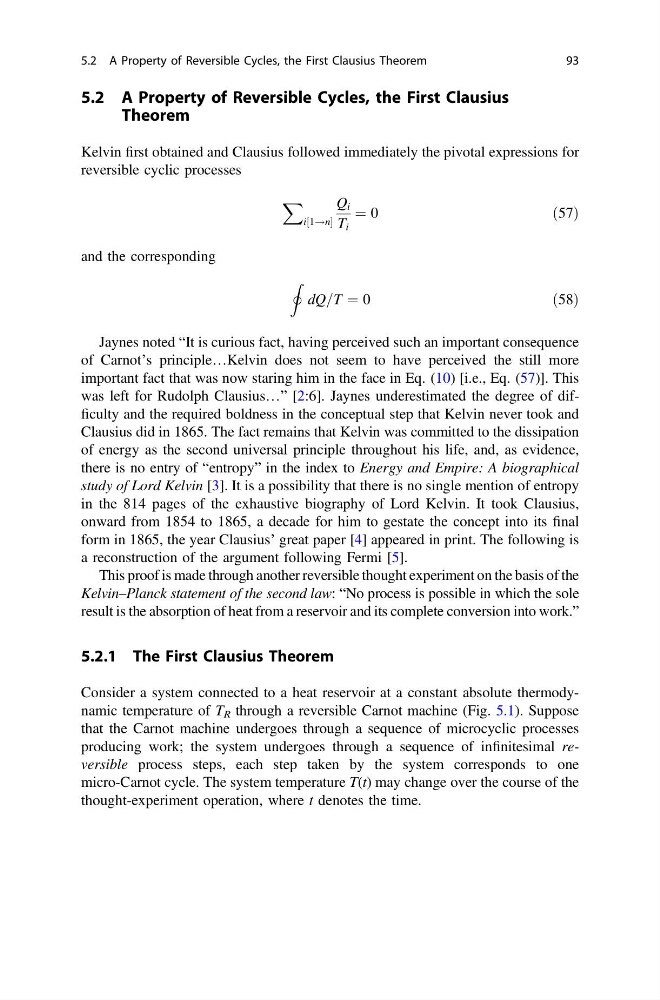
Kelvin first obtained and Clausius followed immediately the pivotal expressions for
reversible cyclic processes
X
i 1!n
½
Q i
T i
¼ 0
ð57Þ
and the corresponding
I
dQ=T ¼ 0
ð58Þ
Jaynes noted “It is curious fact, having perceived such an important consequence
of Carnot’s principle…Kelvin does not seem to have perceived the still more
important fact that was now staring him in the face in Eq. (10) [i.e., Eq. (57)]. This
was left for Rudolph Clausius…” [2:6]. Jaynes underestimated the degree of difficulty and the required boldness in the conceptual step that Kelvin never took and
Clausius did in 1865. The fact remains that Kelvin was committed to the dissipation
of energy as the second universal principle throughout his life, and, as evidence,
there is no entry of “entropy” in the index to Energy and Empire: A biographical
study of Lord Kelvin [3]. It is a possibility that there is no single mention of entropy
in the 814 pages of the exhaustive biography of Lord Kelvin. It took Clausius,
onward from 1854 to 1865, a decade for him to gestate the concept into its final
form in 1865, the year Clausius’ great paper [4] appeared in print. The following is
a reconstruction of the argument following Fermi [5].
This proof is made through another reversible thought experiment on the basis of the
Kelvin–Planck statement of the second law: “No process is possible in which the sole
result is the absorption of heat from a reservoir and its complete conversion into work.”
5.2.1 The First Clausius Theorem
Consider a system connected to a heat reservoir at a constant absolute thermodynamic temperature of T R through a reversible Carnot machine (Fig. 5.1). Suppose
that the Carnot machine undergoes through a sequence of microcyclic processes
producing work; the system undergoes through a sequence of infinitesimal reversible process steps, each step taken by the system corresponds to one
micro-Carnot cycle. The system temperature T(t) may change over the course of the
thought-experiment operation, where t denotes the time.
5.2 A Property of Reversible Cycles, the First Clausius Theorem
93
Theorem
Kelvin first obtained and Clausius followed immediately the pivotal expressions for
reversible cyclic processes
X
i 1!n
½
Q i
T i
¼ 0
ð57Þ
and the corresponding
I
dQ=T ¼ 0
ð58Þ
Jaynes noted “It is curious fact, having perceived such an important consequence
of Carnot’s principle…Kelvin does not seem to have perceived the still more
important fact that was now staring him in the face in Eq. (10) [i.e., Eq. (57)]. This
was left for Rudolph Clausius…” [2:6]. Jaynes underestimated the degree of difficulty and the required boldness in the conceptual step that Kelvin never took and
Clausius did in 1865. The fact remains that Kelvin was committed to the dissipation
of energy as the second universal principle throughout his life, and, as evidence,
there is no entry of “entropy” in the index to Energy and Empire: A biographical
study of Lord Kelvin [3]. It is a possibility that there is no single mention of entropy
in the 814 pages of the exhaustive biography of Lord Kelvin. It took Clausius,
onward from 1854 to 1865, a decade for him to gestate the concept into its final
form in 1865, the year Clausius’ great paper [4] appeared in print. The following is
a reconstruction of the argument following Fermi [5].
This proof is made through another reversible thought experiment on the basis of the
Kelvin–Planck statement of the second law: “No process is possible in which the sole
result is the absorption of heat from a reservoir and its complete conversion into work.”
5.2.1 The First Clausius Theorem
Consider a system connected to a heat reservoir at a constant absolute thermodynamic temperature of T R through a reversible Carnot machine (Fig. 5.1). Suppose
that the Carnot machine undergoes through a sequence of microcyclic processes
producing work; the system undergoes through a sequence of infinitesimal reversible process steps, each step taken by the system corresponds to one
micro-Carnot cycle. The system temperature T(t) may change over the course of the
thought-experiment operation, where t denotes the time.
5.2 A Property of Reversible Cycles, the First Clausius Theorem
93