

post Clausius’ and Boltzmann’s contribution, in regard to “What accounts for the
direction of natural processes?” or, to use Planck’s phrase, what “determine[s]
the direction of a thermodynamical process” [1:81]. Planck, being a student of
Boltzmann, was in a unique position of possessing the correct answers to that
question: Clausius provided the macroscopic inductive account for the unidirectionality, and Boltzmann, the microscopic reductive account. This gave insight to
Planck on the limitation in thinking in terms of energy alone, and he had this to say:
Although these considerations make it evident that the principle of the conservation of
energy cannot serve to determine the direction of a thermodynamical process, and therewith
the conditions of thermodynamical equilibrium, unceasing attempts have been made to
make the principle of the conservation of energy [i.e., the conception of energy] in some
way or other serve this purpose…That attempts are still made to represent this law [the
second law] as contained in the principle of energy may be seen from the fact that the too
restrictive term “Energetics” as sometimes applied to all investigations on these questions.
The conception of energy is not sufficient for the second law. [1:81]
Clausius was the first to see the necessity of going beyond the conception of
energy after his attempts in a series of papers on “proof” of the so-called Clausius
Inequality (of different versions), which culminated in his 1865 paper that introduced the concept of entropy.
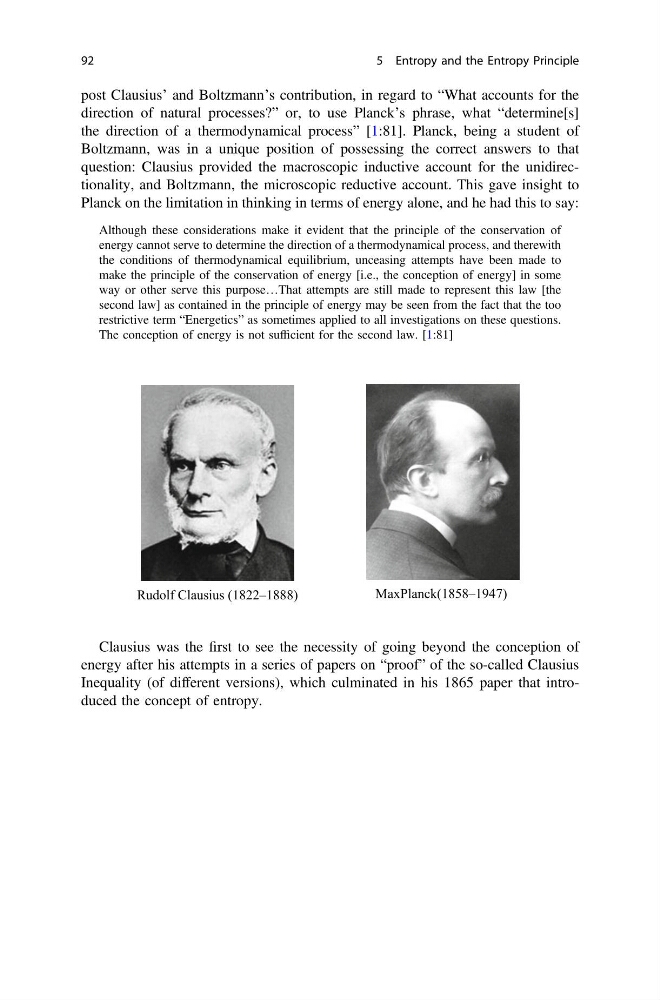
MaxPlanck(1858–1947)
Rudolf Clausius (1822–1888)
92
5 Entropy and the Entropy Principle
direction of natural processes?” or, to use Planck’s phrase, what “determine[s]
the direction of a thermodynamical process” [1:81]. Planck, being a student of
Boltzmann, was in a unique position of possessing the correct answers to that
question: Clausius provided the macroscopic inductive account for the unidirectionality, and Boltzmann, the microscopic reductive account. This gave insight to
Planck on the limitation in thinking in terms of energy alone, and he had this to say:
Although these considerations make it evident that the principle of the conservation of
energy cannot serve to determine the direction of a thermodynamical process, and therewith
the conditions of thermodynamical equilibrium, unceasing attempts have been made to
make the principle of the conservation of energy [i.e., the conception of energy] in some
way or other serve this purpose…That attempts are still made to represent this law [the
second law] as contained in the principle of energy may be seen from the fact that the too
restrictive term “Energetics” as sometimes applied to all investigations on these questions.
The conception of energy is not sufficient for the second law. [1:81]
Clausius was the first to see the necessity of going beyond the conception of
energy after his attempts in a series of papers on “proof” of the so-called Clausius
Inequality (of different versions), which culminated in his 1865 paper that introduced the concept of entropy.
MaxPlanck(1858–1947)
Rudolf Clausius (1822–1888)
92
5 Entropy and the Entropy Principle