

56
4 Mechanical characterization on constituent level
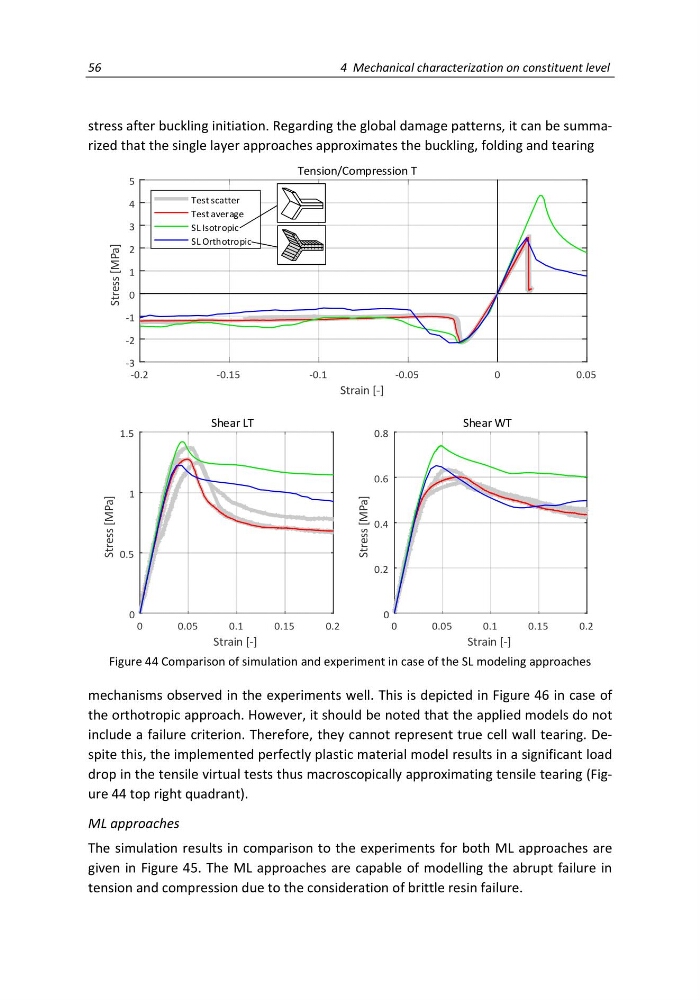
stress after buckling initiation. Regarding the global damage patterns, it can be summarized that the single layer approaches approximates the buckling, folding and tearing
-0.2
-0.15
-0.1
-0.05
0
0.05
Strain [-]
-3
-2
-1
0
1
2
3
4
5
Stress [MPa]
Tension/Compression T
Test scatter
Test average
SL Isotropic
SL Orthotropic
0
0.05
0.1
0.15
0.2
Strain [-]
0
0.5
1
1.5
Stress [MPa]
Shear LT
0
0.05
0.1
0.15
0.2
Strain [-]
0
0.2
0.4
0.6
0.8
Stress [MPa]
Shear WT
Figure 44 Comparison of simulation and experiment in case of the SL modeling approaches
mechanisms observed in the experiments well. This is depicted in Figure 46 in case of
the orthotropic approach. However, it should be noted that the applied models do not
include a failure criterion. Therefore, they cannot represent true cell wall tearing. Despite this, the implemented perfectly plastic material model results in a significant load
drop in the tensile virtual tests thus macroscopically approximating tensile tearing (Figure 44 top right quadrant).
ML approaches
The simulation results in comparison to the experiments for both ML approaches are
given in Figure 45. The ML approaches are capable of modelling the abrupt failure in
tension and compression due to the consideration of brittle resin failure.
4 Mechanical characterization on constituent level
stress after buckling initiation. Regarding the global damage patterns, it can be summarized that the single layer approaches approximates the buckling, folding and tearing
-0.2
-0.15
-0.1
-0.05
0
0.05
Strain [-]
-3
-2
-1
0
1
2
3
4
5
Stress [MPa]
Tension/Compression T
Test scatter
Test average
SL Isotropic
SL Orthotropic
0
0.05
0.1
0.15
0.2
Strain [-]
0
0.5
1
1.5
Stress [MPa]
Shear LT
0
0.05
0.1
0.15
0.2
Strain [-]
0
0.2
0.4
0.6
0.8
Stress [MPa]
Shear WT
Figure 44 Comparison of simulation and experiment in case of the SL modeling approaches
mechanisms observed in the experiments well. This is depicted in Figure 46 in case of
the orthotropic approach. However, it should be noted that the applied models do not
include a failure criterion. Therefore, they cannot represent true cell wall tearing. Despite this, the implemented perfectly plastic material model results in a significant load
drop in the tensile virtual tests thus macroscopically approximating tensile tearing (Figure 44 top right quadrant).
ML approaches
The simulation results in comparison to the experiments for both ML approaches are
given in Figure 45. The ML approaches are capable of modelling the abrupt failure in
tension and compression due to the consideration of brittle resin failure.