

30
2 State of the art
2.5 Assessment of the state of the art and need for further research
The assessment of the reviewed state of the art with respect to the scope of the present
thesis is categorized into three groups, virtual testing, computational modelling of honeycomb sandwich structures and sandwich panel joint design. Each group is addressed
in the following.
Virtual testing
The general concept of virtual testing is well described in the literature. These resources
provide a solid foundation for the implementation of a virtual testing approach for the
proposed field of application. With regards to honeycomb sandwich structures, the
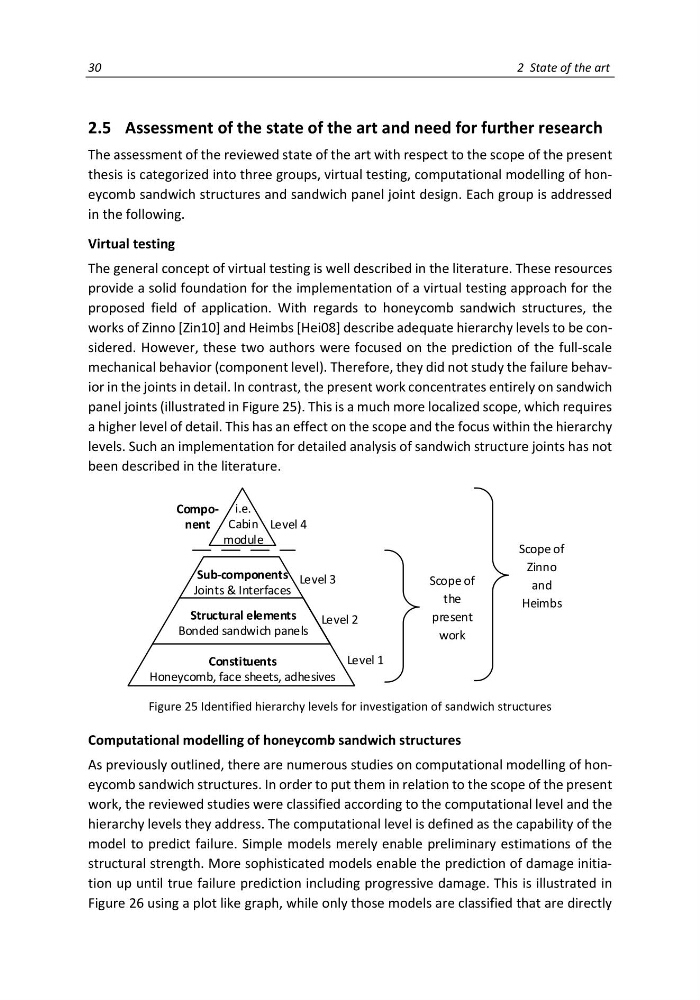
works of Zinno [Zin10] and Heimbs [Hei08] describe adequate hierarchy levels to be considered. However, these two authors were focused on the prediction of the full-scale
mechanical behavior (component level). Therefore, they did not study the failure behavior in the joints in detail. In contrast, the present work concentrates entirely on sandwich
panel joints (illustrated in Figure 25). This is a much more localized scope, which requires
a higher level of detail. This has an effect on the scope and the focus within the hierarchy
levels. Such an implementation for detailed analysis of sandwich structure joints has not
been described in the literature.
Constituents
Honeycomb, face sheets, adhesives
Structural elements
Bonded sandwich panels
Sub-components
Joints & Interfaces
Level 1
Level 2
Level 3
Level 4
Component
Scope of
the
present
work
Scope of
Zinno
and
Heimbs
i.e.
Cabin
module
Figure 25 Identified hierarchy levels for investigation of sandwich structures
Computational modelling of honeycomb sandwich structures
As previously outlined, there are numerous studies on computational modelling of honeycomb sandwich structures. In order to put them in relation to the scope of the present
work, the reviewed studies were classified according to the computational level and the
hierarchy levels they address. The computational level is defined as the capability of the
model to predict failure. Simple models merely enable preliminary estimations of the
structural strength. More sophisticated models enable the prediction of damage initiation up until true failure prediction including progressive damage. This is illustrated in
Figure 26 using a plot like graph, while only those models are classified that are directly
2 State of the art
2.5 Assessment of the state of the art and need for further research
The assessment of the reviewed state of the art with respect to the scope of the present
thesis is categorized into three groups, virtual testing, computational modelling of honeycomb sandwich structures and sandwich panel joint design. Each group is addressed
in the following.
Virtual testing
The general concept of virtual testing is well described in the literature. These resources
provide a solid foundation for the implementation of a virtual testing approach for the
proposed field of application. With regards to honeycomb sandwich structures, the
works of Zinno [Zin10] and Heimbs [Hei08] describe adequate hierarchy levels to be considered. However, these two authors were focused on the prediction of the full-scale
mechanical behavior (component level). Therefore, they did not study the failure behavior in the joints in detail. In contrast, the present work concentrates entirely on sandwich
panel joints (illustrated in Figure 25). This is a much more localized scope, which requires
a higher level of detail. This has an effect on the scope and the focus within the hierarchy
levels. Such an implementation for detailed analysis of sandwich structure joints has not
been described in the literature.
Constituents
Honeycomb, face sheets, adhesives
Structural elements
Bonded sandwich panels
Sub-components
Joints & Interfaces
Level 1
Level 2
Level 3
Level 4
Component
Scope of
the
present
work
Scope of
Zinno
and
Heimbs
i.e.
Cabin
module
Figure 25 Identified hierarchy levels for investigation of sandwich structures
Computational modelling of honeycomb sandwich structures
As previously outlined, there are numerous studies on computational modelling of honeycomb sandwich structures. In order to put them in relation to the scope of the present
work, the reviewed studies were classified according to the computational level and the
hierarchy levels they address. The computational level is defined as the capability of the
model to predict failure. Simple models merely enable preliminary estimations of the
structural strength. More sophisticated models enable the prediction of damage initiation up until true failure prediction including progressive damage. This is illustrated in
Figure 26 using a plot like graph, while only those models are classified that are directly