

2.4 Virtual testing
29
mesoscale simulations of the cellular core. Furthermore, different joint designs were investigated, and numerical models were derived for implementation in a full-scale model,
which enables global failure prediction of the investigated monuments. While Heimbs
did not explicitly abstract or describe his approach as a whole, his work certainly reflects
a virtual testing approach in the previously outlined sense. In a similar work, Zinno
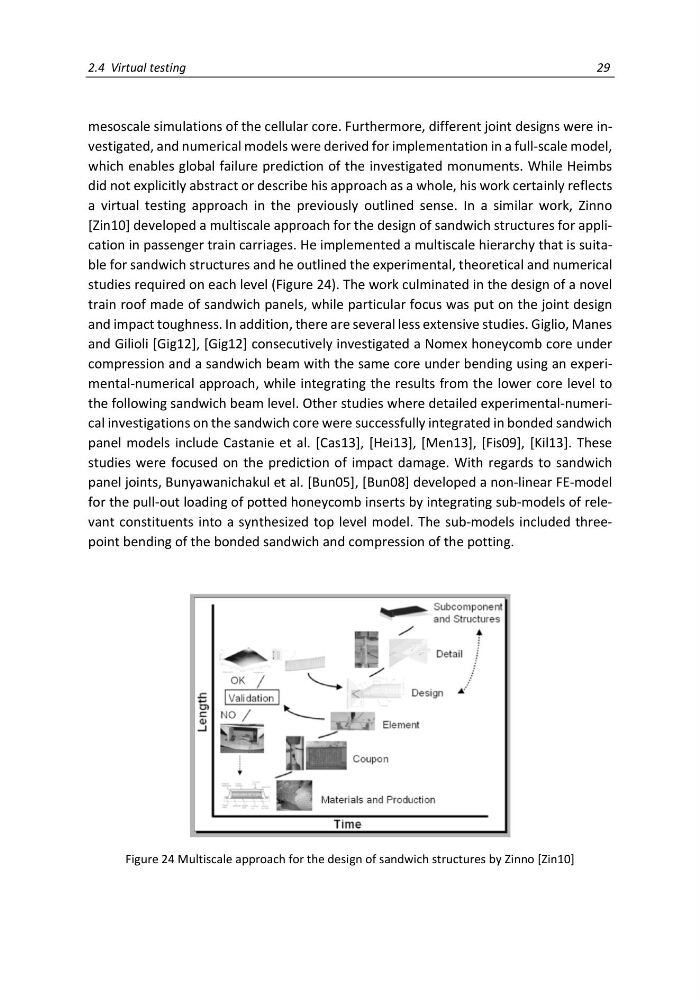
[Zin10] developed a multiscale approach for the design of sandwich structures for application in passenger train carriages. He implemented a multiscale hierarchy that is suitable for sandwich structures and he outlined the experimental, theoretical and numerical
studies required on each level (Figure 24). The work culminated in the design of a novel
train roof made of sandwich panels, while particular focus was put on the joint design
and impact toughness. In addition, there are several less extensive studies. Giglio, Manes
and Gilioli [Gig12], [Gig12] consecutively investigated a Nomex honeycomb core under
compression and a sandwich beam with the same core under bending using an experimental-numerical approach, while integrating the results from the lower core level to
the following sandwich beam level. Other studies where detailed experimental-numerical investigations on the sandwich core were successfully integrated in bonded sandwich
panel models include Castanie et al. [Cas13], [Hei13], [Men13], [Fis09], [Kil13]. These
studies were focused on the prediction of impact damage. With regards to sandwich
panel joints, Bunyawanichakul et al. [Bun05], [Bun08] developed a non-linear FE-model
for the pull-out loading of potted honeycomb inserts by integrating sub-models of relevant constituents into a synthesized top level model. The sub-models included threepoint bending of the bonded sandwich and compression of the potting.
Figure 24 Multiscale approach for the design of sandwich structures by Zinno [Zin10]
29
mesoscale simulations of the cellular core. Furthermore, different joint designs were investigated, and numerical models were derived for implementation in a full-scale model,
which enables global failure prediction of the investigated monuments. While Heimbs
did not explicitly abstract or describe his approach as a whole, his work certainly reflects
a virtual testing approach in the previously outlined sense. In a similar work, Zinno
[Zin10] developed a multiscale approach for the design of sandwich structures for application in passenger train carriages. He implemented a multiscale hierarchy that is suitable for sandwich structures and he outlined the experimental, theoretical and numerical
studies required on each level (Figure 24). The work culminated in the design of a novel
train roof made of sandwich panels, while particular focus was put on the joint design
and impact toughness. In addition, there are several less extensive studies. Giglio, Manes
and Gilioli [Gig12], [Gig12] consecutively investigated a Nomex honeycomb core under
compression and a sandwich beam with the same core under bending using an experimental-numerical approach, while integrating the results from the lower core level to
the following sandwich beam level. Other studies where detailed experimental-numerical investigations on the sandwich core were successfully integrated in bonded sandwich
panel models include Castanie et al. [Cas13], [Hei13], [Men13], [Fis09], [Kil13]. These
studies were focused on the prediction of impact damage. With regards to sandwich
panel joints, Bunyawanichakul et al. [Bun05], [Bun08] developed a non-linear FE-model
for the pull-out loading of potted honeycomb inserts by integrating sub-models of relevant constituents into a synthesized top level model. The sub-models included threepoint bending of the bonded sandwich and compression of the potting.
Figure 24 Multiscale approach for the design of sandwich structures by Zinno [Zin10]