

6.1 Threaded inserts perpendicular to the face sheet
97
available. However, the reviewed studies generally followed the same setup, which is
also suggested in the ESA Insert Design Handbook (IDH) [ESA11] and the Shurlok Design
Manual [Shu96]. The IDH additionally provides manufacturing drawings for all required
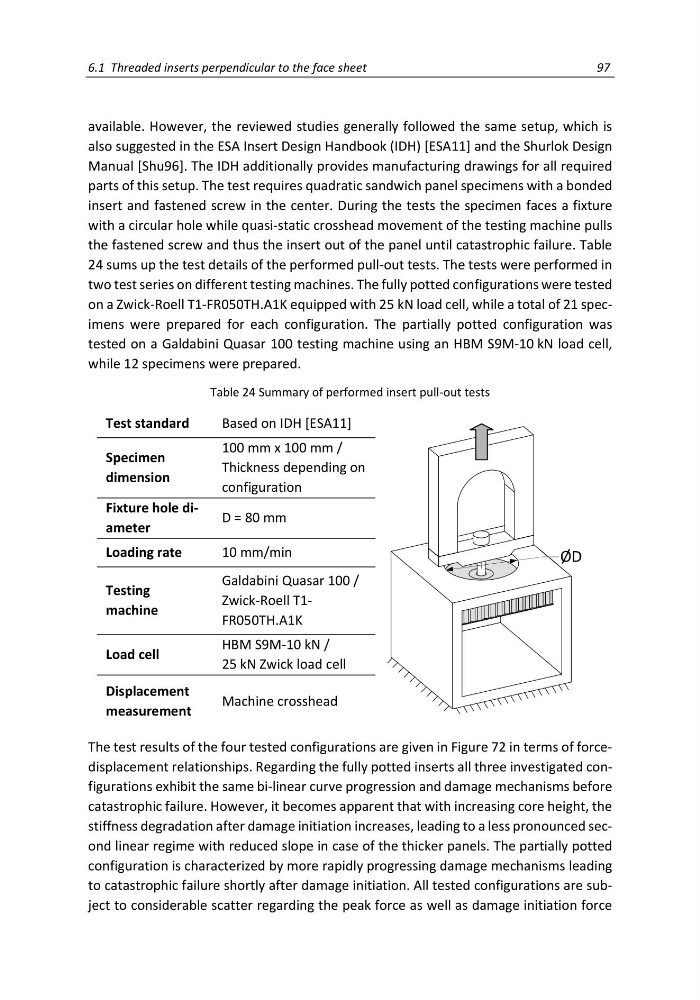
parts of this setup. The test requires quadratic sandwich panel specimens with a bonded
insert and fastened screw in the center. During the tests the specimen faces a fixture
with a circular hole while quasi-static crosshead movement of the testing machine pulls
the fastened screw and thus the insert out of the panel until catastrophic failure. Table
24 sums up the test details of the performed pull-out tests. The tests were performed in
two test series on different testing machines. The fully potted configurations were tested
on a Zwick-Roell T1-FR050TH.A1K equipped with 25 kN load cell, while a total of 21 specimens were prepared for each configuration. The partially potted configuration was
tested on a Galdabini Quasar 100 testing machine using an HBM S9M-10 kN load cell,
while 12 specimens were prepared.
Table 24 Summary of performed insert pull-out tests
Test standard
Based on IDH [ESA11]
Specimen
dimension
100 mm x 100 mm /
Thickness depending on
configuration
Fixture hole diameter
D = 80 mm
Loading rate
10 mm/min
Testing
machine
Galdabini Quasar 100 /
Zwick-Roell T1FR050TH.A1K
Load cell
HBM S9M-10 kN /
25 kN Zwick load cell
Displacement
measurement
Machine crosshead
The test results of the four tested configurations are given in Figure 72 in terms of forcedisplacement relationships. Regarding the fully potted inserts all three investigated configurations exhibit the same bi-linear curve progression and damage mechanisms before
catastrophic failure. However, it becomes apparent that with increasing core height, the
stiffness degradation after damage initiation increases, leading to a less pronounced second linear regime with reduced slope in case of the thicker panels. The partially potted
configuration is characterized by more rapidly progressing damage mechanisms leading
to catastrophic failure shortly after damage initiation. All tested configurations are subject to considerable scatter regarding the peak force as well as damage initiation force
97
available. However, the reviewed studies generally followed the same setup, which is
also suggested in the ESA Insert Design Handbook (IDH) [ESA11] and the Shurlok Design
Manual [Shu96]. The IDH additionally provides manufacturing drawings for all required
parts of this setup. The test requires quadratic sandwich panel specimens with a bonded
insert and fastened screw in the center. During the tests the specimen faces a fixture
with a circular hole while quasi-static crosshead movement of the testing machine pulls
the fastened screw and thus the insert out of the panel until catastrophic failure. Table
24 sums up the test details of the performed pull-out tests. The tests were performed in
two test series on different testing machines. The fully potted configurations were tested
on a Zwick-Roell T1-FR050TH.A1K equipped with 25 kN load cell, while a total of 21 specimens were prepared for each configuration. The partially potted configuration was
tested on a Galdabini Quasar 100 testing machine using an HBM S9M-10 kN load cell,
while 12 specimens were prepared.
Table 24 Summary of performed insert pull-out tests
Test standard
Based on IDH [ESA11]
Specimen
dimension
100 mm x 100 mm /
Thickness depending on
configuration
Fixture hole diameter
D = 80 mm
Loading rate
10 mm/min
Testing
machine
Galdabini Quasar 100 /
Zwick-Roell T1FR050TH.A1K
Load cell
HBM S9M-10 kN /
25 kN Zwick load cell
Displacement
measurement
Machine crosshead
The test results of the four tested configurations are given in Figure 72 in terms of forcedisplacement relationships. Regarding the fully potted inserts all three investigated configurations exhibit the same bi-linear curve progression and damage mechanisms before
catastrophic failure. However, it becomes apparent that with increasing core height, the
stiffness degradation after damage initiation increases, leading to a less pronounced second linear regime with reduced slope in case of the thicker panels. The partially potted
configuration is characterized by more rapidly progressing damage mechanisms leading
to catastrophic failure shortly after damage initiation. All tested configurations are subject to considerable scatter regarding the peak force as well as damage initiation force