

5.2 In-plane shear
87
5.2 In-plane shear
The in-plane shear strength and stiffness of sandwich panels are important design parameters in terms of both, global panel behavior and local effects in the vicinity of joints.
Shear tests are therefore standard in sandwich construction [Ada14]. Due to the low inplane stiffness and strength of the core, the in-plane behavior of the panel is dominated
by the face sheets. However, the core should not be neglected entirely since its properties may have an effect on the face wrinkling [Sta06]. In the framework of the present
thesis, two panel configurations were investigated in terms of in-plane shear. This is described in the following.
Materials and configurations
The investigated panel configurations reflect the main face sheet layups of the present
thesis. Since the core height and orientation have negligible effect on the in-plane shear
behavior of the panel, no core variations were considered. As a result, only two panel
configurations are investigated under shear, both of which have also been studied in
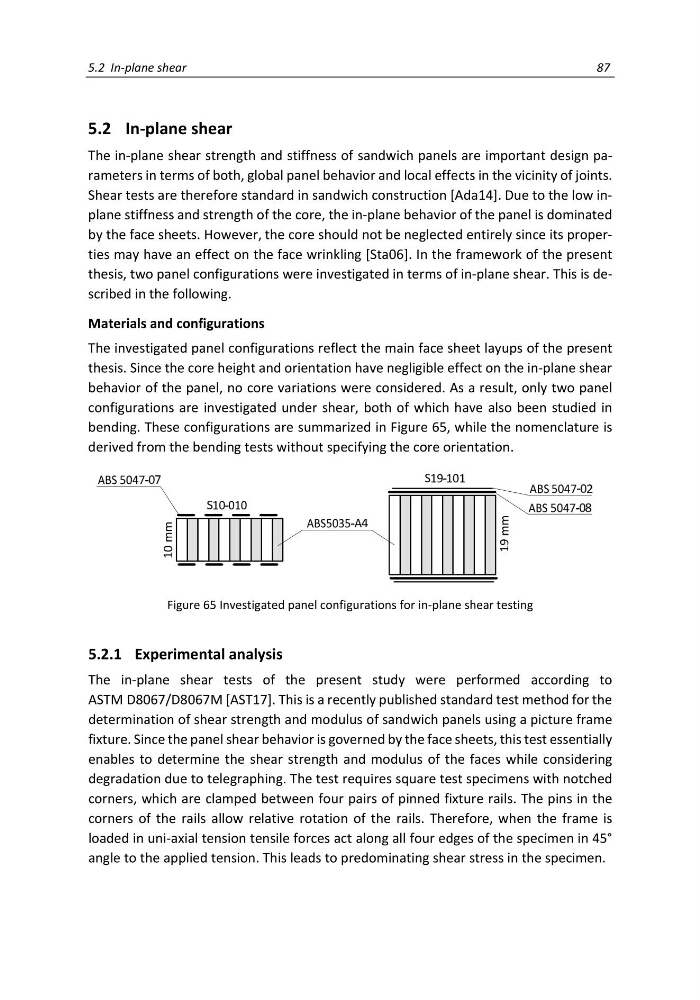
bending. These configurations are summarized in Figure 65, while the nomenclature is
derived from the bending tests without specifying the core orientation.
5.2.1 Experimental analysis
The in-plane shear tests of the present study were performed according to
ASTM D8067/D8067M [AST17]. This is a recently published standard test method for the
determination of shear strength and modulus of sandwich panels using a picture frame
fixture. Since the panel shear behavior is governed by the face sheets, this test essentially
enables to determine the shear strength and modulus of the faces while considering
degradation due to telegraphing. The test requires square test specimens with notched
corners, which are clamped between four pairs of pinned fixture rails. The pins in the
corners of the rails allow relative rotation of the rails. Therefore, when the frame is
loaded in uni-axial tension tensile forces act along all four edges of the specimen in 45°
angle to the applied tension. This leads to predominating shear stress in the specimen.
Figure 65 Investigated panel configurations for in-plane shear testing
87
5.2 In-plane shear
The in-plane shear strength and stiffness of sandwich panels are important design parameters in terms of both, global panel behavior and local effects in the vicinity of joints.
Shear tests are therefore standard in sandwich construction [Ada14]. Due to the low inplane stiffness and strength of the core, the in-plane behavior of the panel is dominated
by the face sheets. However, the core should not be neglected entirely since its properties may have an effect on the face wrinkling [Sta06]. In the framework of the present
thesis, two panel configurations were investigated in terms of in-plane shear. This is described in the following.
Materials and configurations
The investigated panel configurations reflect the main face sheet layups of the present
thesis. Since the core height and orientation have negligible effect on the in-plane shear
behavior of the panel, no core variations were considered. As a result, only two panel
configurations are investigated under shear, both of which have also been studied in
bending. These configurations are summarized in Figure 65, while the nomenclature is
derived from the bending tests without specifying the core orientation.
5.2.1 Experimental analysis
The in-plane shear tests of the present study were performed according to
ASTM D8067/D8067M [AST17]. This is a recently published standard test method for the
determination of shear strength and modulus of sandwich panels using a picture frame
fixture. Since the panel shear behavior is governed by the face sheets, this test essentially
enables to determine the shear strength and modulus of the faces while considering
degradation due to telegraphing. The test requires square test specimens with notched
corners, which are clamped between four pairs of pinned fixture rails. The pins in the
corners of the rails allow relative rotation of the rails. Therefore, when the frame is
loaded in uni-axial tension tensile forces act along all four edges of the specimen in 45°
angle to the applied tension. This leads to predominating shear stress in the specimen.
Figure 65 Investigated panel configurations for in-plane shear testing