

3.2 Motion of a Continuum
65
which give
a 1 =
∂v 1
∂t
+ v 1
∂v 1
∂x 1
+ v 2
∂v 1
∂x 2
+ v 3
∂v 1
∂x 3
= 0.
Similar calculations give a 2 = a 3 = 0.
Thus, although the velocity field changes with time, the acceleration of all
particles in the continuum is zero! While this may seem puzzling at first, the
reason is quite simple. Each individual particle travels with a constant velocity (zero
acceleration), but the velocity of each particle is different. Hence, if Fred is stationed
at a fixed point in space, the velocity he records changes as different particles pass
his location. At his location (x 1 , x 2 , x 3 ), Fred’s recordings would correspond to the
temporal changes in velocity given in the problem statement above.
Finally, while this book deals almost exclusively with solid mechanics, some
cell sheets (epithelia) in the embryo exhibit solid-like behavior on short time scales
but fluid-like behavior on long time scales. Although the cells in an epithelium are
connected by adhesions, the cells slide past each other, like molecules in a liquid,
when they are stretched for long periods of time. During early development, for
example, groups of cells sometimes undergo swirling motions that resemble vortices
(Sandersius et al. 2011). Vortical flow is considered in the next example.
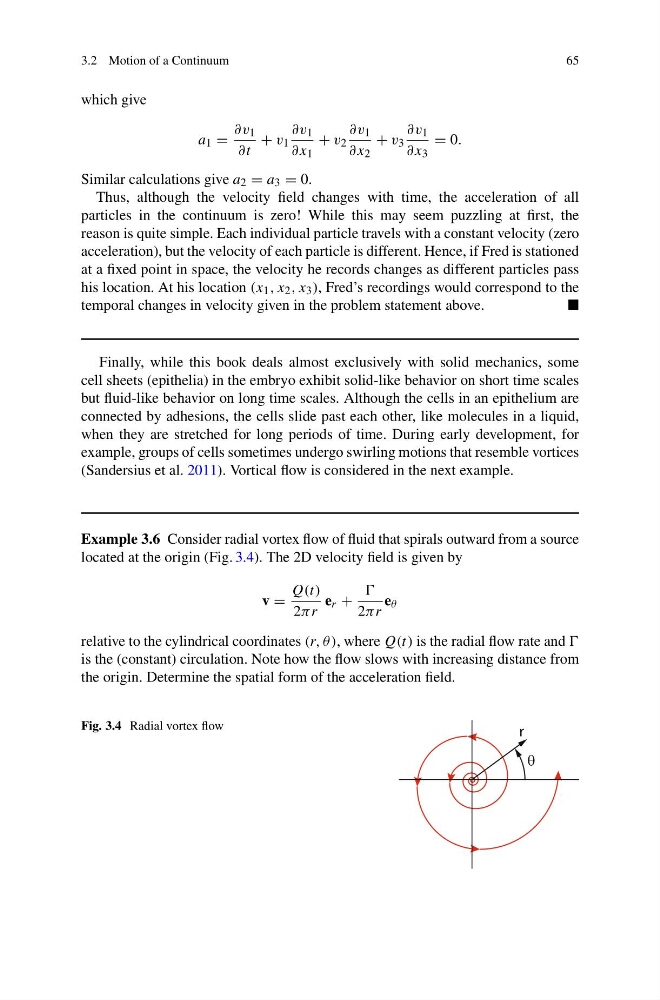
Example 3.6 Consider radial vortex flow of fluid that spirals outward from a source
located at the origin (Fig. 3.4). The 2D velocity field is given by
v =
Q(t)
2πr
e r +
2πr
e θ
relative to the cylindrical coordinates (r, θ ), where Q(t) is the radial flow rate and
is the (constant) circulation. Note how the flow slows with increasing distance from
the origin. Determine the spatial form of the acceleration field.
Fig. 3.4 Radial vortex flow
r
T
65
which give
a 1 =
∂v 1
∂t
+ v 1
∂v 1
∂x 1
+ v 2
∂v 1
∂x 2
+ v 3
∂v 1
∂x 3
= 0.
Similar calculations give a 2 = a 3 = 0.
Thus, although the velocity field changes with time, the acceleration of all
particles in the continuum is zero! While this may seem puzzling at first, the
reason is quite simple. Each individual particle travels with a constant velocity (zero
acceleration), but the velocity of each particle is different. Hence, if Fred is stationed
at a fixed point in space, the velocity he records changes as different particles pass
his location. At his location (x 1 , x 2 , x 3 ), Fred’s recordings would correspond to the
temporal changes in velocity given in the problem statement above.
Finally, while this book deals almost exclusively with solid mechanics, some
cell sheets (epithelia) in the embryo exhibit solid-like behavior on short time scales
but fluid-like behavior on long time scales. Although the cells in an epithelium are
connected by adhesions, the cells slide past each other, like molecules in a liquid,
when they are stretched for long periods of time. During early development, for
example, groups of cells sometimes undergo swirling motions that resemble vortices
(Sandersius et al. 2011). Vortical flow is considered in the next example.
Example 3.6 Consider radial vortex flow of fluid that spirals outward from a source
located at the origin (Fig. 3.4). The 2D velocity field is given by
v =
Q(t)
2πr
e r +
2πr
e θ
relative to the cylindrical coordinates (r, θ ), where Q(t) is the radial flow rate and
is the (constant) circulation. Note how the flow slows with increasing distance from
the origin. Determine the spatial form of the acceleration field.
Fig. 3.4 Radial vortex flow
r
T