

8.10 Mesenchymal Morphogenesis
509
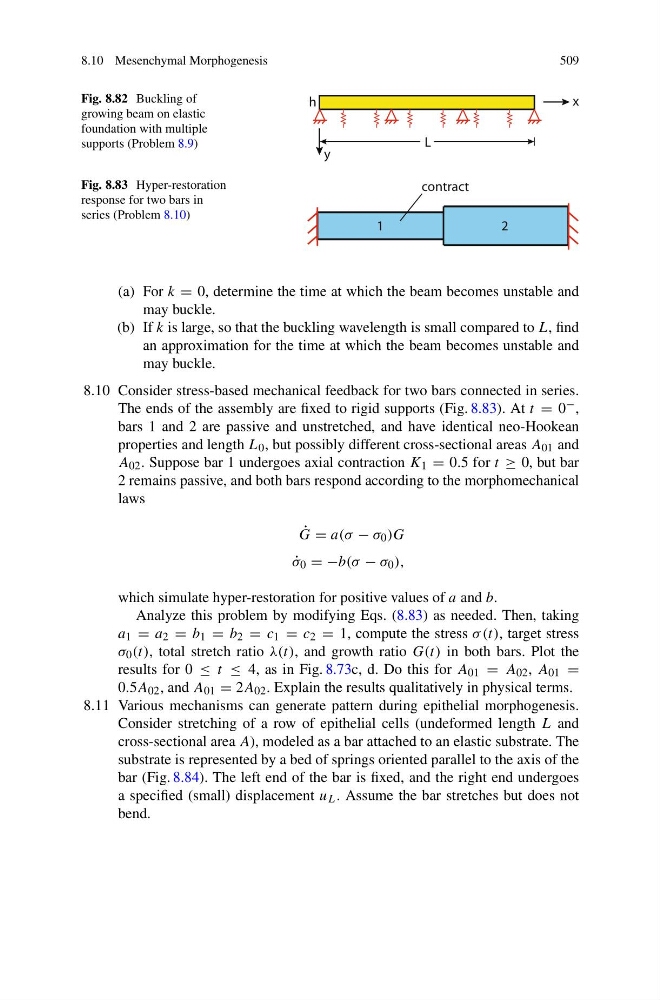
Fig. 8.82 Buckling of
growing beam on elastic
foundation with multiple
supports (Problem 8.9)
x
y
L
h
Fig. 8.83 Hyper-restoration
response for two bars in
series (Problem 8.10)
1
2
contract
(a) For k = 0, determine the time at which the beam becomes unstable and
may buckle.
(b) If k is large, so that the buckling wavelength is small compared to L, find
an approximation for the time at which the beam becomes unstable and
may buckle.
8.10 Consider stress-based mechanical feedback for two bars connected in series.
The ends of the assembly are fixed to rigid supports (Fig. 8.83). At t = 0 − ,
bars 1 and 2 are passive and unstretched, and have identical neo-Hookean
properties and length L 0 , but possibly different cross-sectional areas A 01 and
A 02 . Suppose bar 1 undergoes axial contraction K 1 = 0.5 for t ≥ 0, but bar
2 remains passive, and both bars respond according to the morphomechanical
laws
˙
G = a(σ − σ 0 )G
˙
σ 0 = −b(σ − σ 0 ),
which simulate hyper-restoration for positive values of a and b.
Analyze this problem by modifying Eqs. (8.83) as needed. Then, taking
a 1 = a 2 = b 1 = b 2 = c 1 = c 2 = 1, compute the stress σ (t), target stress
σ 0 (t), total stretch ratio λ(t), and growth ratio G(t) in both bars. Plot the
results for 0 ≤ t ≤ 4, as in Fig. 8.73c, d. Do this for A 01 = A 02 , A 01 =
0.5A 02 , and A 01 = 2A 02 . Explain the results qualitatively in physical terms.
8.11 Various mechanisms can generate pattern during epithelial morphogenesis.
Consider stretching of a row of epithelial cells (undeformed length L and
cross-sectional area A), modeled as a bar attached to an elastic substrate. The
substrate is represented by a bed of springs oriented parallel to the axis of the
bar (Fig. 8.84). The left end of the bar is fixed, and the right end undergoes
a specified (small) displacement u L . Assume the bar stretches but does not
bend.
509
Fig. 8.82 Buckling of
growing beam on elastic
foundation with multiple
supports (Problem 8.9)
x
y
L
h
Fig. 8.83 Hyper-restoration
response for two bars in
series (Problem 8.10)
1
2
contract
(a) For k = 0, determine the time at which the beam becomes unstable and
may buckle.
(b) If k is large, so that the buckling wavelength is small compared to L, find
an approximation for the time at which the beam becomes unstable and
may buckle.
8.10 Consider stress-based mechanical feedback for two bars connected in series.
The ends of the assembly are fixed to rigid supports (Fig. 8.83). At t = 0 − ,
bars 1 and 2 are passive and unstretched, and have identical neo-Hookean
properties and length L 0 , but possibly different cross-sectional areas A 01 and
A 02 . Suppose bar 1 undergoes axial contraction K 1 = 0.5 for t ≥ 0, but bar
2 remains passive, and both bars respond according to the morphomechanical
laws
˙
G = a(σ − σ 0 )G
˙
σ 0 = −b(σ − σ 0 ),
which simulate hyper-restoration for positive values of a and b.
Analyze this problem by modifying Eqs. (8.83) as needed. Then, taking
a 1 = a 2 = b 1 = b 2 = c 1 = c 2 = 1, compute the stress σ (t), target stress
σ 0 (t), total stretch ratio λ(t), and growth ratio G(t) in both bars. Plot the
results for 0 ≤ t ≤ 4, as in Fig. 8.73c, d. Do this for A 01 = A 02 , A 01 =
0.5A 02 , and A 01 = 2A 02 . Explain the results qualitatively in physical terms.
8.11 Various mechanisms can generate pattern during epithelial morphogenesis.
Consider stretching of a row of epithelial cells (undeformed length L and
cross-sectional area A), modeled as a bar attached to an elastic substrate. The
substrate is represented by a bed of springs oriented parallel to the axis of the
bar (Fig. 8.84). The left end of the bar is fixed, and the right end undergoes
a specified (small) displacement u L . Assume the bar stretches but does not
bend.