

508
8 Morphogenesis
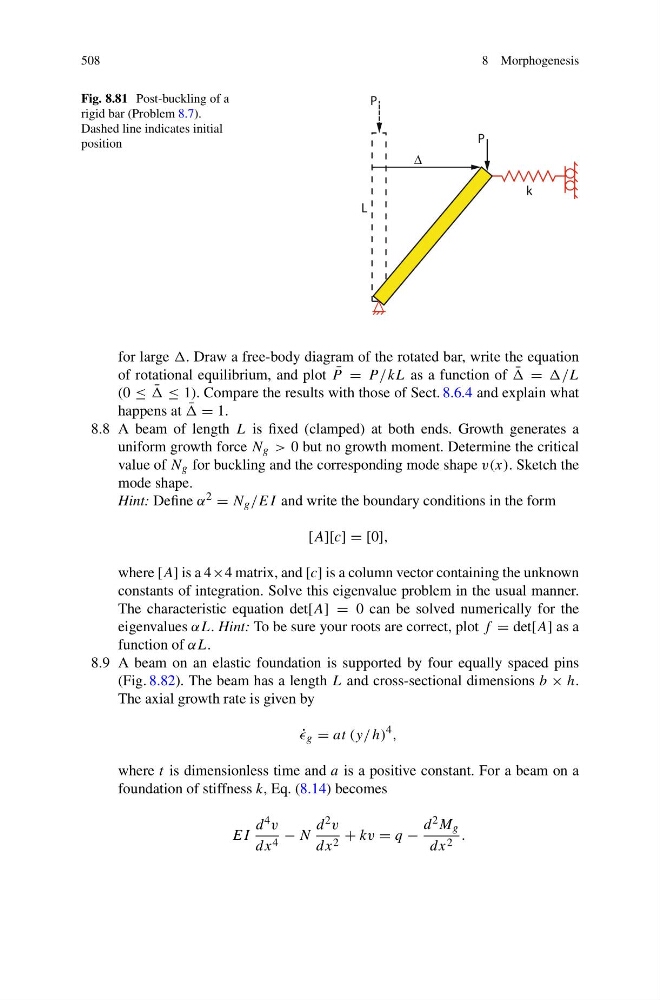
Fig. 8.81 Post-buckling of a
rigid bar (Problem 8.7).
Dashed line indicates initial
position
k
P
'
L
P
for large . Draw a free-body diagram of the rotated bar, write the equation
of rotational equilibrium, and plot ¯
P = P /kL as a function of ¯
=
(0 ≤ ¯
≤ 1). Compare the results with those of Sect. 8.6.4 and explain what
happens at ¯
= 1.
8.8 A beam of length L is fixed (clamped) at both ends. Growth generates a
uniform growth force N g > 0 but no growth moment. Determine the critical
value of N g for buckling and the corresponding mode shape v(x). Sketch the
mode shape.
Hint: Define α 2 = N g /EI and write the boundary conditions in the form
[A][c] = [0],
where [A] is a 4×4 matrix, and [c] is a column vector containing the unknown
constants of integration. Solve this eigenvalue problem in the usual manner.
The characteristic equation det[A] = 0 can be solved numerically for the
eigenvalues αL. Hint: To be sure your roots are correct, plot f = det[A] as a
function of αL.
8.9 A beam on an elastic foundation is supported by four equally spaced pins
(Fig. 8.82). The beam has a length L and cross-sectional dimensions b × h.
The axial growth rate is given by
˙
g = at (y/ h)
4 ,
where t is dimensionless time and a is a positive constant. For a beam on a
foundation of stiffness k, Eq. (8.14) becomes
EI
d 4 v
dx 4 − N
d 2 v
dx 2 + kv = q −
d 2 M g
dx 2 .
8 Morphogenesis
Fig. 8.81 Post-buckling of a
rigid bar (Problem 8.7).
Dashed line indicates initial
position
k
P
'
L
P
for large . Draw a free-body diagram of the rotated bar, write the equation
of rotational equilibrium, and plot ¯
P = P /kL as a function of ¯
=
(0 ≤ ¯
≤ 1). Compare the results with those of Sect. 8.6.4 and explain what
happens at ¯
= 1.
8.8 A beam of length L is fixed (clamped) at both ends. Growth generates a
uniform growth force N g > 0 but no growth moment. Determine the critical
value of N g for buckling and the corresponding mode shape v(x). Sketch the
mode shape.
Hint: Define α 2 = N g /EI and write the boundary conditions in the form
[A][c] = [0],
where [A] is a 4×4 matrix, and [c] is a column vector containing the unknown
constants of integration. Solve this eigenvalue problem in the usual manner.
The characteristic equation det[A] = 0 can be solved numerically for the
eigenvalues αL. Hint: To be sure your roots are correct, plot f = det[A] as a
function of αL.
8.9 A beam on an elastic foundation is supported by four equally spaced pins
(Fig. 8.82). The beam has a length L and cross-sectional dimensions b × h.
The axial growth rate is given by
˙
g = at (y/ h)
4 ,
where t is dimensionless time and a is a positive constant. For a beam on a
foundation of stiffness k, Eq. (8.14) becomes
EI
d 4 v
dx 4 − N
d 2 v
dx 2 + kv = q −
d 2 M g
dx 2 .