

504
8 Morphogenesis
When cultured on a layer of collagen gel, endothelial and several other types
of cells form aggregates connected by lines of tension that are visible in the gel.
Eventually, these lines become filled with migrating cells and form a 2D polygonal
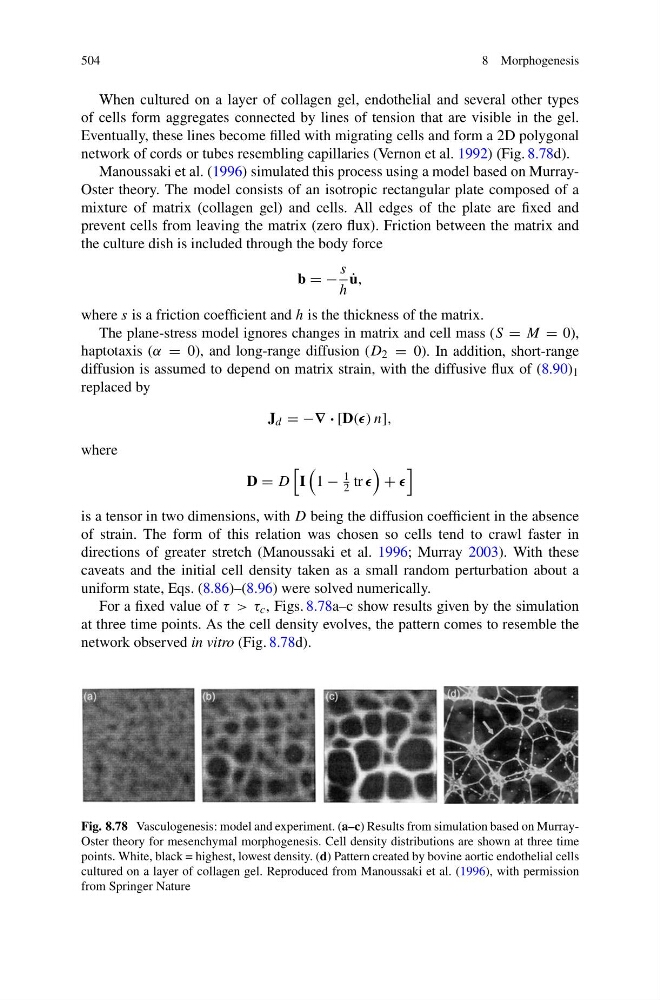
network of cords or tubes resembling capillaries (Vernon et al. 1992) (Fig. 8.78d).
Manoussaki et al. (1996) simulated this process using a model based on MurrayOster theory. The model consists of an isotropic rectangular plate composed of a
mixture of matrix (collagen gel) and cells. All edges of the plate are fixed and
prevent cells from leaving the matrix (zero flux). Friction between the matrix and
the culture dish is included through the body force
b = −
s
h
˙
u,
where s is a friction coefficient and h is the thickness of the matrix.
The plane-stress model ignores changes in matrix and cell mass (S = M = 0),
haptotaxis (α = 0), and long-range diffusion (D 2 = 0). In addition, short-range
diffusion is assumed to depend on matrix strain, with the diffusive flux of (8.90) 1
replaced by
J d = −∇ · [D() n],
where
D = D
I
1 −
1
2 tr
+
is a tensor in two dimensions, with D being the diffusion coefficient in the absence
of strain. The form of this relation was chosen so cells tend to crawl faster in
directions of greater stretch (Manoussaki et al. 1996; Murray 2003). With these
caveats and the initial cell density taken as a small random perturbation about a
uniform state, Eqs. (8.86)–(8.96) were solved numerically.
For a fixed value of τ > τ c , Figs. 8.78a–c show results given by the simulation
at three time points. As the cell density evolves, the pattern comes to resemble the
network observed in vitro (Fig. 8.78d).
Fig. 8.78 Vasculogenesis: model and experiment. (a–c) Results from simulation based on MurrayOster theory for mesenchymal morphogenesis. Cell density distributions are shown at three time
points. White, black = highest, lowest density. (d) Pattern created by bovine aortic endothelial cells
cultured on a layer of collagen gel. Reproduced from Manoussaki et al. (1996), with permission
from Springer Nature
8 Morphogenesis
When cultured on a layer of collagen gel, endothelial and several other types
of cells form aggregates connected by lines of tension that are visible in the gel.
Eventually, these lines become filled with migrating cells and form a 2D polygonal
network of cords or tubes resembling capillaries (Vernon et al. 1992) (Fig. 8.78d).
Manoussaki et al. (1996) simulated this process using a model based on MurrayOster theory. The model consists of an isotropic rectangular plate composed of a
mixture of matrix (collagen gel) and cells. All edges of the plate are fixed and
prevent cells from leaving the matrix (zero flux). Friction between the matrix and
the culture dish is included through the body force
b = −
s
h
˙
u,
where s is a friction coefficient and h is the thickness of the matrix.
The plane-stress model ignores changes in matrix and cell mass (S = M = 0),
haptotaxis (α = 0), and long-range diffusion (D 2 = 0). In addition, short-range
diffusion is assumed to depend on matrix strain, with the diffusive flux of (8.90) 1
replaced by
J d = −∇ · [D() n],
where
D = D
I
1 −
1
2 tr
+
is a tensor in two dimensions, with D being the diffusion coefficient in the absence
of strain. The form of this relation was chosen so cells tend to crawl faster in
directions of greater stretch (Manoussaki et al. 1996; Murray 2003). With these
caveats and the initial cell density taken as a small random perturbation about a
uniform state, Eqs. (8.86)–(8.96) were solved numerically.
For a fixed value of τ > τ c , Figs. 8.78a–c show results given by the simulation
at three time points. As the cell density evolves, the pattern comes to resemble the
network observed in vitro (Fig. 8.78d).
Fig. 8.78 Vasculogenesis: model and experiment. (a–c) Results from simulation based on MurrayOster theory for mesenchymal morphogenesis. Cell density distributions are shown at three time
points. White, black = highest, lowest density. (d) Pattern created by bovine aortic endothelial cells
cultured on a layer of collagen gel. Reproduced from Manoussaki et al. (1996), with permission
from Springer Nature