

8.10 Mesenchymal Morphogenesis
503
W 1 < W c
W 2 > W c
W 3 > W 2
(a)
(b)
(c)
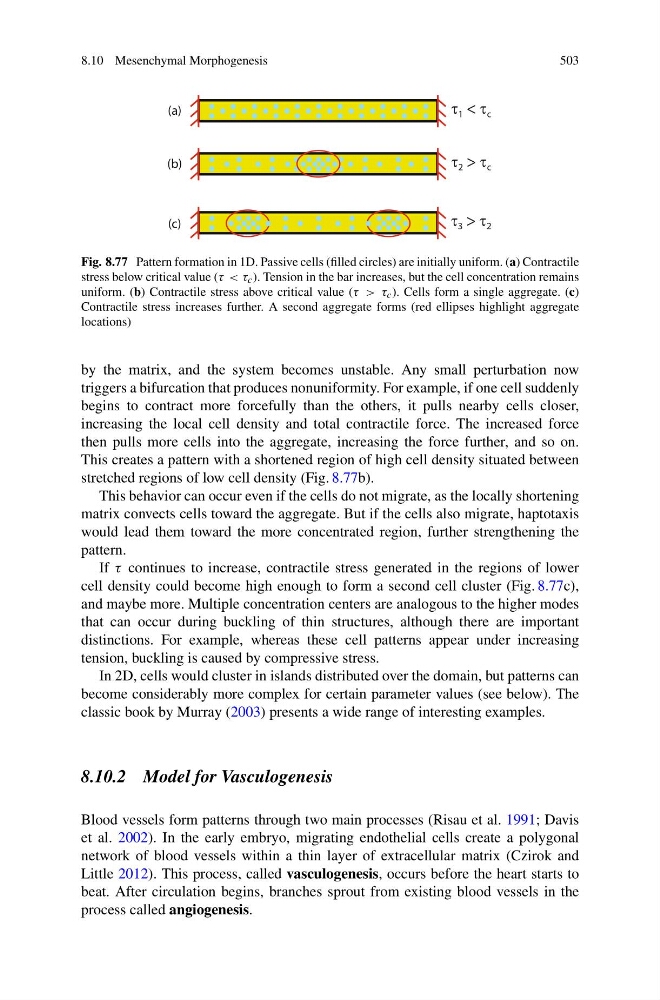
Fig. 8.77 Pattern formation in 1D. Passive cells (filled circles) are initially uniform. (a) Contractile
stress below critical value (τ < τ c ). Tension in the bar increases, but the cell concentration remains
uniform. (b) Contractile stress above critical value (τ > τ c ). Cells form a single aggregate. (c)
Contractile stress increases further. A second aggregate forms (red ellipses highlight aggregate
locations)
by the matrix, and the system becomes unstable. Any small perturbation now
triggers a bifurcation that produces nonuniformity. For example, if one cell suddenly
begins to contract more forcefully than the others, it pulls nearby cells closer,
increasing the local cell density and total contractile force. The increased force
then pulls more cells into the aggregate, increasing the force further, and so on.
This creates a pattern with a shortened region of high cell density situated between
stretched regions of low cell density (Fig. 8.77b).
This behavior can occur even if the cells do not migrate, as the locally shortening
matrix convects cells toward the aggregate. But if the cells also migrate, haptotaxis
would lead them toward the more concentrated region, further strengthening the
pattern.
If τ continues to increase, contractile stress generated in the regions of lower
cell density could become high enough to form a second cell cluster (Fig. 8.77c),
and maybe more. Multiple concentration centers are analogous to the higher modes
that can occur during buckling of thin structures, although there are important
distinctions. For example, whereas these cell patterns appear under increasing
tension, buckling is caused by compressive stress.
In 2D, cells would cluster in islands distributed over the domain, but patterns can
become considerably more complex for certain parameter values (see below). The
classic book by Murray (2003) presents a wide range of interesting examples.
8.10.2 Model for Vasculogenesis
Blood vessels form patterns through two main processes (Risau et al. 1991; Davis
et al. 2002). In the early embryo, migrating endothelial cells create a polygonal
network of blood vessels within a thin layer of extracellular matrix (Czirok and
Little 2012). This process, called vasculogenesis, occurs before the heart starts to
beat. After circulation begins, branches sprout from existing blood vessels in the
process called angiogenesis.
503
W 1 < W c
W 2 > W c
W 3 > W 2
(a)
(b)
(c)
Fig. 8.77 Pattern formation in 1D. Passive cells (filled circles) are initially uniform. (a) Contractile
stress below critical value (τ < τ c ). Tension in the bar increases, but the cell concentration remains
uniform. (b) Contractile stress above critical value (τ > τ c ). Cells form a single aggregate. (c)
Contractile stress increases further. A second aggregate forms (red ellipses highlight aggregate
locations)
by the matrix, and the system becomes unstable. Any small perturbation now
triggers a bifurcation that produces nonuniformity. For example, if one cell suddenly
begins to contract more forcefully than the others, it pulls nearby cells closer,
increasing the local cell density and total contractile force. The increased force
then pulls more cells into the aggregate, increasing the force further, and so on.
This creates a pattern with a shortened region of high cell density situated between
stretched regions of low cell density (Fig. 8.77b).
This behavior can occur even if the cells do not migrate, as the locally shortening
matrix convects cells toward the aggregate. But if the cells also migrate, haptotaxis
would lead them toward the more concentrated region, further strengthening the
pattern.
If τ continues to increase, contractile stress generated in the regions of lower
cell density could become high enough to form a second cell cluster (Fig. 8.77c),
and maybe more. Multiple concentration centers are analogous to the higher modes
that can occur during buckling of thin structures, although there are important
distinctions. For example, whereas these cell patterns appear under increasing
tension, buckling is caused by compressive stress.
In 2D, cells would cluster in islands distributed over the domain, but patterns can
become considerably more complex for certain parameter values (see below). The
classic book by Murray (2003) presents a wide range of interesting examples.
8.10.2 Model for Vasculogenesis
Blood vessels form patterns through two main processes (Risau et al. 1991; Davis
et al. 2002). In the early embryo, migrating endothelial cells create a polygonal
network of blood vessels within a thin layer of extracellular matrix (Czirok and
Little 2012). This process, called vasculogenesis, occurs before the heart starts to
beat. After circulation begins, branches sprout from existing blood vessels in the
process called angiogenesis.