

2.4 Some Properties of Tensors
33
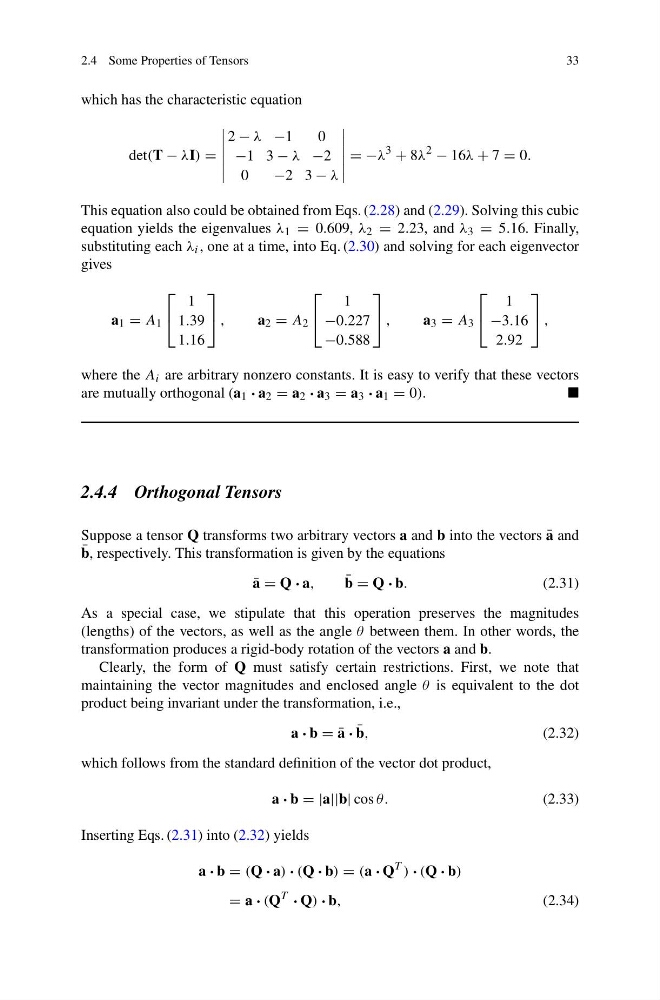
which has the characteristic equation
det(T − λI) =
2 − λ −1
0
−1 3 − λ −2
0
−2 3 − λ
= −λ
3
+ 8λ
2
− 16λ + 7 = 0.
This equation also could be obtained from Eqs. (2.28) and (2.29). Solving this cubic
equation yields the eigenvalues λ 1 = 0.609, λ 2 = 2.23, and λ 3 = 5.16. Finally,
substituting each λ i , one at a time, into Eq. (2.30) and solving for each eigenvector
gives
a 1 = A 1
⎡
⎣
1
1.39
1.16
⎤
⎦ ,
a 2 = A 2
⎡
⎣
1
−0.227
−0.588
⎤
⎦ ,
a 3 = A 3
⎡
⎣
1
−3.16
2.92
⎤
⎦ ,
where the A i are arbitrary nonzero constants. It is easy to verify that these vectors
are mutually orthogonal (a 1 · a 2 = a 2 · a 3 = a 3 · a 1 = 0).
2.4.4 Orthogonal Tensors
Suppose a tensor Q transforms two arbitrary vectors a and b into the vectors ¯
a and
¯
b, respectively. This transformation is given by the equations
¯
a = Q · a,
¯
b = Q · b.
(2.31)
As a special case, we stipulate that this operation preserves the magnitudes
(lengths) of the vectors, as well as the angle θ between them. In other words, the
transformation produces a rigid-body rotation of the vectors a and b.
Clearly, the form of Q must satisfy certain restrictions. First, we note that
maintaining the vector magnitudes and enclosed angle θ is equivalent to the dot
product being invariant under the transformation, i.e.,
a · b = ¯
a · ¯
b,
(2.32)
which follows from the standard definition of the vector dot product,
a · b = |a||b| cos θ.
(2.33)
Inserting Eqs. (2.31) into (2.32) yields
a · b = (Q · a) · (Q · b) = (a · Q
T ) · (Q · b)
= a · (Q
T
· Q) · b,
(2.34)
33
which has the characteristic equation
det(T − λI) =
2 − λ −1
0
−1 3 − λ −2
0
−2 3 − λ
= −λ
3
+ 8λ
2
− 16λ + 7 = 0.
This equation also could be obtained from Eqs. (2.28) and (2.29). Solving this cubic
equation yields the eigenvalues λ 1 = 0.609, λ 2 = 2.23, and λ 3 = 5.16. Finally,
substituting each λ i , one at a time, into Eq. (2.30) and solving for each eigenvector
gives
a 1 = A 1
⎡
⎣
1
1.39
1.16
⎤
⎦ ,
a 2 = A 2
⎡
⎣
1
−0.227
−0.588
⎤
⎦ ,
a 3 = A 3
⎡
⎣
1
−3.16
2.92
⎤
⎦ ,
where the A i are arbitrary nonzero constants. It is easy to verify that these vectors
are mutually orthogonal (a 1 · a 2 = a 2 · a 3 = a 3 · a 1 = 0).
2.4.4 Orthogonal Tensors
Suppose a tensor Q transforms two arbitrary vectors a and b into the vectors ¯
a and
¯
b, respectively. This transformation is given by the equations
¯
a = Q · a,
¯
b = Q · b.
(2.31)
As a special case, we stipulate that this operation preserves the magnitudes
(lengths) of the vectors, as well as the angle θ between them. In other words, the
transformation produces a rigid-body rotation of the vectors a and b.
Clearly, the form of Q must satisfy certain restrictions. First, we note that
maintaining the vector magnitudes and enclosed angle θ is equivalent to the dot
product being invariant under the transformation, i.e.,
a · b = ¯
a · ¯
b,
(2.32)
which follows from the standard definition of the vector dot product,
a · b = |a||b| cos θ.
(2.33)
Inserting Eqs. (2.31) into (2.32) yields
a · b = (Q · a) · (Q · b) = (a · Q
T ) · (Q · b)
= a · (Q
T
· Q) · b,
(2.34)