

32
2 Vector and Tensor Analysis
or
(T − λI) · a = 0,
(2.26)
where λ is the eigenvalue (principal value) and a is the associated eigenvector
(principal direction). For a nontrivial solution (a = 0), we must have 11
det(T − λI) = 0,
(2.27)
which yields a characteristic polynomial equation of order n to be solved for the
λ i (i = 1, 2, . . . , n), where n is the dimension of the space. In 3D, expanding the
matrix form of Eq. (2.27) yields
− λ
3
+ I 1 λ
2
− I 2 λ + I 3 = 0,
(2.28)
where
I 1 = tr T
I 2 =
1
2
(tr T)
2
− tr(T · T)
I 3 = det T.
(2.29)
After the λ i are determined from (2.28), Eq. (2.26) yields an eigenvector for each of
the three eigenvalues.
Since Eq. (2.26) is a tensor equation, both the eigenvalues and eigenvectors are
independent of coordinates and are, therefore, invariants of the tensor T. Moreover,
it follows from Eq. (2.28) that I 1 , I 2 , and I 3 also are invariant, and they are called
the principal invariants of T.
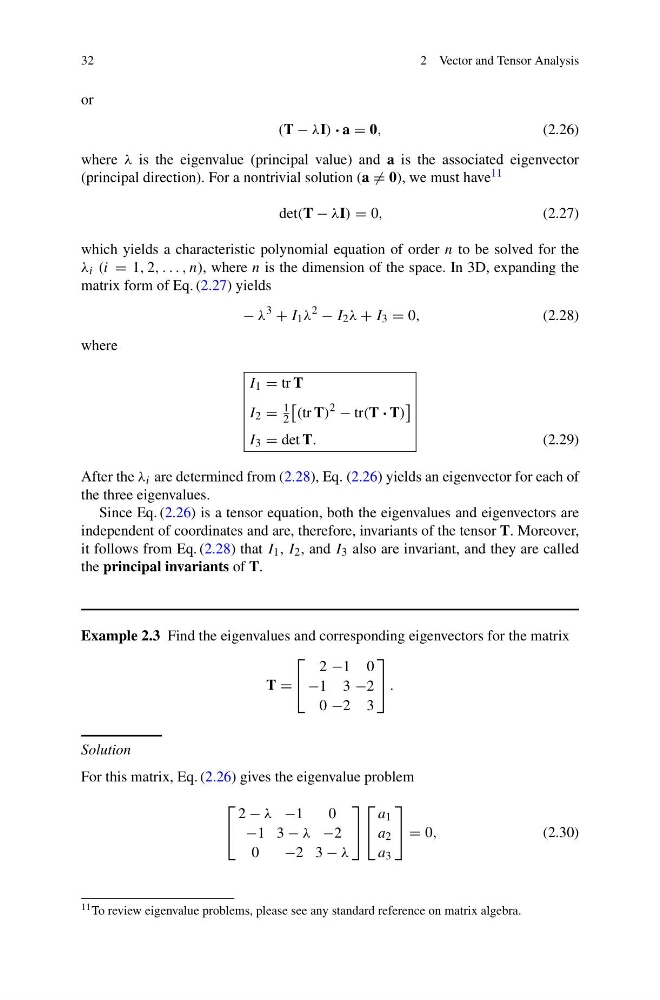
Example 2.3 Find the eigenvalues and corresponding eigenvectors for the matrix
T =
⎡
⎣
2 −1 0
−1 3 −2
0 −2 3
⎤
⎦ .
Solution
For this matrix, Eq. (2.26) gives the eigenvalue problem
⎡
⎣
2 − λ −1
0
−1 3 − λ −2
0
−2 3 − λ
⎤
⎦
⎡
⎣
a 1
a 2
a 3
⎤
⎦ = 0,
(2.30)
11 To review eigenvalue problems, please see any standard reference on matrix algebra.
2 Vector and Tensor Analysis
or
(T − λI) · a = 0,
(2.26)
where λ is the eigenvalue (principal value) and a is the associated eigenvector
(principal direction). For a nontrivial solution (a = 0), we must have 11
det(T − λI) = 0,
(2.27)
which yields a characteristic polynomial equation of order n to be solved for the
λ i (i = 1, 2, . . . , n), where n is the dimension of the space. In 3D, expanding the
matrix form of Eq. (2.27) yields
− λ
3
+ I 1 λ
2
− I 2 λ + I 3 = 0,
(2.28)
where
I 1 = tr T
I 2 =
1
2
(tr T)
2
− tr(T · T)
I 3 = det T.
(2.29)
After the λ i are determined from (2.28), Eq. (2.26) yields an eigenvector for each of
the three eigenvalues.
Since Eq. (2.26) is a tensor equation, both the eigenvalues and eigenvectors are
independent of coordinates and are, therefore, invariants of the tensor T. Moreover,
it follows from Eq. (2.28) that I 1 , I 2 , and I 3 also are invariant, and they are called
the principal invariants of T.
Example 2.3 Find the eigenvalues and corresponding eigenvectors for the matrix
T =
⎡
⎣
2 −1 0
−1 3 −2
0 −2 3
⎤
⎦ .
Solution
For this matrix, Eq. (2.26) gives the eigenvalue problem
⎡
⎣
2 − λ −1
0
−1 3 − λ −2
0
−2 3 − λ
⎤
⎦
⎡
⎣
a 1
a 2
a 3
⎤
⎦ = 0,
(2.30)
11 To review eigenvalue problems, please see any standard reference on matrix algebra.