

8.5 Early Heart Development
449
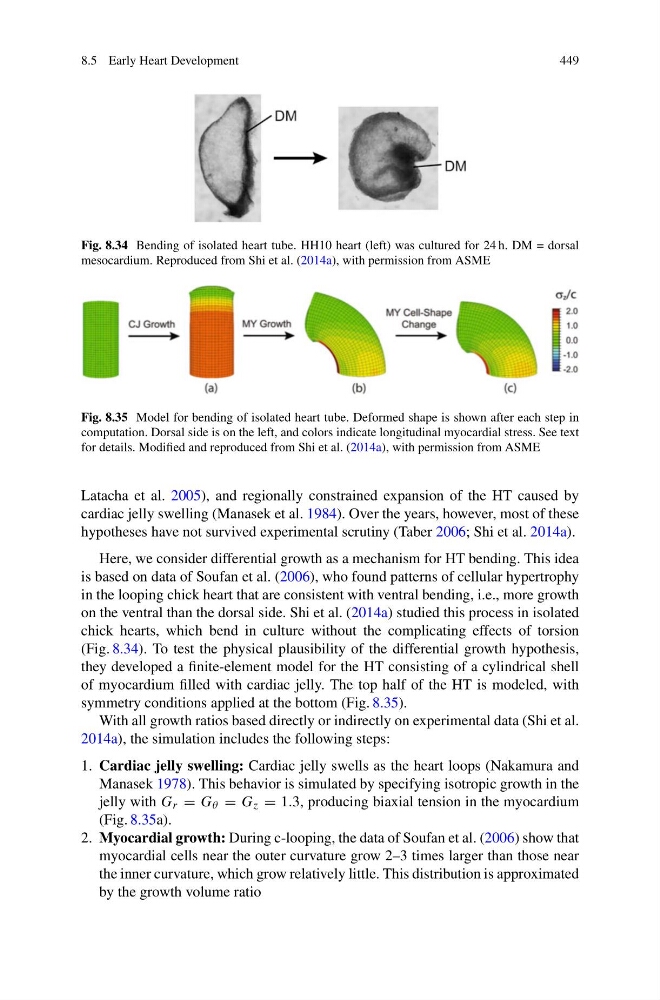
Fig. 8.34 Bending of isolated heart tube. HH10 heart (left) was cultured for 24 h. DM = dorsal
mesocardium. Reproduced from Shi et al. (2014a), with permission from ASME
Fig. 8.35 Model for bending of isolated heart tube. Deformed shape is shown after each step in
computation. Dorsal side is on the left, and colors indicate longitudinal myocardial stress. See text
for details. Modified and reproduced from Shi et al. (2014a), with permission from ASME
Latacha et al. 2005), and regionally constrained expansion of the HT caused by
cardiac jelly swelling (Manasek et al. 1984). Over the years, however, most of these
hypotheses have not survived experimental scrutiny (Taber 2006; Shi et al. 2014a).
Here, we consider differential growth as a mechanism for HT bending. This idea
is based on data of Soufan et al. (2006), who found patterns of cellular hypertrophy
in the looping chick heart that are consistent with ventral bending, i.e., more growth
on the ventral than the dorsal side. Shi et al. (2014a) studied this process in isolated
chick hearts, which bend in culture without the complicating effects of torsion
(Fig. 8.34). To test the physical plausibility of the differential growth hypothesis,
they developed a finite-element model for the HT consisting of a cylindrical shell
of myocardium filled with cardiac jelly. The top half of the HT is modeled, with
symmetry conditions applied at the bottom (Fig. 8.35).
With all growth ratios based directly or indirectly on experimental data (Shi et al.
2014a), the simulation includes the following steps:
1. Cardiac jelly swelling: Cardiac jelly swells as the heart loops (Nakamura and
Manasek 1978). This behavior is simulated by specifying isotropic growth in the
jelly with G r = G θ = G z = 1.3, producing biaxial tension in the myocardium
(Fig. 8.35a).
2. Myocardial growth: During c-looping, the data of Soufan et al. (2006) show that
myocardial cells near the outer curvature grow 2–3 times larger than those near
the inner curvature, which grow relatively little. This distribution is approximated
by the growth volume ratio
449
Fig. 8.34 Bending of isolated heart tube. HH10 heart (left) was cultured for 24 h. DM = dorsal
mesocardium. Reproduced from Shi et al. (2014a), with permission from ASME
Fig. 8.35 Model for bending of isolated heart tube. Deformed shape is shown after each step in
computation. Dorsal side is on the left, and colors indicate longitudinal myocardial stress. See text
for details. Modified and reproduced from Shi et al. (2014a), with permission from ASME
Latacha et al. 2005), and regionally constrained expansion of the HT caused by
cardiac jelly swelling (Manasek et al. 1984). Over the years, however, most of these
hypotheses have not survived experimental scrutiny (Taber 2006; Shi et al. 2014a).
Here, we consider differential growth as a mechanism for HT bending. This idea
is based on data of Soufan et al. (2006), who found patterns of cellular hypertrophy
in the looping chick heart that are consistent with ventral bending, i.e., more growth
on the ventral than the dorsal side. Shi et al. (2014a) studied this process in isolated
chick hearts, which bend in culture without the complicating effects of torsion
(Fig. 8.34). To test the physical plausibility of the differential growth hypothesis,
they developed a finite-element model for the HT consisting of a cylindrical shell
of myocardium filled with cardiac jelly. The top half of the HT is modeled, with
symmetry conditions applied at the bottom (Fig. 8.35).
With all growth ratios based directly or indirectly on experimental data (Shi et al.
2014a), the simulation includes the following steps:
1. Cardiac jelly swelling: Cardiac jelly swells as the heart loops (Nakamura and
Manasek 1978). This behavior is simulated by specifying isotropic growth in the
jelly with G r = G θ = G z = 1.3, producing biaxial tension in the myocardium
(Fig. 8.35a).
2. Myocardial growth: During c-looping, the data of Soufan et al. (2006) show that
myocardial cells near the outer curvature grow 2–3 times larger than those near
the inner curvature, which grow relatively little. This distribution is approximated
by the growth volume ratio