

414
8 Morphogenesis
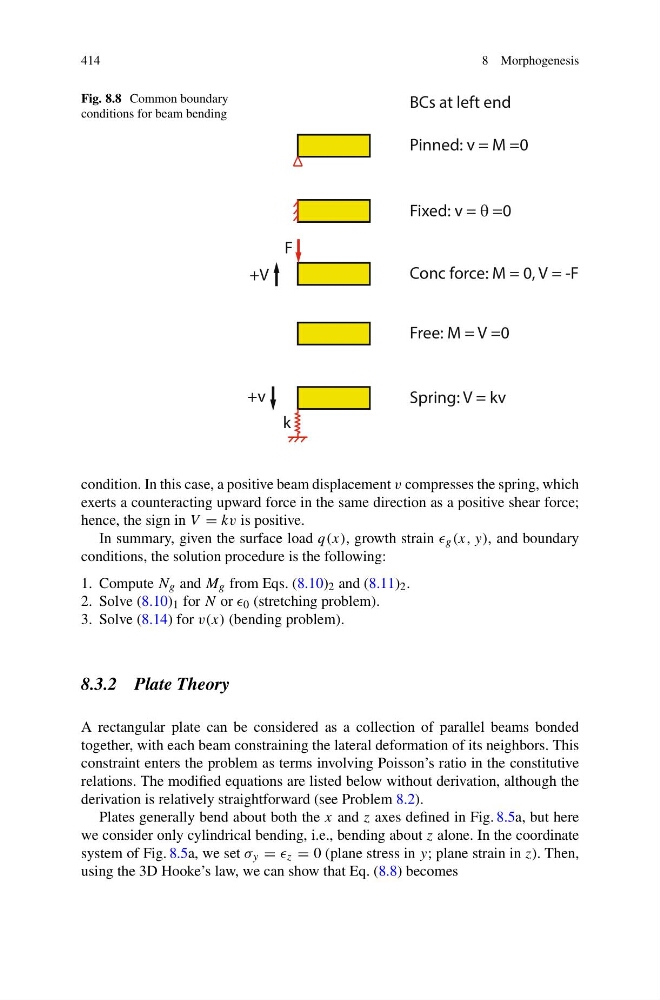
Fig. 8.8 Common boundary
conditions for beam bending
BCs at left end
F
+V
+v
k
Pinned: v = M =0
Fixed: v = T =0
Conc force: M = 0, V = -F
Free: M = V =0
Spring: V = kv
condition. In this case, a positive beam displacement v compresses the spring, which
exerts a counteracting upward force in the same direction as a positive shear force;
hence, the sign in V = kv is positive.
In summary, given the surface load q(x), growth strain g (x, y), and boundary
conditions, the solution procedure is the following:
1. Compute N g and M g from Eqs. (8.10) 2 and (8.11) 2 .
2. Solve (8.10) 1 for N or 0 (stretching problem).
3. Solve (8.14) for v(x) (bending problem).
8.3.2 Plate Theory
A rectangular plate can be considered as a collection of parallel beams bonded
together, with each beam constraining the lateral deformation of its neighbors. This
constraint enters the problem as terms involving Poisson’s ratio in the constitutive
relations. The modified equations are listed below without derivation, although the
derivation is relatively straightforward (see Problem 8.2).
Plates generally bend about both the x and z axes defined in Fig. 8.5a, but here
we consider only cylindrical bending, i.e., bending about z alone. In the coordinate
system of Fig. 8.5a, we set σ y = z = 0 (plane stress in y; plane strain in z). Then,
using the 3D Hooke’s law, we can show that Eq. (8.8) becomes
8 Morphogenesis
Fig. 8.8 Common boundary
conditions for beam bending
BCs at left end
F
+V
+v
k
Pinned: v = M =0
Fixed: v = T =0
Conc force: M = 0, V = -F
Free: M = V =0
Spring: V = kv
condition. In this case, a positive beam displacement v compresses the spring, which
exerts a counteracting upward force in the same direction as a positive shear force;
hence, the sign in V = kv is positive.
In summary, given the surface load q(x), growth strain g (x, y), and boundary
conditions, the solution procedure is the following:
1. Compute N g and M g from Eqs. (8.10) 2 and (8.11) 2 .
2. Solve (8.10) 1 for N or 0 (stretching problem).
3. Solve (8.14) for v(x) (bending problem).
8.3.2 Plate Theory
A rectangular plate can be considered as a collection of parallel beams bonded
together, with each beam constraining the lateral deformation of its neighbors. This
constraint enters the problem as terms involving Poisson’s ratio in the constitutive
relations. The modified equations are listed below without derivation, although the
derivation is relatively straightforward (see Problem 8.2).
Plates generally bend about both the x and z axes defined in Fig. 8.5a, but here
we consider only cylindrical bending, i.e., bending about z alone. In the coordinate
system of Fig. 8.5a, we set σ y = z = 0 (plane stress in y; plane strain in z). Then,
using the 3D Hooke’s law, we can show that Eq. (8.8) becomes