

410
8 Morphogenesis
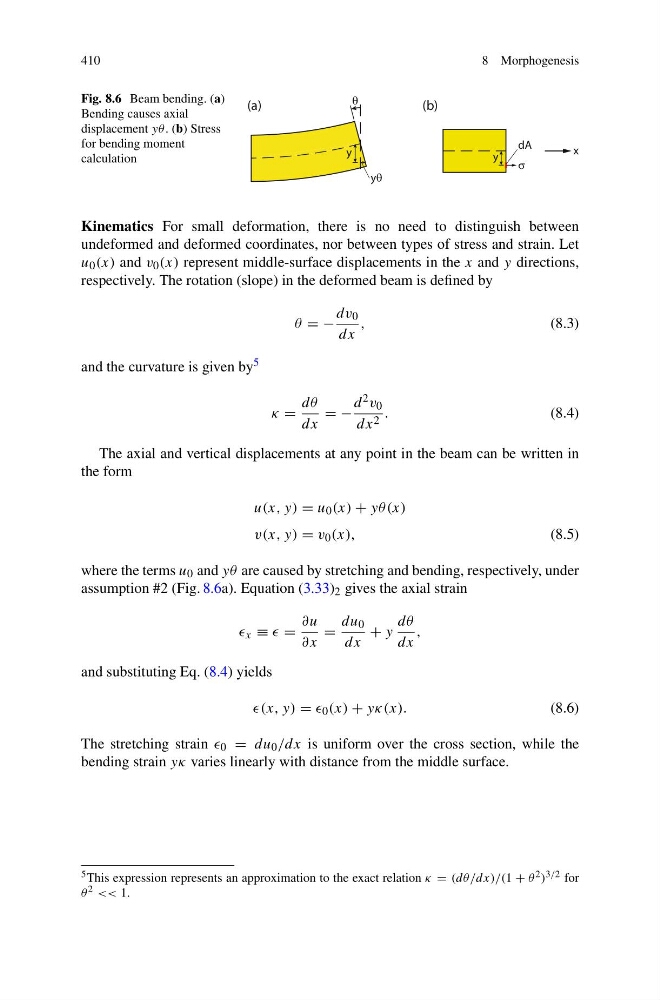
Fig. 8.6 Beam bending. (a)
Bending causes axial
displacement yθ. (b) Stress
for bending moment
calculation
T
yT
y
V
y
dA
x
)
b
(
)
a
(
Kinematics For small deformation, there is no need to distinguish between
undeformed and deformed coordinates, nor between types of stress and strain. Let
u 0 (x) and v 0 (x) represent middle-surface displacements in the x and y directions,
respectively. The rotation (slope) in the deformed beam is defined by
θ = −
dv 0
dx
,
(8.3)
and the curvature is given by 5
κ =
dθ
dx
= −
d 2 v 0
dx 2 .
(8.4)
The axial and vertical displacements at any point in the beam can be written in
the form
u(x, y) = u 0 (x) + yθ(x)
v(x, y) = v 0 (x),
(8.5)
where the terms u 0 and yθ are caused by stretching and bending, respectively, under
assumption #2 (Fig. 8.6a). Equation (3.33) 2 gives the axial strain
x ≡ =
∂u
∂x
=
du 0
dx
+ y
dθ
dx
,
and substituting Eq. (8.4) yields
y) = 0 (x) + yκ(x).
(8.6)
The stretching strain 0 = du 0 /dx is uniform over the cross section, while the
bending strain yκ varies linearly with distance from the middle surface.
5 This expression represents an approximation to the exact relation κ = (dθ/dx)/(1 + θ 2 ) 3/2 for
θ 2 << 1.
8 Morphogenesis
Fig. 8.6 Beam bending. (a)
Bending causes axial
displacement yθ. (b) Stress
for bending moment
calculation
T
yT
y
V
y
dA
x
)
b
(
)
a
(
Kinematics For small deformation, there is no need to distinguish between
undeformed and deformed coordinates, nor between types of stress and strain. Let
u 0 (x) and v 0 (x) represent middle-surface displacements in the x and y directions,
respectively. The rotation (slope) in the deformed beam is defined by
θ = −
dv 0
dx
,
(8.3)
and the curvature is given by 5
κ =
dθ
dx
= −
d 2 v 0
dx 2 .
(8.4)
The axial and vertical displacements at any point in the beam can be written in
the form
u(x, y) = u 0 (x) + yθ(x)
v(x, y) = v 0 (x),
(8.5)
where the terms u 0 and yθ are caused by stretching and bending, respectively, under
assumption #2 (Fig. 8.6a). Equation (3.33) 2 gives the axial strain
x ≡ =
∂u
∂x
=
du 0
dx
+ y
dθ
dx
,
and substituting Eq. (8.4) yields
y) = 0 (x) + yκ(x).
(8.6)
The stretching strain 0 = du 0 /dx is uniform over the cross section, while the
bending strain yκ varies linearly with distance from the middle surface.
5 This expression represents an approximation to the exact relation κ = (dθ/dx)/(1 + θ 2 ) 3/2 for
θ 2 << 1.