

8.3 Linear Theory for Growing Beams and Plates
409
8.3 Linear Theory for Growing Beams and Plates
A row of cells bound together can be modeled as a beam with length much greater
than its thickness and width. However, most epithelia are really plates (or curved
plates, i.e., shells) with a relatively large length and width. Here, we derive the
governing equations for a growing beam and then modify these equations for a
plate.
8.3.1 Beam Theory
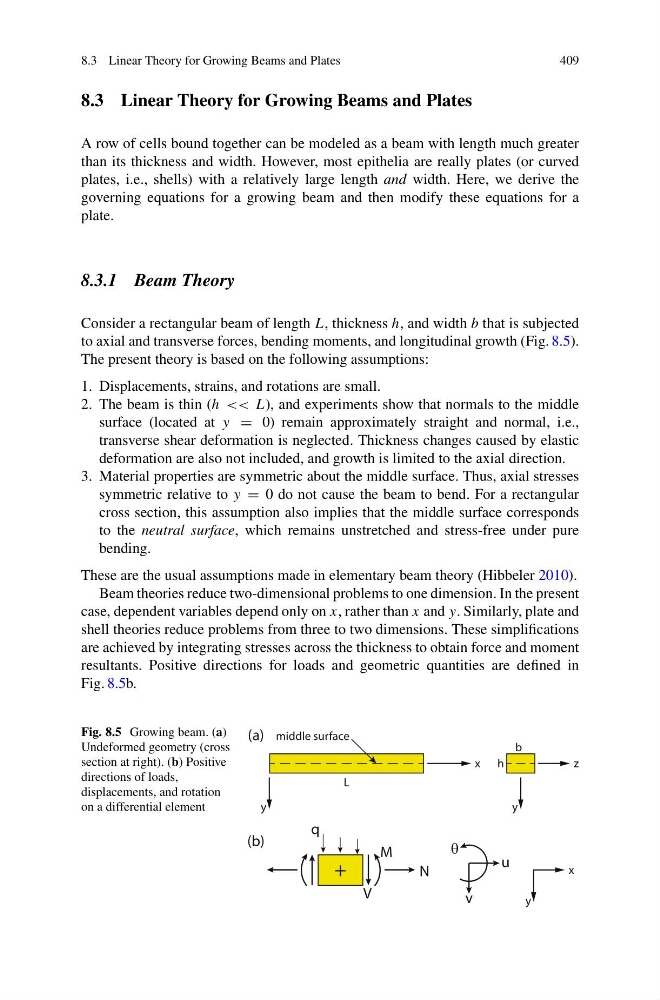
Consider a rectangular beam of length L, thickness h, and width b that is subjected
to axial and transverse forces, bending moments, and longitudinal growth (Fig. 8.5).
The present theory is based on the following assumptions:
1. Displacements, strains, and rotations are small.
2. The beam is thin (h << L), and experiments show that normals to the middle
surface (located at y = 0) remain approximately straight and normal, i.e.,
transverse shear deformation is neglected. Thickness changes caused by elastic
deformation are also not included, and growth is limited to the axial direction.
3. Material properties are symmetric about the middle surface. Thus, axial stresses
symmetric relative to y = 0 do not cause the beam to bend. For a rectangular
cross section, this assumption also implies that the middle surface corresponds
to the neutral surface, which remains unstretched and stress-free under pure
bending.
These are the usual assumptions made in elementary beam theory (Hibbeler 2010).
Beam theories reduce two-dimensional problems to one dimension. In the present
case, dependent variables depend only on x, rather than x and y. Similarly, plate and
shell theories reduce problems from three to two dimensions. These simplifications
are achieved by integrating stresses across the thickness to obtain force and moment
resultants. Positive directions for loads and geometric quantities are defined in
Fig. 8.5b.
Fig. 8.5 Growing beam. (a)
Undeformed geometry (cross
section at right). (b) Positive
directions of loads,
displacements, and rotation
on a differential element
L
x
y
y
z
h
b
middle surface
+
N
M
V
q
x
(a)
(b)
u
v
T
y
409
8.3 Linear Theory for Growing Beams and Plates
A row of cells bound together can be modeled as a beam with length much greater
than its thickness and width. However, most epithelia are really plates (or curved
plates, i.e., shells) with a relatively large length and width. Here, we derive the
governing equations for a growing beam and then modify these equations for a
plate.
8.3.1 Beam Theory
Consider a rectangular beam of length L, thickness h, and width b that is subjected
to axial and transverse forces, bending moments, and longitudinal growth (Fig. 8.5).
The present theory is based on the following assumptions:
1. Displacements, strains, and rotations are small.
2. The beam is thin (h << L), and experiments show that normals to the middle
surface (located at y = 0) remain approximately straight and normal, i.e.,
transverse shear deformation is neglected. Thickness changes caused by elastic
deformation are also not included, and growth is limited to the axial direction.
3. Material properties are symmetric about the middle surface. Thus, axial stresses
symmetric relative to y = 0 do not cause the beam to bend. For a rectangular
cross section, this assumption also implies that the middle surface corresponds
to the neutral surface, which remains unstretched and stress-free under pure
bending.
These are the usual assumptions made in elementary beam theory (Hibbeler 2010).
Beam theories reduce two-dimensional problems to one dimension. In the present
case, dependent variables depend only on x, rather than x and y. Similarly, plate and
shell theories reduce problems from three to two dimensions. These simplifications
are achieved by integrating stresses across the thickness to obtain force and moment
resultants. Positive directions for loads and geometric quantities are defined in
Fig. 8.5b.
Fig. 8.5 Growing beam. (a)
Undeformed geometry (cross
section at right). (b) Positive
directions of loads,
displacements, and rotation
on a differential element
L
x
y
y
z
h
b
middle surface
+
N
M
V
q
x
(a)
(b)
u
v
T
y