

7.6 Case Study: Growth and Remodeling of Arteries
381
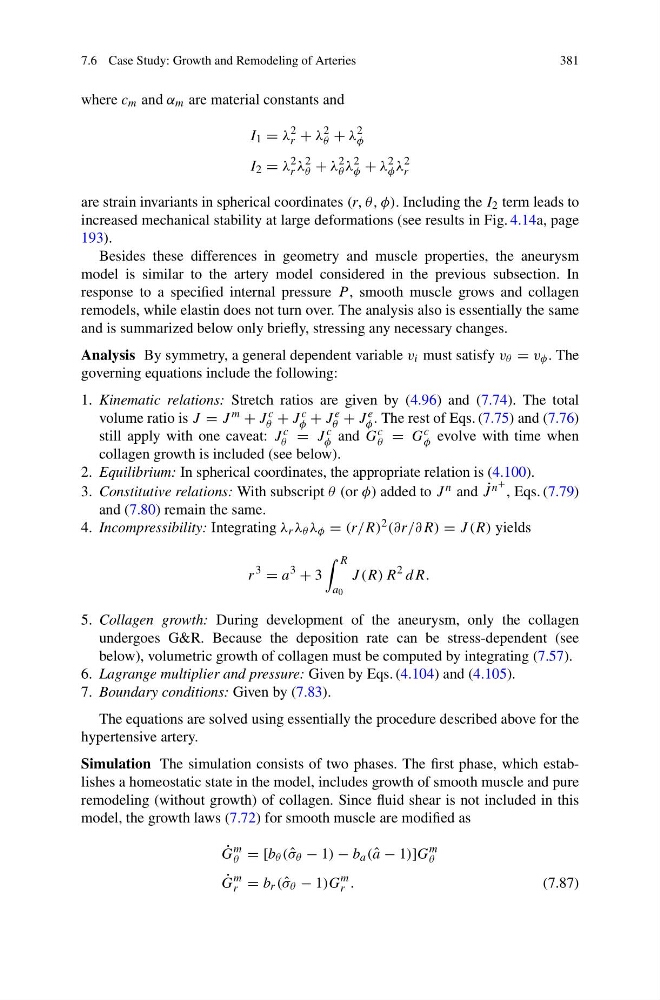
where c m and α m are material constants and
I 1 = λ
2
r + λ
2
θ + λ
2
φ
I 2 = λ
2
r λ
2
θ + λ
2
θ λ
2
φ + λ
2
φ λ
2
r
are strain invariants in spherical coordinates (r, θ, φ). Including the I 2 term leads to
increased mechanical stability at large deformations (see results in Fig. 4.14a, page
193).
Besides these differences in geometry and muscle properties, the aneurysm
model is similar to the artery model considered in the previous subsection. In
response to a specified internal pressure P , smooth muscle grows and collagen
remodels, while elastin does not turn over. The analysis also is essentially the same
and is summarized below only briefly, stressing any necessary changes.
Analysis By symmetry, a general dependent variable v i must satisfy v θ = v φ . The
governing equations include the following:
1. Kinematic relations: Stretch ratios are given by (4.96) and (7.74). The total
volume ratio is J = J m + J c
θ + J c
φ + J e
θ + J e
φ . The rest of Eqs. (7.75) and (7.76)
still apply with one caveat: J c
θ = J c
φ and G c
θ = G c
φ evolve with time when
collagen growth is included (see below).
2. Equilibrium: In spherical coordinates, the appropriate relation is (4.100).
3. Constitutive relations: With subscript θ (or φ) added to J n and ˙
J n + , Eqs. (7.79)
and (7.80) remain the same.
4. Incompressibility: Integrating λ r λ θ λ φ = (r/R) 2 (∂r/∂R) = J (R) yields
r
3
= a
3
+ 3
R
a 0
J (R) R
2 dR.
5. Collagen growth: During development of the aneurysm, only the collagen
undergoes G&R. Because the deposition rate can be stress-dependent (see
below), volumetric growth of collagen must be computed by integrating (7.57).
6. Lagrange multiplier and pressure: Given by Eqs. (4.104) and (4.105).
7. Boundary conditions: Given by (7.83).
The equations are solved using essentially the procedure described above for the
hypertensive artery.
Simulation The simulation consists of two phases. The first phase, which establishes a homeostatic state in the model, includes growth of smooth muscle and pure
remodeling (without growth) of collagen. Since fluid shear is not included in this
model, the growth laws (7.72) for smooth muscle are modified as
˙
G
m
θ = [b θ ( ˆ
σ θ − 1) − b a ( ˆ
a − 1)]G
m
θ
˙
G
m
r = b r ( ˆ
σ θ − 1)G
m
r .
(7.87)
381
where c m and α m are material constants and
I 1 = λ
2
r + λ
2
θ + λ
2
φ
I 2 = λ
2
r λ
2
θ + λ
2
θ λ
2
φ + λ
2
φ λ
2
r
are strain invariants in spherical coordinates (r, θ, φ). Including the I 2 term leads to
increased mechanical stability at large deformations (see results in Fig. 4.14a, page
193).
Besides these differences in geometry and muscle properties, the aneurysm
model is similar to the artery model considered in the previous subsection. In
response to a specified internal pressure P , smooth muscle grows and collagen
remodels, while elastin does not turn over. The analysis also is essentially the same
and is summarized below only briefly, stressing any necessary changes.
Analysis By symmetry, a general dependent variable v i must satisfy v θ = v φ . The
governing equations include the following:
1. Kinematic relations: Stretch ratios are given by (4.96) and (7.74). The total
volume ratio is J = J m + J c
θ + J c
φ + J e
θ + J e
φ . The rest of Eqs. (7.75) and (7.76)
still apply with one caveat: J c
θ = J c
φ and G c
θ = G c
φ evolve with time when
collagen growth is included (see below).
2. Equilibrium: In spherical coordinates, the appropriate relation is (4.100).
3. Constitutive relations: With subscript θ (or φ) added to J n and ˙
J n + , Eqs. (7.79)
and (7.80) remain the same.
4. Incompressibility: Integrating λ r λ θ λ φ = (r/R) 2 (∂r/∂R) = J (R) yields
r
3
= a
3
+ 3
R
a 0
J (R) R
2 dR.
5. Collagen growth: During development of the aneurysm, only the collagen
undergoes G&R. Because the deposition rate can be stress-dependent (see
below), volumetric growth of collagen must be computed by integrating (7.57).
6. Lagrange multiplier and pressure: Given by Eqs. (4.104) and (4.105).
7. Boundary conditions: Given by (7.83).
The equations are solved using essentially the procedure described above for the
hypertensive artery.
Simulation The simulation consists of two phases. The first phase, which establishes a homeostatic state in the model, includes growth of smooth muscle and pure
remodeling (without growth) of collagen. Since fluid shear is not included in this
model, the growth laws (7.72) for smooth muscle are modified as
˙
G
m
θ = [b θ ( ˆ
σ θ − 1) − b a ( ˆ
a − 1)]G
m
θ
˙
G
m
r = b r ( ˆ
σ θ − 1)G
m
r .
(7.87)