

7.6 Case Study: Growth and Remodeling of Arteries
377
collagen turnover rate lowers the peak opening angle, but has relatively little effect
otherwise (Fig. 7.11b).
The opening angle depends on a number of factors, including wall geometry,
material properties, and residual stress in the individual constituents. All these
factors are affected by local growth and remodeling. Investigating all the possible
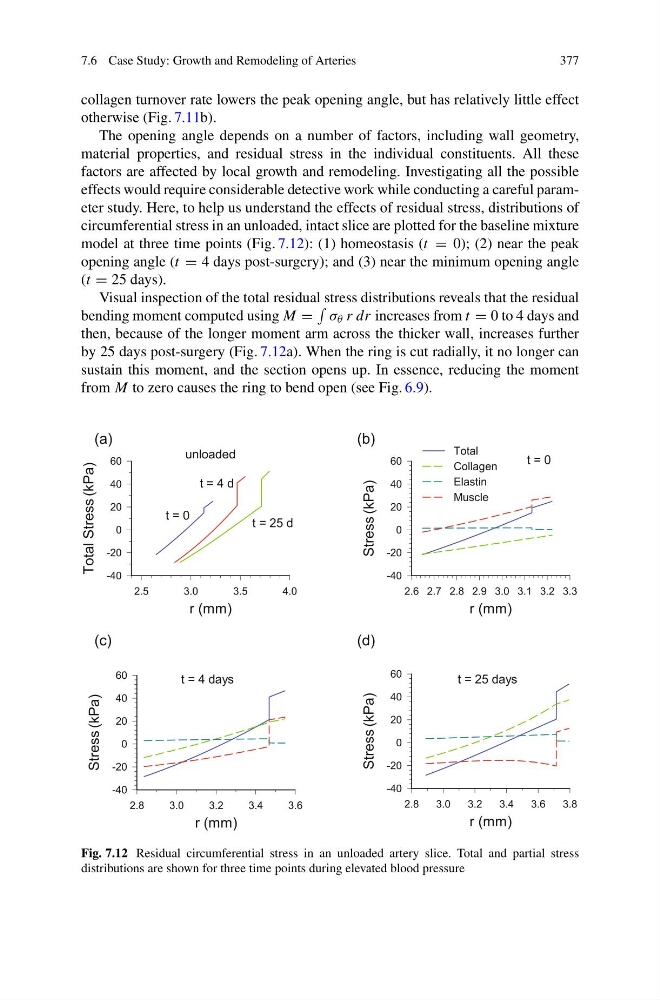
effects would require considerable detective work while conducting a careful parameter study. Here, to help us understand the effects of residual stress, distributions of
circumferential stress in an unloaded, intact slice are plotted for the baseline mixture
model at three time points (Fig. 7.12): (1) homeostasis (t = 0); (2) near the peak
opening angle (t = 4 days post-surgery); and (3) near the minimum opening angle
(t = 25 days).
Visual inspection of the total residual stress distributions reveals that the residual
bending moment computed using M =
σ θ r dr increases from t = 0 to 4 days and
then, because of the longer moment arm across the thicker wall, increases further
by 25 days post-surgery (Fig. 7.12a). When the ring is cut radially, it no longer can
sustain this moment, and the section opens up. In essence, reducing the moment
from M to zero causes the ring to bend open (see Fig. 6.9).
Fig. 7.12 Residual circumferential stress in an unloaded artery slice. Total and partial stress
distributions are shown for three time points during elevated blood pressure
377
collagen turnover rate lowers the peak opening angle, but has relatively little effect
otherwise (Fig. 7.11b).
The opening angle depends on a number of factors, including wall geometry,
material properties, and residual stress in the individual constituents. All these
factors are affected by local growth and remodeling. Investigating all the possible
effects would require considerable detective work while conducting a careful parameter study. Here, to help us understand the effects of residual stress, distributions of
circumferential stress in an unloaded, intact slice are plotted for the baseline mixture
model at three time points (Fig. 7.12): (1) homeostasis (t = 0); (2) near the peak
opening angle (t = 4 days post-surgery); and (3) near the minimum opening angle
(t = 25 days).
Visual inspection of the total residual stress distributions reveals that the residual
bending moment computed using M =
σ θ r dr increases from t = 0 to 4 days and
then, because of the longer moment arm across the thicker wall, increases further
by 25 days post-surgery (Fig. 7.12a). When the ring is cut radially, it no longer can
sustain this moment, and the section opens up. In essence, reducing the moment
from M to zero causes the ring to bend open (see Fig. 6.9).
Fig. 7.12 Residual circumferential stress in an unloaded artery slice. Total and partial stress
distributions are shown for three time points during elevated blood pressure