

366
7 Remodeling
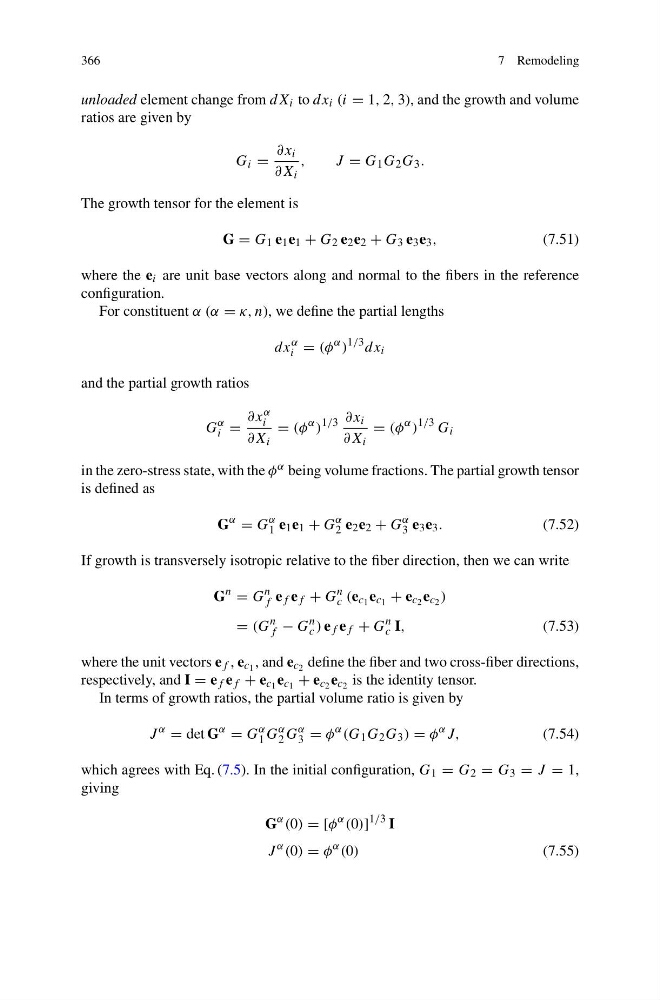
unloaded element change from dX i to dx i (i = 1, 2, 3), and the growth and volume
ratios are given by
G i =
∂x i
∂X i
,
J = G 1 G 2 G 3 .
The growth tensor for the element is
G = G 1 e 1 e 1 + G 2 e 2 e 2 + G 3 e 3 e 3 ,
(7.51)
where the e i are unit base vectors along and normal to the fibers in the reference
configuration.
For constituent α (α = κ, n), we define the partial lengths
dx
α
i = (φ
α )
1/3 dx i
and the partial growth ratios
G
α
i =
∂x α
i
∂X i
= (φ
α )
1/3 ∂x i
∂X i
= (φ
α )
1/3 G i
in the zero-stress state, with the φ α being volume fractions. The partial growth tensor
is defined as
G
α
= G
α
1 e 1 e 1 + G
α
2 e 2 e 2 + G
α
3 e 3 e 3 .
(7.52)
If growth is transversely isotropic relative to the fiber direction, then we can write
G
n
= G
n
f e f e f + G
n
c (e c 1 e c 1 + e c 2 e c 2 )
= (G
n
f − G
n
c ) e f e f + G
n
c I,
(7.53)
where the unit vectors e f , e c 1 , and e c 2 define the fiber and two cross-fiber directions,
respectively, and I = e f e f + e c 1 e c 1 + e c 2 e c 2 is the identity tensor.
In terms of growth ratios, the partial volume ratio is given by
J
α
= det G
α
= G
α
1 G
α
2 G
α
3 = φ
α (G 1 G 2 G 3 ) = φ
α J,
(7.54)
which agrees with Eq. (7.5). In the initial configuration, G 1 = G 2 = G 3 = J = 1,
giving
G
α (0) = [φ
α (0)]
1/3 I
J
α (0) = φ
α (0)
(7.55)
7 Remodeling
unloaded element change from dX i to dx i (i = 1, 2, 3), and the growth and volume
ratios are given by
G i =
∂x i
∂X i
,
J = G 1 G 2 G 3 .
The growth tensor for the element is
G = G 1 e 1 e 1 + G 2 e 2 e 2 + G 3 e 3 e 3 ,
(7.51)
where the e i are unit base vectors along and normal to the fibers in the reference
configuration.
For constituent α (α = κ, n), we define the partial lengths
dx
α
i = (φ
α )
1/3 dx i
and the partial growth ratios
G
α
i =
∂x α
i
∂X i
= (φ
α )
1/3 ∂x i
∂X i
= (φ
α )
1/3 G i
in the zero-stress state, with the φ α being volume fractions. The partial growth tensor
is defined as
G
α
= G
α
1 e 1 e 1 + G
α
2 e 2 e 2 + G
α
3 e 3 e 3 .
(7.52)
If growth is transversely isotropic relative to the fiber direction, then we can write
G
n
= G
n
f e f e f + G
n
c (e c 1 e c 1 + e c 2 e c 2 )
= (G
n
f − G
n
c ) e f e f + G
n
c I,
(7.53)
where the unit vectors e f , e c 1 , and e c 2 define the fiber and two cross-fiber directions,
respectively, and I = e f e f + e c 1 e c 1 + e c 2 e c 2 is the identity tensor.
In terms of growth ratios, the partial volume ratio is given by
J
α
= det G
α
= G
α
1 G
α
2 G
α
3 = φ
α (G 1 G 2 G 3 ) = φ
α J,
(7.54)
which agrees with Eq. (7.5). In the initial configuration, G 1 = G 2 = G 3 = J = 1,
giving
G
α (0) = [φ
α (0)]
1/3 I
J
α (0) = φ
α (0)
(7.55)