

342
7 Remodeling
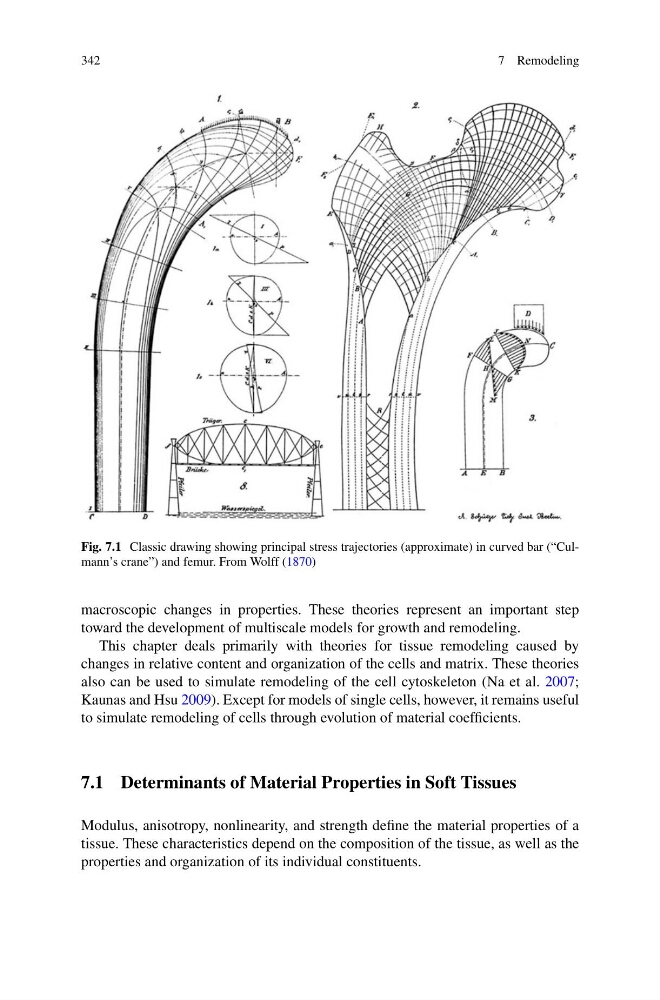
Fig. 7.1 Classic drawing showing principal stress trajectories (approximate) in curved bar (“Culmann’s crane”) and femur. From Wolff (1870)
macroscopic changes in properties. These theories represent an important step
toward the development of multiscale models for growth and remodeling.
This chapter deals primarily with theories for tissue remodeling caused by
changes in relative content and organization of the cells and matrix. These theories
also can be used to simulate remodeling of the cell cytoskeleton (Na et al. 2007;
Kaunas and Hsu 2009). Except for models of single cells, however, it remains useful
to simulate remodeling of cells through evolution of material coefficients.
7.1 Determinants of Material Properties in Soft Tissues
Modulus, anisotropy, nonlinearity, and strength define the material properties of a
tissue. These characteristics depend on the composition of the tissue, as well as the
properties and organization of its individual constituents.
7 Remodeling
Fig. 7.1 Classic drawing showing principal stress trajectories (approximate) in curved bar (“Culmann’s crane”) and femur. From Wolff (1870)
macroscopic changes in properties. These theories represent an important step
toward the development of multiscale models for growth and remodeling.
This chapter deals primarily with theories for tissue remodeling caused by
changes in relative content and organization of the cells and matrix. These theories
also can be used to simulate remodeling of the cell cytoskeleton (Na et al. 2007;
Kaunas and Hsu 2009). Except for models of single cells, however, it remains useful
to simulate remodeling of cells through evolution of material coefficients.
7.1 Determinants of Material Properties in Soft Tissues
Modulus, anisotropy, nonlinearity, and strength define the material properties of a
tissue. These characteristics depend on the composition of the tissue, as well as the
properties and organization of its individual constituents.