

6.11 Case Study: Functional Adaptation in Arteries
333
G x = G
G x = 1
Bar 1
Bar 2
x
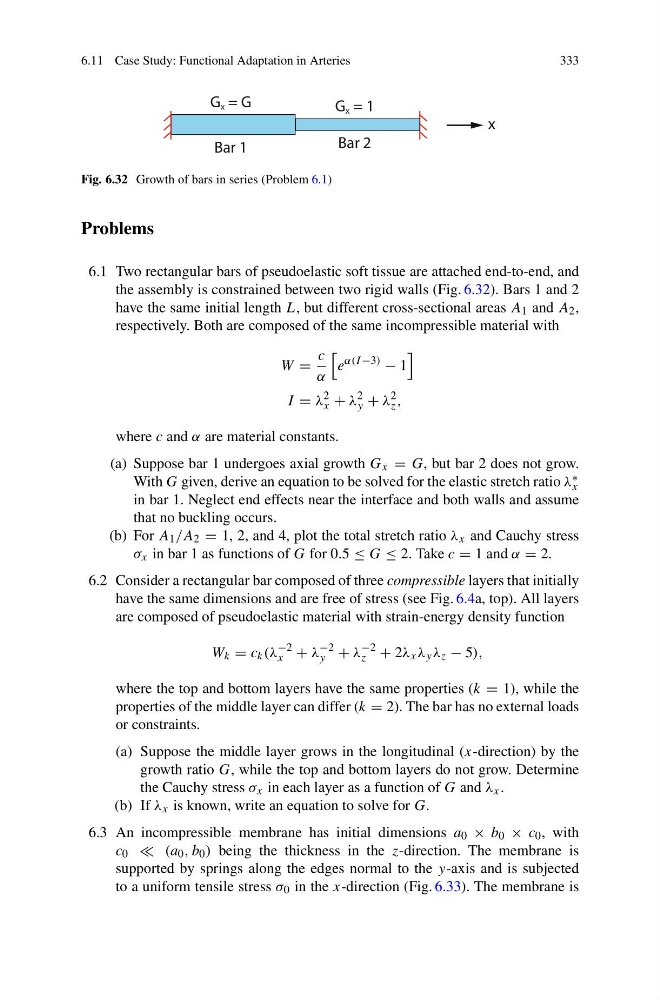
Fig. 6.32 Growth of bars in series (Problem 6.1)
Problems
6.1 Two rectangular bars of pseudoelastic soft tissue are attached end-to-end, and
the assembly is constrained between two rigid walls (Fig. 6.32). Bars 1 and 2
have the same initial length L, but different cross-sectional areas A 1 and A 2 ,
respectively. Both are composed of the same incompressible material with
W =
c
α
e
α(I −3)
− 1
I = λ
2
x + λ
2
y + λ
2
z ,
where c and α are material constants.
(a) Suppose bar 1 undergoes axial growth G x = G, but bar 2 does not grow.
With G given, derive an equation to be solved for the elastic stretch ratio λ ∗
x
in bar 1. Neglect end effects near the interface and both walls and assume
that no buckling occurs.
(b) For A 1 /A 2 = 1, 2, and 4, plot the total stretch ratio λ x and Cauchy stress
σ x in bar 1 as functions of G for 0.5 ≤ G ≤ 2. Take c = 1 and α = 2.
6.2 Consider a rectangular bar composed of three compressible layers that initially
have the same dimensions and are free of stress (see Fig. 6.4a, top). All layers
are composed of pseudoelastic material with strain-energy density function
W k = c k (λ
−2
x + λ
−2
y + λ
−2
z + 2λ x λ y λ z − 5),
where the top and bottom layers have the same properties (k = 1), while the
properties of the middle layer can differ (k = 2). The bar has no external loads
or constraints.
(a) Suppose the middle layer grows in the longitudinal (x-direction) by the
growth ratio G, while the top and bottom layers do not grow. Determine
the Cauchy stress σ x in each layer as a function of G and λ x .
(b) If λ x is known, write an equation to solve for G.
6.3 An incompressible membrane has initial dimensions a 0 × b 0 × c 0 , with
c 0 (a 0 , b 0 ) being the thickness in the z-direction. The membrane is
supported by springs along the edges normal to the y-axis and is subjected
to a uniform tensile stress σ 0 in the x-direction (Fig. 6.33). The membrane is
333
G x = G
G x = 1
Bar 1
Bar 2
x
Fig. 6.32 Growth of bars in series (Problem 6.1)
Problems
6.1 Two rectangular bars of pseudoelastic soft tissue are attached end-to-end, and
the assembly is constrained between two rigid walls (Fig. 6.32). Bars 1 and 2
have the same initial length L, but different cross-sectional areas A 1 and A 2 ,
respectively. Both are composed of the same incompressible material with
W =
c
α
e
α(I −3)
− 1
I = λ
2
x + λ
2
y + λ
2
z ,
where c and α are material constants.
(a) Suppose bar 1 undergoes axial growth G x = G, but bar 2 does not grow.
With G given, derive an equation to be solved for the elastic stretch ratio λ ∗
x
in bar 1. Neglect end effects near the interface and both walls and assume
that no buckling occurs.
(b) For A 1 /A 2 = 1, 2, and 4, plot the total stretch ratio λ x and Cauchy stress
σ x in bar 1 as functions of G for 0.5 ≤ G ≤ 2. Take c = 1 and α = 2.
6.2 Consider a rectangular bar composed of three compressible layers that initially
have the same dimensions and are free of stress (see Fig. 6.4a, top). All layers
are composed of pseudoelastic material with strain-energy density function
W k = c k (λ
−2
x + λ
−2
y + λ
−2
z + 2λ x λ y λ z − 5),
where the top and bottom layers have the same properties (k = 1), while the
properties of the middle layer can differ (k = 2). The bar has no external loads
or constraints.
(a) Suppose the middle layer grows in the longitudinal (x-direction) by the
growth ratio G, while the top and bottom layers do not grow. Determine
the Cauchy stress σ x in each layer as a function of G and λ x .
(b) If λ x is known, write an equation to solve for G.
6.3 An incompressible membrane has initial dimensions a 0 × b 0 × c 0 , with
c 0 (a 0 , b 0 ) being the thickness in the z-direction. The membrane is
supported by springs along the edges normal to the y-axis and is subjected
to a uniform tensile stress σ 0 in the x-direction (Fig. 6.33). The membrane is