

320
6 Growth
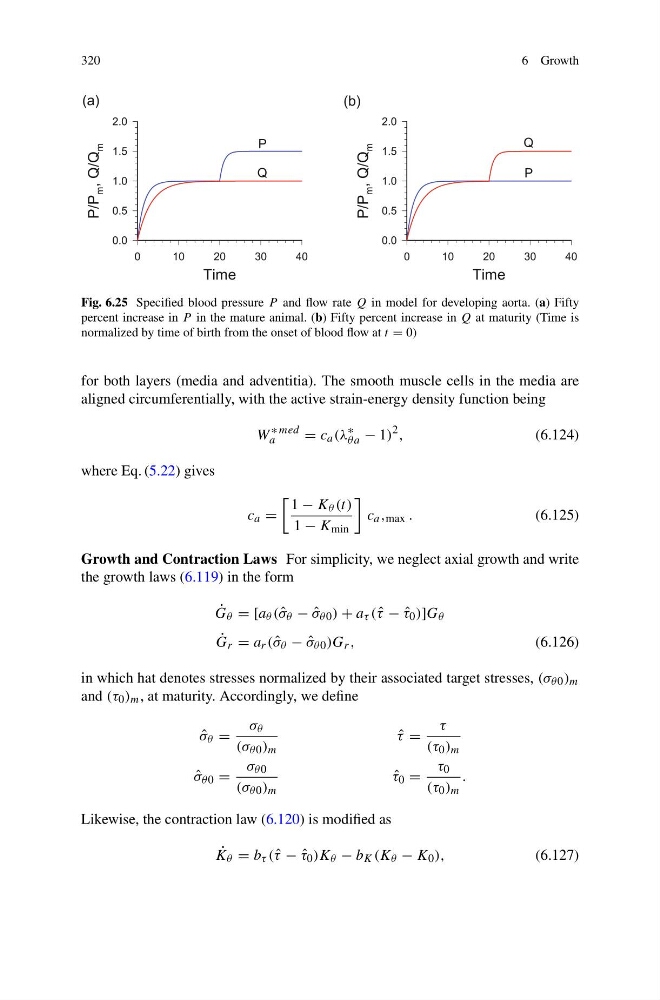
Fig. 6.25 Specified blood pressure P and flow rate Q in model for developing aorta. (a) Fifty
percent increase in P in the mature animal. (b) Fifty percent increase in Q at maturity (Time is
normalized by time of birth from the onset of blood flow at t = 0)
for both layers (media and adventitia). The smooth muscle cells in the media are
aligned circumferentially, with the active strain-energy density function being
W
∗ med
a
= c a (λ
∗
θa − 1)
2 ,
(6.124)
where Eq. (5.22) gives
c a =
1 − K θ (t)
1 − K min
c a , max .
(6.125)
Growth and Contraction Laws For simplicity, we neglect axial growth and write
the growth laws (6.119) in the form
˙
G θ = [a θ ( ˆ
σ θ − ˆ
σ θ0 ) + a τ ( ˆ
τ − ˆ
τ 0 )]G θ
˙
G r = a r ( ˆ
σ θ − ˆ
σ θ0 )G r ,
(6.126)
in which hat denotes stresses normalized by their associated target stresses, (σ θ0 ) m
and (τ 0 ) m , at maturity. Accordingly, we define
ˆ
σ θ =
σ θ
(σ θ0 ) m
ˆ
τ =
τ
(τ 0 ) m
ˆ
σ θ0 =
σ θ0
(σ θ0 ) m
ˆ
τ 0 =
τ 0
(τ 0 ) m
.
Likewise, the contraction law (6.120) is modified as
˙
K θ = b τ ( ˆ
τ − ˆ
τ 0 )K θ − b K (K θ − K 0 ),
(6.127)
6 Growth
Fig. 6.25 Specified blood pressure P and flow rate Q in model for developing aorta. (a) Fifty
percent increase in P in the mature animal. (b) Fifty percent increase in Q at maturity (Time is
normalized by time of birth from the onset of blood flow at t = 0)
for both layers (media and adventitia). The smooth muscle cells in the media are
aligned circumferentially, with the active strain-energy density function being
W
∗ med
a
= c a (λ
∗
θa − 1)
2 ,
(6.124)
where Eq. (5.22) gives
c a =
1 − K θ (t)
1 − K min
c a , max .
(6.125)
Growth and Contraction Laws For simplicity, we neglect axial growth and write
the growth laws (6.119) in the form
˙
G θ = [a θ ( ˆ
σ θ − ˆ
σ θ0 ) + a τ ( ˆ
τ − ˆ
τ 0 )]G θ
˙
G r = a r ( ˆ
σ θ − ˆ
σ θ0 )G r ,
(6.126)
in which hat denotes stresses normalized by their associated target stresses, (σ θ0 ) m
and (τ 0 ) m , at maturity. Accordingly, we define
ˆ
σ θ =
σ θ
(σ θ0 ) m
ˆ
τ =
τ
(τ 0 ) m
ˆ
σ θ0 =
σ θ0
(σ θ0 ) m
ˆ
τ 0 =
τ 0
(τ 0 ) m
.
Likewise, the contraction law (6.120) is modified as
˙
K θ = b τ ( ˆ
τ − ˆ
τ 0 )K θ − b K (K θ − K 0 ),
(6.127)