

270
6 Growth
Finally, note that this solution requires applying end loads that do not exist if
the bar is free of all external loads and constraints. As shown by the finite-element
solution of Fig. 6.4d, these end effects are localized within boundary layers of width
on the order of the bar thickness, where the axial stress rapidly approaches zero
and shearing occurs. Hence, these effects become less significant as the beam grows
longer.
Example 6.5 An incompressible neo-Hookean bar has a square cross section (2H ×
2H ) in the undeformed configuration. The bar undergoes differential axial growth
described by
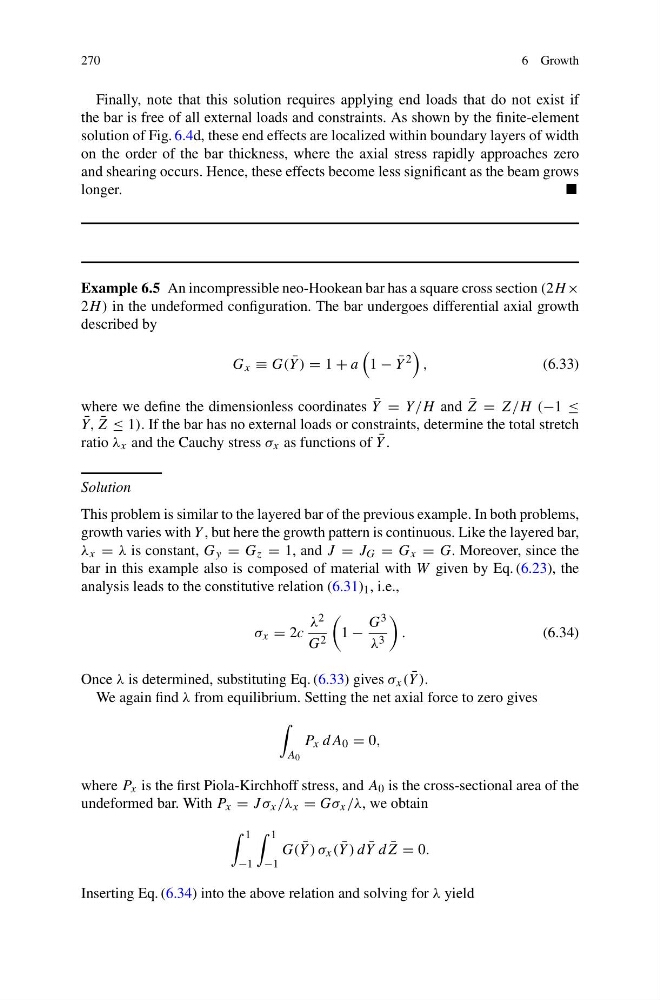
G x ≡ G( ¯
Y ) = 1 + a
1 − ¯
Y
2
,
(6.33)
where we define the dimensionless coordinates ¯
Y = Y/H and ¯
Z = Z/H (−1 ≤
¯
Y, ¯
Z ≤ 1). If the bar has no external loads or constraints, determine the total stretch
ratio λ x and the Cauchy stress σ x as functions of ¯
Y .
Solution
This problem is similar to the layered bar of the previous example. In both problems,
growth varies with Y , but here the growth pattern is continuous. Like the layered bar,
λ x = λ is constant, G y = G z = 1, and J = J G = G x = G. Moreover, since the
bar in this example also is composed of material with W given by Eq. (6.23), the
analysis leads to the constitutive relation (6.31) 1 , i.e.,
σ x = 2c
λ 2
G 2
1 −
G 3
λ 3
.
(6.34)
Once λ is determined, substituting Eq. (6.33) gives σ x ( ¯
Y ).
We again find λ from equilibrium. Setting the net axial force to zero gives
A 0
P x dA 0 = 0,
where P x is the first Piola-Kirchhoff stress, and A 0 is the cross-sectional area of the
undeformed bar. With P x = J σ x /λ x = Gσ x /λ, we obtain
1
−1
1
−1
G( ¯
Y ) σ x ( ¯
Y ) d ¯
Y d ¯
Z = 0.
Inserting Eq. (6.34) into the above relation and solving for λ yield
6 Growth
Finally, note that this solution requires applying end loads that do not exist if
the bar is free of all external loads and constraints. As shown by the finite-element
solution of Fig. 6.4d, these end effects are localized within boundary layers of width
on the order of the bar thickness, where the axial stress rapidly approaches zero
and shearing occurs. Hence, these effects become less significant as the beam grows
longer.
Example 6.5 An incompressible neo-Hookean bar has a square cross section (2H ×
2H ) in the undeformed configuration. The bar undergoes differential axial growth
described by
G x ≡ G( ¯
Y ) = 1 + a
1 − ¯
Y
2
,
(6.33)
where we define the dimensionless coordinates ¯
Y = Y/H and ¯
Z = Z/H (−1 ≤
¯
Y, ¯
Z ≤ 1). If the bar has no external loads or constraints, determine the total stretch
ratio λ x and the Cauchy stress σ x as functions of ¯
Y .
Solution
This problem is similar to the layered bar of the previous example. In both problems,
growth varies with Y , but here the growth pattern is continuous. Like the layered bar,
λ x = λ is constant, G y = G z = 1, and J = J G = G x = G. Moreover, since the
bar in this example also is composed of material with W given by Eq. (6.23), the
analysis leads to the constitutive relation (6.31) 1 , i.e.,
σ x = 2c
λ 2
G 2
1 −
G 3
λ 3
.
(6.34)
Once λ is determined, substituting Eq. (6.33) gives σ x ( ¯
Y ).
We again find λ from equilibrium. Setting the net axial force to zero gives
A 0
P x dA 0 = 0,
where P x is the first Piola-Kirchhoff stress, and A 0 is the cross-sectional area of the
undeformed bar. With P x = J σ x /λ x = Gσ x /λ, we obtain
1
−1
1
−1
G( ¯
Y ) σ x ( ¯
Y ) d ¯
Y d ¯
Z = 0.
Inserting Eq. (6.34) into the above relation and solving for λ yield