

5.4 Mechanical Properties of Contractile Fibers
225
For K(t) given by Eqs. (5.4) and (5.5), this relation gives
c a (t) = c a,max sin
πt
T
(5.23)
for striated muscle and
c a (t) = c a,max
1 − e
−αt
(5.24)
for smooth muscle (see Fig. 5.4b,d), where c a,max , T , and α are to be determined
experimentally.
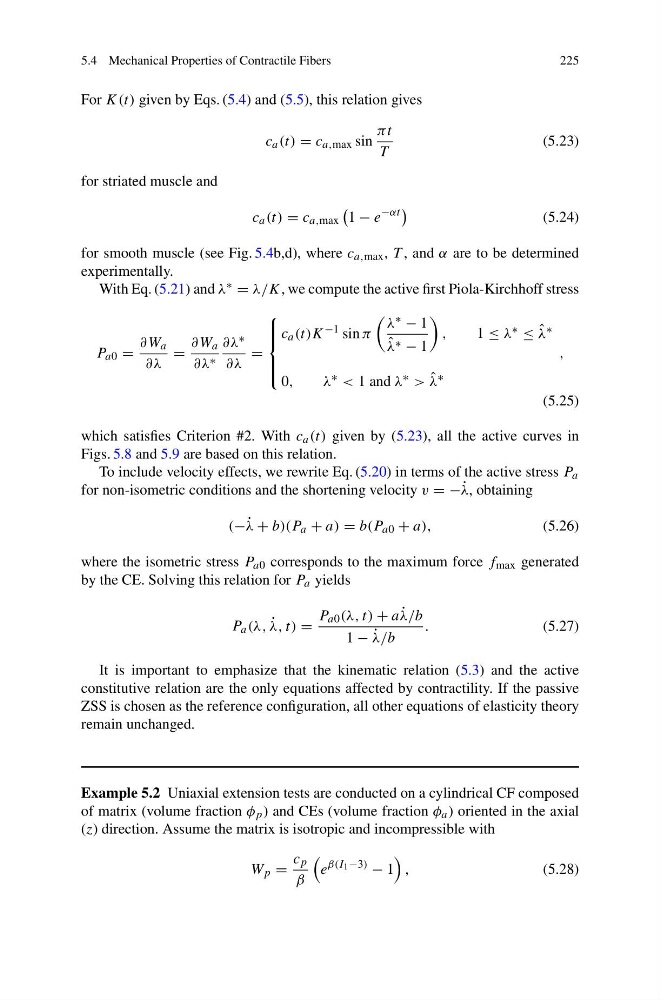
With Eq. (5.21) and λ ∗ = λ/K, we compute the active first Piola-Kirchhoff stress
P a0 =
∂W a
∂λ
=
∂W a
∂λ ∗
∂λ ∗
∂λ
=
⎧
⎪ ⎪ ⎨
⎪ ⎪ ⎩
c a (t)K −1 sin π
λ ∗ − 1
ˆ
λ ∗ − 1
,
1 ≤ λ ∗ ≤ ˆ
λ ∗
0,
λ ∗ < 1 and λ ∗ > ˆ
λ ∗
,
(5.25)
which satisfies Criterion #2. With c a (t) given by (5.23), all the active curves in
Figs. 5.8 and 5.9 are based on this relation.
To include velocity effects, we rewrite Eq. (5.20) in terms of the active stress P a
for non-isometric conditions and the shortening velocity v = − ˙
λ, obtaining
(− ˙
λ + b)(P a + a) = b(P a0 + a),
(5.26)
where the isometric stress P a0 corresponds to the maximum force f max generated
by the CE. Solving this relation for P a yields
P a (λ, ˙
λ, t) =
P a0 (λ, t) + a ˙
λ/b
1 − ˙
λ/b
.
(5.27)
It is important to emphasize that the kinematic relation (5.3) and the active
constitutive relation are the only equations affected by contractility. If the passive
ZSS is chosen as the reference configuration, all other equations of elasticity theory
remain unchanged.
Example 5.2 Uniaxial extension tests are conducted on a cylindrical CF composed
of matrix (volume fraction φ p ) and CEs (volume fraction φ a ) oriented in the axial
(z) direction. Assume the matrix is isotropic and incompressible with
W p =
c p
β
e
β(I 1 −3)
− 1
,
(5.28)
225
For K(t) given by Eqs. (5.4) and (5.5), this relation gives
c a (t) = c a,max sin
πt
T
(5.23)
for striated muscle and
c a (t) = c a,max
1 − e
−αt
(5.24)
for smooth muscle (see Fig. 5.4b,d), where c a,max , T , and α are to be determined
experimentally.
With Eq. (5.21) and λ ∗ = λ/K, we compute the active first Piola-Kirchhoff stress
P a0 =
∂W a
∂λ
=
∂W a
∂λ ∗
∂λ ∗
∂λ
=
⎧
⎪ ⎪ ⎨
⎪ ⎪ ⎩
c a (t)K −1 sin π
λ ∗ − 1
ˆ
λ ∗ − 1
,
1 ≤ λ ∗ ≤ ˆ
λ ∗
0,
λ ∗ < 1 and λ ∗ > ˆ
λ ∗
,
(5.25)
which satisfies Criterion #2. With c a (t) given by (5.23), all the active curves in
Figs. 5.8 and 5.9 are based on this relation.
To include velocity effects, we rewrite Eq. (5.20) in terms of the active stress P a
for non-isometric conditions and the shortening velocity v = − ˙
λ, obtaining
(− ˙
λ + b)(P a + a) = b(P a0 + a),
(5.26)
where the isometric stress P a0 corresponds to the maximum force f max generated
by the CE. Solving this relation for P a yields
P a (λ, ˙
λ, t) =
P a0 (λ, t) + a ˙
λ/b
1 − ˙
λ/b
.
(5.27)
It is important to emphasize that the kinematic relation (5.3) and the active
constitutive relation are the only equations affected by contractility. If the passive
ZSS is chosen as the reference configuration, all other equations of elasticity theory
remain unchanged.
Example 5.2 Uniaxial extension tests are conducted on a cylindrical CF composed
of matrix (volume fraction φ p ) and CEs (volume fraction φ a ) oriented in the axial
(z) direction. Assume the matrix is isotropic and incompressible with
W p =
c p
β
e
β(I 1 −3)
− 1
,
(5.28)