

224
5 Contraction
5.4.3 Constitutive Relation for a Contractile Element
Based on the preceding discussion, a constitutive equation for a general CE must
meet the following criteria:
1. The stress in the passive state (K = 1) is zero.
2. The stress in the active state (0 < K < 1) is approximately 1D and depends
on the stretch ratio λ ∗ = λ/K relative to the active ZSS. In addition, physical
admissibility requires σ a = 0 when λ ∗ = 1 (see Sect. 3.6.3).
3. For isometric contraction, the maximum active stress increases to a peak and then
falls back toward zero with increasing stretch.
4. The stiffness increases as contraction increases (K decreases).
5. Contraction velocity decreases with increasing tension.
To determine a possible form for W a , we first consider the isometric test results
along with the first four criteria. Then, Hill’s equation (5.20) is used to include
velocity effects.
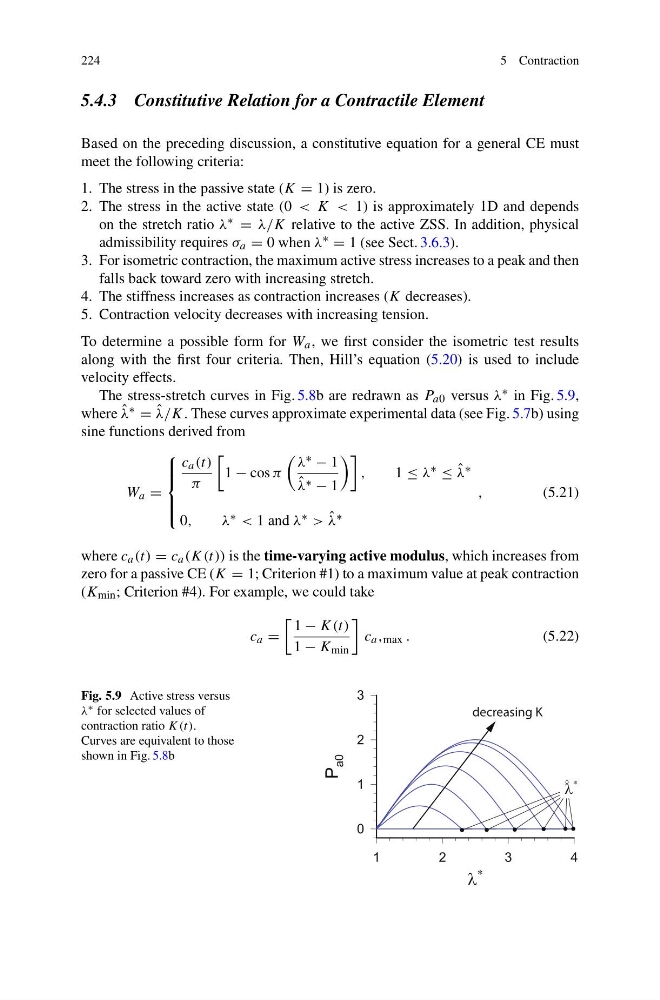
The stress-stretch curves in Fig. 5.8b are redrawn as P a0 versus λ ∗ in Fig. 5.9,
where ˆ
λ ∗ = ˆ
λ/K. These curves approximate experimental data (see Fig. 5.7b) using
sine functions derived from
W a =
⎧
⎪ ⎪ ⎨
⎪ ⎪ ⎩
c a (t)
π
1 − cos π
λ ∗ − 1
ˆ
λ ∗ − 1
,
1 ≤ λ ∗ ≤ ˆ
λ ∗
0,
λ ∗ < 1 and λ ∗ > ˆ
λ ∗
,
(5.21)
where c a (t) = c a (K(t)) is the time-varying active modulus, which increases from
zero for a passive CE (K = 1; Criterion #1) to a maximum value at peak contraction
(K min ; Criterion #4). For example, we could take
c a =
1 − K(t)
1 − K min
c a , max .
(5.22)
Fig. 5.9 Active stress versus
λ ∗ for selected values of
contraction ratio K(t).
Curves are equivalent to those
shown in Fig. 5.8b
λ
*
∧
decreasing K
5 Contraction
5.4.3 Constitutive Relation for a Contractile Element
Based on the preceding discussion, a constitutive equation for a general CE must
meet the following criteria:
1. The stress in the passive state (K = 1) is zero.
2. The stress in the active state (0 < K < 1) is approximately 1D and depends
on the stretch ratio λ ∗ = λ/K relative to the active ZSS. In addition, physical
admissibility requires σ a = 0 when λ ∗ = 1 (see Sect. 3.6.3).
3. For isometric contraction, the maximum active stress increases to a peak and then
falls back toward zero with increasing stretch.
4. The stiffness increases as contraction increases (K decreases).
5. Contraction velocity decreases with increasing tension.
To determine a possible form for W a , we first consider the isometric test results
along with the first four criteria. Then, Hill’s equation (5.20) is used to include
velocity effects.
The stress-stretch curves in Fig. 5.8b are redrawn as P a0 versus λ ∗ in Fig. 5.9,
where ˆ
λ ∗ = ˆ
λ/K. These curves approximate experimental data (see Fig. 5.7b) using
sine functions derived from
W a =
⎧
⎪ ⎪ ⎨
⎪ ⎪ ⎩
c a (t)
π
1 − cos π
λ ∗ − 1
ˆ
λ ∗ − 1
,
1 ≤ λ ∗ ≤ ˆ
λ ∗
0,
λ ∗ < 1 and λ ∗ > ˆ
λ ∗
,
(5.21)
where c a (t) = c a (K(t)) is the time-varying active modulus, which increases from
zero for a passive CE (K = 1; Criterion #1) to a maximum value at peak contraction
(K min ; Criterion #4). For example, we could take
c a =
1 − K(t)
1 − K min
c a , max .
(5.22)
Fig. 5.9 Active stress versus
λ ∗ for selected values of
contraction ratio K(t).
Curves are equivalent to those
shown in Fig. 5.8b
λ
*
∧
decreasing K