

206
4 Problems in Soft Tissue Biomechanics
Note that, for an incompressible material (ν = 0.5), this relation agrees
with the solution given in Problem 4.7 for a neo-Hookean membrane, i.e.,
W = c(I 1 − 3).
4.9 Write a computer program to solve the problem in Sect. 4.6 for inflation of a
spherical shell. For a 0 /h 0 = 5, use the program to reproduce the results in
Fig. 4.14a, and plot the stress σ θ /c 1 across the deformed wall for a = 4a 0 and
c 2 = 0.5. Solve the problem using a grid based on (a) the material coordinate
R and (b) the spatial coordinate r.
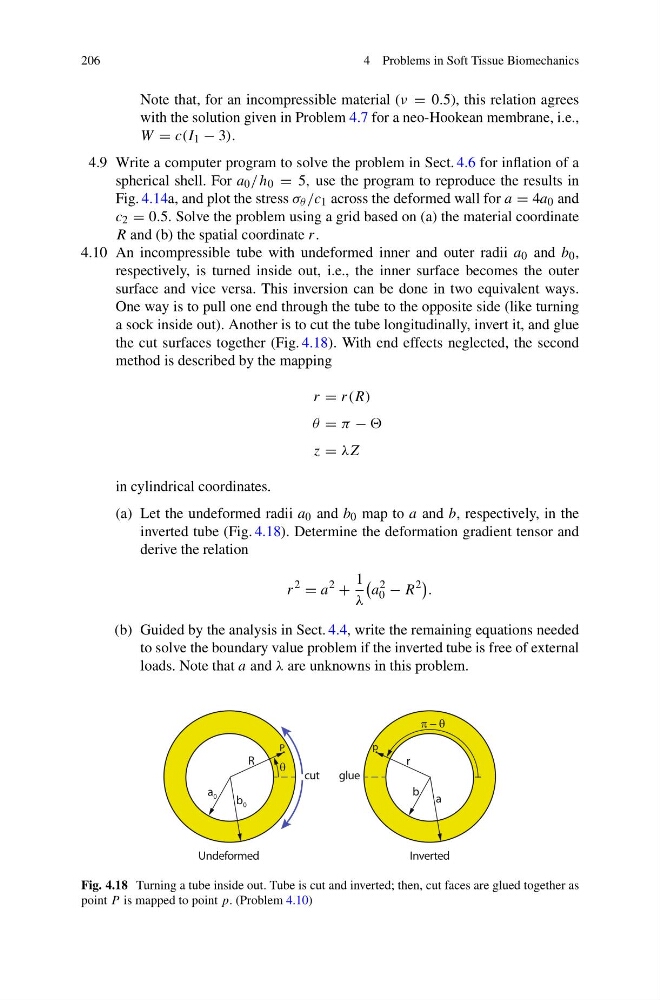
4.10 An incompressible tube with undeformed inner and outer radii a 0 and b 0 ,
respectively, is turned inside out, i.e., the inner surface becomes the outer
surface and vice versa. This inversion can be done in two equivalent ways.
One way is to pull one end through the tube to the opposite side (like turning
a sock inside out). Another is to cut the tube longitudinally, invert it, and glue
the cut surfaces together (Fig. 4.18). With end effects neglected, the second
method is described by the mapping
r = r(R)
θ = π −
z = λZ
in cylindrical coordinates.
(a) Let the undeformed radii a 0 and b 0 map to a and b, respectively, in the
inverted tube (Fig. 4.18). Determine the deformation gradient tensor and
derive the relation
r
2
= a
2
+
1
λ
a
2
0 − R
2
.
(b) Guided by the analysis in Sect. 4.4, write the remaining equations needed
to solve the boundary value problem if the inverted tube is free of external
loads. Note that a and λ are unknowns in this problem.
P
R
θ
a 0
b 0
P
r
π − θ
b a
cut
glue
P
p
d
e
t
r
e
v
n
I
d
e
m
r
o
f
e
d
n
U
Fig. 4.18 Turning a tube inside out. Tube is cut and inverted; then, cut faces are glued together as
point P is mapped to point p. (Problem 4.10)
4 Problems in Soft Tissue Biomechanics
Note that, for an incompressible material (ν = 0.5), this relation agrees
with the solution given in Problem 4.7 for a neo-Hookean membrane, i.e.,
W = c(I 1 − 3).
4.9 Write a computer program to solve the problem in Sect. 4.6 for inflation of a
spherical shell. For a 0 /h 0 = 5, use the program to reproduce the results in
Fig. 4.14a, and plot the stress σ θ /c 1 across the deformed wall for a = 4a 0 and
c 2 = 0.5. Solve the problem using a grid based on (a) the material coordinate
R and (b) the spatial coordinate r.
4.10 An incompressible tube with undeformed inner and outer radii a 0 and b 0 ,
respectively, is turned inside out, i.e., the inner surface becomes the outer
surface and vice versa. This inversion can be done in two equivalent ways.
One way is to pull one end through the tube to the opposite side (like turning
a sock inside out). Another is to cut the tube longitudinally, invert it, and glue
the cut surfaces together (Fig. 4.18). With end effects neglected, the second
method is described by the mapping
r = r(R)
θ = π −
z = λZ
in cylindrical coordinates.
(a) Let the undeformed radii a 0 and b 0 map to a and b, respectively, in the
inverted tube (Fig. 4.18). Determine the deformation gradient tensor and
derive the relation
r
2
= a
2
+
1
λ
a
2
0 − R
2
.
(b) Guided by the analysis in Sect. 4.4, write the remaining equations needed
to solve the boundary value problem if the inverted tube is free of external
loads. Note that a and λ are unknowns in this problem.
P
R
θ
a 0
b 0
P
r
π − θ
b a
cut
glue
P
p
d
e
t
r
e
v
n
I
d
e
m
r
o
f
e
d
n
U
Fig. 4.18 Turning a tube inside out. Tube is cut and inverted; then, cut faces are glued together as
point P is mapped to point p. (Problem 4.10)