

4.7 Bending of a Block
205
where ψ is the angle of twist per unit undeformed length, and λ is the axial
stretch ratio. The tube is composed of incompressible material with
W = c 1 (I 1 − 3) + c 2 (I 2 − 3).
If λ, ψ, and the deformed inner radius a are specified, write all the equations
needed to compute the internal pressure p i , the axial force N , and the twisting
moment M. List the steps required to carry out the computation.
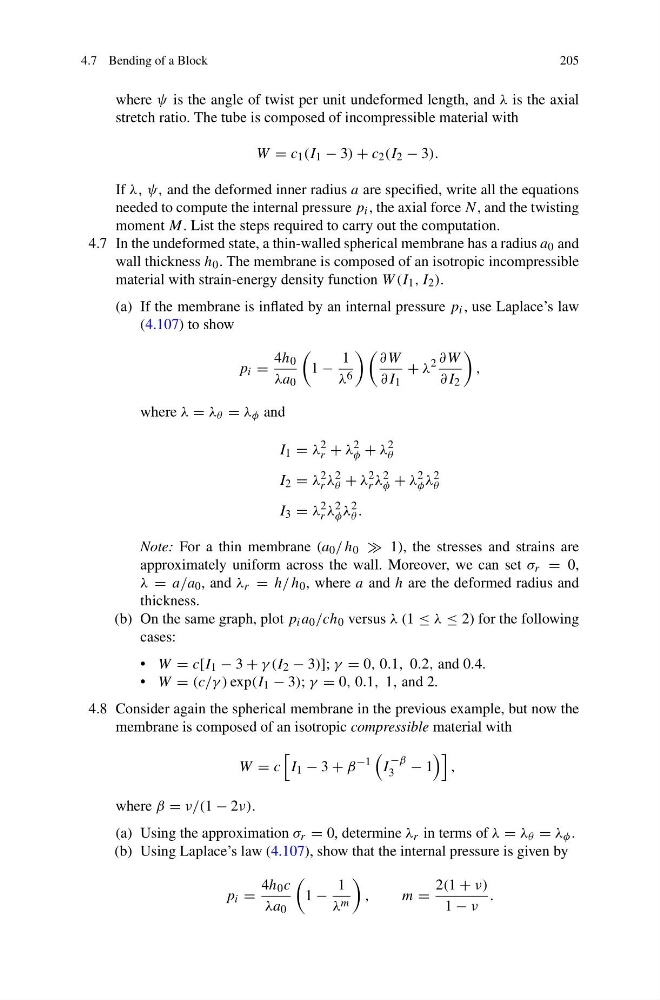
4.7 In the undeformed state, a thin-walled spherical membrane has a radius a 0 and
wall thickness h 0 . The membrane is composed of an isotropic incompressible
material with strain-energy density function W (I 1 , I 2 ).
(a) If the membrane is inflated by an internal pressure p i , use Laplace’s law
(4.107) to show
p i =
4h 0
λa 0
1 −
1
λ 6
∂W
∂I 1
+ λ
2 ∂W
∂I 2
,
where λ = λ θ = λ φ and
I 1 = λ
2
r + λ
2
φ + λ
2
θ
I 2 = λ
2
r λ
2
θ + λ
2
r λ
2
φ + λ
2
φ λ
2
θ
I 3 = λ
2
r λ
2
φ λ
2
θ .
Note: For a thin membrane (a 0 /h 0 1), the stresses and strains are
approximately uniform across the wall. Moreover, we can set σ r = 0,
λ = a/a 0 , and λ r = h/ h 0 , where a and h are the deformed radius and
thickness.
(b) On the same graph, plot p i a 0 /ch 0 versus λ (1 ≤ λ ≤ 2) for the following
cases:
• W = c[I 1 − 3 + γ (I 2 − 3)]; γ = 0, 0.1, 0.2, and 0.4.
• W = (c/γ ) exp(I 1 − 3); γ = 0, 0.1, 1, and 2.
4.8 Consider again the spherical membrane in the previous example, but now the
membrane is composed of an isotropic compressible material with
W = c
I 1 − 3 + β
−1
I
−β
3 − 1
,
where β = ν/(1 − 2ν).
(a) Using the approximation σ r = 0, determine λ r in terms of λ = λ θ = λ φ .
(b) Using Laplace’s law (4.107), show that the internal pressure is given by
p i =
4h 0 c
λa 0
1 −
1
λ m
,
m=
2(1 + ν)
1 − ν
.
205
where ψ is the angle of twist per unit undeformed length, and λ is the axial
stretch ratio. The tube is composed of incompressible material with
W = c 1 (I 1 − 3) + c 2 (I 2 − 3).
If λ, ψ, and the deformed inner radius a are specified, write all the equations
needed to compute the internal pressure p i , the axial force N , and the twisting
moment M. List the steps required to carry out the computation.
4.7 In the undeformed state, a thin-walled spherical membrane has a radius a 0 and
wall thickness h 0 . The membrane is composed of an isotropic incompressible
material with strain-energy density function W (I 1 , I 2 ).
(a) If the membrane is inflated by an internal pressure p i , use Laplace’s law
(4.107) to show
p i =
4h 0
λa 0
1 −
1
λ 6
∂W
∂I 1
+ λ
2 ∂W
∂I 2
,
where λ = λ θ = λ φ and
I 1 = λ
2
r + λ
2
φ + λ
2
θ
I 2 = λ
2
r λ
2
θ + λ
2
r λ
2
φ + λ
2
φ λ
2
θ
I 3 = λ
2
r λ
2
φ λ
2
θ .
Note: For a thin membrane (a 0 /h 0 1), the stresses and strains are
approximately uniform across the wall. Moreover, we can set σ r = 0,
λ = a/a 0 , and λ r = h/ h 0 , where a and h are the deformed radius and
thickness.
(b) On the same graph, plot p i a 0 /ch 0 versus λ (1 ≤ λ ≤ 2) for the following
cases:
• W = c[I 1 − 3 + γ (I 2 − 3)]; γ = 0, 0.1, 0.2, and 0.4.
• W = (c/γ ) exp(I 1 − 3); γ = 0, 0.1, 1, and 2.
4.8 Consider again the spherical membrane in the previous example, but now the
membrane is composed of an isotropic compressible material with
W = c
I 1 − 3 + β
−1
I
−β
3 − 1
,
where β = ν/(1 − 2ν).
(a) Using the approximation σ r = 0, determine λ r in terms of λ = λ θ = λ φ .
(b) Using Laplace’s law (4.107), show that the internal pressure is given by
p i =
4h 0 c
λa 0
1 −
1
λ m
,
m=
2(1 + ν)
1 − ν
.