

198
4 Problems in Soft Tissue Biomechanics
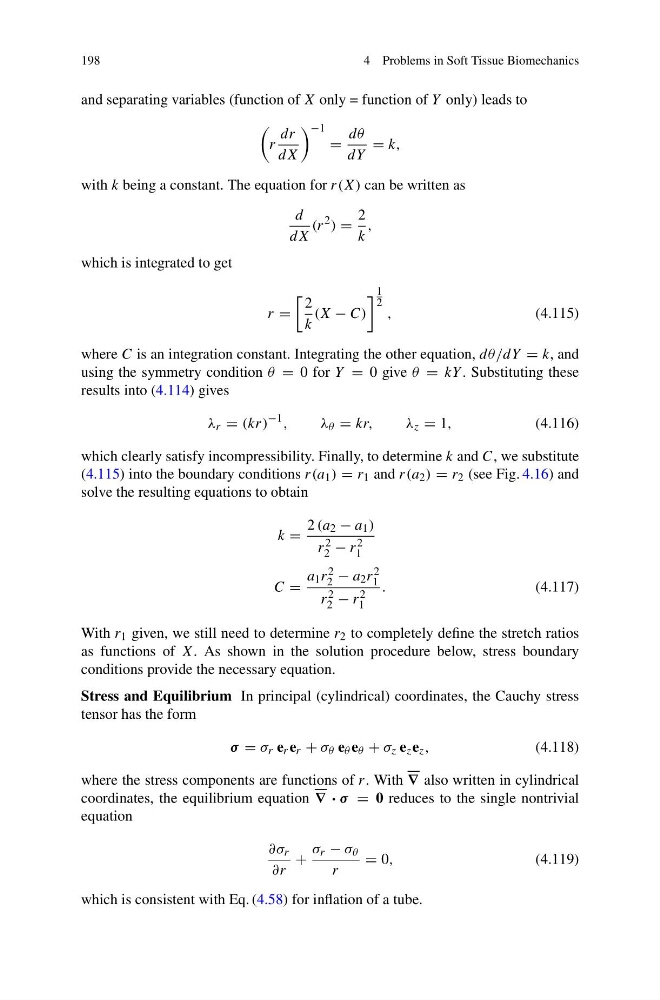
and separating variables (function of X only = function of Y only) leads to
r
dr
dX
−1
=
dθ
dY
= k,
with k being a constant. The equation for r(X) can be written as
d
dX
(r
2 ) =
2
k
,
which is integrated to get
r =
2
k
(X − C)
1
2
,
(4.115)
where C is an integration constant. Integrating the other equation, dθ/dY = k, and
using the symmetry condition θ = 0 for Y = 0 give θ = kY . Substituting these
results into (4.114) gives
λ r = (kr)
−1 ,
λ θ = kr,
λ z = 1,
(4.116)
which clearly satisfy incompressibility. Finally, to determine k and C, we substitute
(4.115) into the boundary conditions r(a 1 ) = r 1 and r(a 2 ) = r 2 (see Fig. 4.16) and
solve the resulting equations to obtain
k =
2 (a 2 − a 1 )
r 2
2 − r 2
1
C =
a 1 r 2
2 − a 2 r 2
1
r 2
2 − r 2
1
.
(4.117)
With r 1 given, we still need to determine r 2 to completely define the stretch ratios
as functions of X. As shown in the solution procedure below, stress boundary
conditions provide the necessary equation.
Stress and Equilibrium In principal (cylindrical) coordinates, the Cauchy stress
tensor has the form
σ = σ r e r e r + σ θ e θ e θ + σ z e z e z ,
(4.118)
where the stress components are functions of r. With ∇ also written in cylindrical
coordinates, the equilibrium equation ∇ · σ = 0 reduces to the single nontrivial
equation
∂σ r
∂r
+
σ r − σ θ
r
= 0,
(4.119)
which is consistent with Eq. (4.58) for inflation of a tube.
4 Problems in Soft Tissue Biomechanics
and separating variables (function of X only = function of Y only) leads to
r
dr
dX
−1
=
dθ
dY
= k,
with k being a constant. The equation for r(X) can be written as
d
dX
(r
2 ) =
2
k
,
which is integrated to get
r =
2
k
(X − C)
1
2
,
(4.115)
where C is an integration constant. Integrating the other equation, dθ/dY = k, and
using the symmetry condition θ = 0 for Y = 0 give θ = kY . Substituting these
results into (4.114) gives
λ r = (kr)
−1 ,
λ θ = kr,
λ z = 1,
(4.116)
which clearly satisfy incompressibility. Finally, to determine k and C, we substitute
(4.115) into the boundary conditions r(a 1 ) = r 1 and r(a 2 ) = r 2 (see Fig. 4.16) and
solve the resulting equations to obtain
k =
2 (a 2 − a 1 )
r 2
2 − r 2
1
C =
a 1 r 2
2 − a 2 r 2
1
r 2
2 − r 2
1
.
(4.117)
With r 1 given, we still need to determine r 2 to completely define the stretch ratios
as functions of X. As shown in the solution procedure below, stress boundary
conditions provide the necessary equation.
Stress and Equilibrium In principal (cylindrical) coordinates, the Cauchy stress
tensor has the form
σ = σ r e r e r + σ θ e θ e θ + σ z e z e z ,
(4.118)
where the stress components are functions of r. With ∇ also written in cylindrical
coordinates, the equilibrium equation ∇ · σ = 0 reduces to the single nontrivial
equation
∂σ r
∂r
+
σ r − σ θ
r
= 0,
(4.119)
which is consistent with Eq. (4.58) for inflation of a tube.