

190
4 Problems in Soft Tissue Biomechanics
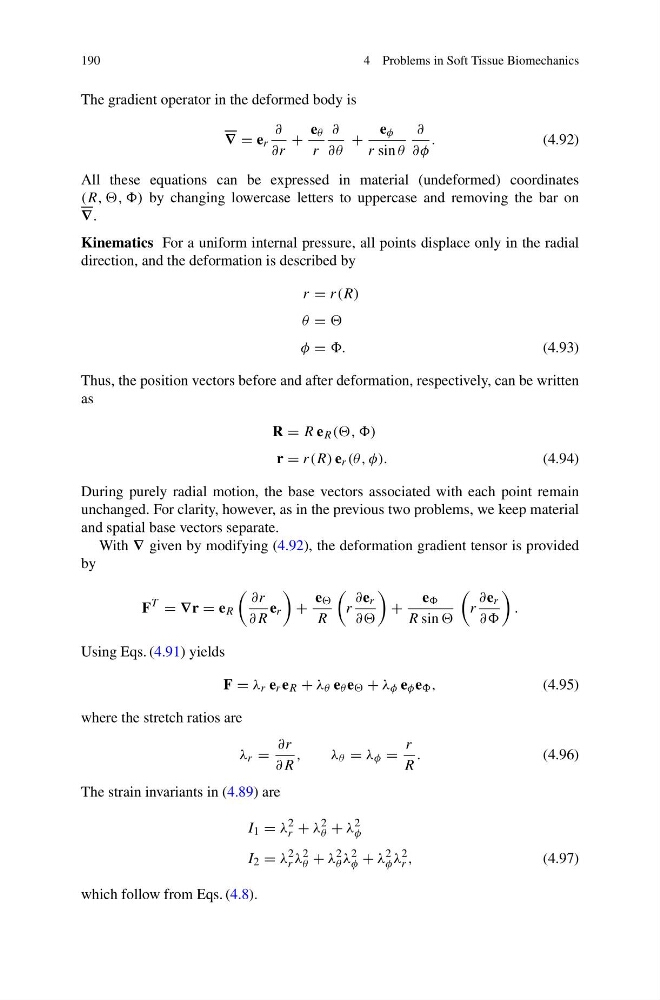
The gradient operator in the deformed body is
∇ = e r
∂
∂r
+
e θ
r
∂
∂θ
+
e φ
r sin θ
∂
∂φ
.
(4.92)
All these equations can be expressed in material (undeformed) coordinates
(R, ,, ,) by changing lowercase letters to uppercase and removing the bar on
∇.
Kinematics For a uniform internal pressure, all points displace only in the radial
direction, and the deformation is described by
r = r(R)
θ =
φ = .
(4.93)
Thus, the position vectors before and after deformation, respectively, can be written
as
R = R e R ((, ,)
r = r(R) e r (θ, φ).
(4.94)
During purely radial motion, the base vectors associated with each point remain
unchanged. For clarity, however, as in the previous two problems, we keep material
and spatial base vectors separate.
With ∇ given by modifying (4.92), the deformation gradient tensor is provided
by
F
T
= ∇r = e R
∂r
∂R
e r
+
e
R
r
∂e r
∂∂
+
e
R sin
r
∂e r
∂∂
.
Using Eqs. (4.91) yields
F = λ r e r e R + λ θ e θ e + λ φ e φ e ,
(4.95)
where the stretch ratios are
λ r =
∂r
∂R
,
λ θ = λ φ =
r
R
.
(4.96)
The strain invariants in (4.89) are
I 1 = λ
2
r + λ
2
θ + λ
2
φ
I 2 = λ
2
r λ
2
θ + λ
2
θ λ
2
φ + λ
2
φ λ
2
r ,
(4.97)
which follow from Eqs. (4.8).
4 Problems in Soft Tissue Biomechanics
The gradient operator in the deformed body is
∇ = e r
∂
∂r
+
e θ
r
∂
∂θ
+
e φ
r sin θ
∂
∂φ
.
(4.92)
All these equations can be expressed in material (undeformed) coordinates
(R, ,, ,) by changing lowercase letters to uppercase and removing the bar on
∇.
Kinematics For a uniform internal pressure, all points displace only in the radial
direction, and the deformation is described by
r = r(R)
θ =
φ = .
(4.93)
Thus, the position vectors before and after deformation, respectively, can be written
as
R = R e R ((, ,)
r = r(R) e r (θ, φ).
(4.94)
During purely radial motion, the base vectors associated with each point remain
unchanged. For clarity, however, as in the previous two problems, we keep material
and spatial base vectors separate.
With ∇ given by modifying (4.92), the deformation gradient tensor is provided
by
F
T
= ∇r = e R
∂r
∂R
e r
+
e
R
r
∂e r
∂∂
+
e
R sin
r
∂e r
∂∂
.
Using Eqs. (4.91) yields
F = λ r e r e R + λ θ e θ e + λ φ e φ e ,
(4.95)
where the stretch ratios are
λ r =
∂r
∂R
,
λ θ = λ φ =
r
R
.
(4.96)
The strain invariants in (4.89) are
I 1 = λ
2
r + λ
2
θ + λ
2
φ
I 2 = λ
2
r λ
2
θ + λ
2
θ λ
2
φ + λ
2
φ λ
2
r ,
(4.97)
which follow from Eqs. (4.8).