

4.6 Inflation of a Spherical Shell
189
A uniform cavity pressure p i inflates (or deflates) the shell into a sphere of specified
inner radius a. (Any potential buckling at negative pressure is not considered.)
Determine p i as a function of a.
4.6.2 Analysis
The analysis of this problem is like that of the cylinder inflation problem, but,
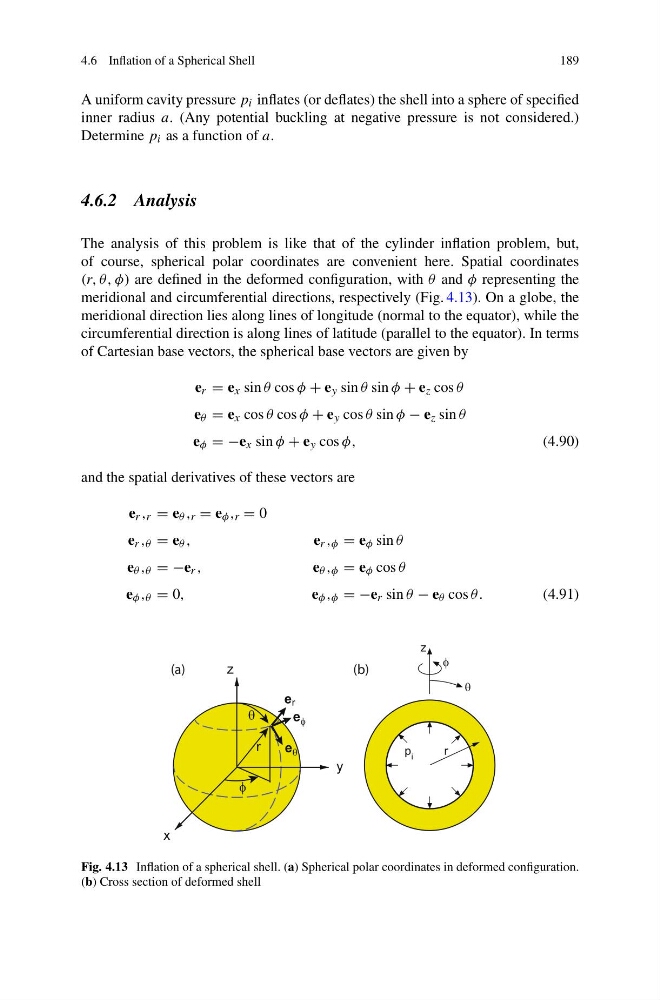
of course, spherical polar coordinates are convenient here. Spatial coordinates
(r, θ, φ) are defined in the deformed configuration, with θ and φ representing the
meridional and circumferential directions, respectively (Fig. 4.13). On a globe, the
meridional direction lies along lines of longitude (normal to the equator), while the
circumferential direction is along lines of latitude (parallel to the equator). In terms
of Cartesian base vectors, the spherical base vectors are given by
e r = e x sin θ cos φ + e y sin θ sin φ + e z cos θ
e θ = e x cos θ cos φ + e y cos θ sin φ − e z sin θ
e φ = −e x sin φ + e y cos φ,
(4.90)
and the spatial derivatives of these vectors are
e r , r = e θ , r = e φ , r = 0
e r , θ = e θ ,
e r , φ = e φ sin θ
e θ , θ = −e r ,
e θ , φ = e φ cos θ
e φ , θ = 0,
e φ , φ = −e r sin θ − e θ cos θ.
(4.91)
P
r
z
θ
φ
p i
)
b
(
)
a
(
φ
θ
r
x
y
z
e r
e φ
e θ
Fig. 4.13 Inflation of a spherical shell. (a) Spherical polar coordinates in deformed configuration.
(b) Cross section of deformed shell
189
A uniform cavity pressure p i inflates (or deflates) the shell into a sphere of specified
inner radius a. (Any potential buckling at negative pressure is not considered.)
Determine p i as a function of a.
4.6.2 Analysis
The analysis of this problem is like that of the cylinder inflation problem, but,
of course, spherical polar coordinates are convenient here. Spatial coordinates
(r, θ, φ) are defined in the deformed configuration, with θ and φ representing the
meridional and circumferential directions, respectively (Fig. 4.13). On a globe, the
meridional direction lies along lines of longitude (normal to the equator), while the
circumferential direction is along lines of latitude (parallel to the equator). In terms
of Cartesian base vectors, the spherical base vectors are given by
e r = e x sin θ cos φ + e y sin θ sin φ + e z cos θ
e θ = e x cos θ cos φ + e y cos θ sin φ − e z sin θ
e φ = −e x sin φ + e y cos φ,
(4.90)
and the spatial derivatives of these vectors are
e r , r = e θ , r = e φ , r = 0
e r , θ = e θ ,
e r , φ = e φ sin θ
e θ , θ = −e r ,
e θ , φ = e φ cos θ
e φ , θ = 0,
e φ , φ = −e r sin θ − e θ cos θ.
(4.91)
P
r
z
θ
φ
p i
)
b
(
)
a
(
φ
θ
r
x
y
z
e r
e φ
e θ
Fig. 4.13 Inflation of a spherical shell. (a) Spherical polar coordinates in deformed configuration.
(b) Cross section of deformed shell