

168
4 Problems in Soft Tissue Biomechanics
For the special case k = 0.5, these equations give the principal strains
(E 1 , E 2 , E 3 ) = (0.320, −0.195, 0). The corresponding principal directions, as
defined by the unit vectors N i = N i /| N i |, are N 1 = 0.615 e x + 0.788 e y ,
N 2 = −0.788 e x + 0.615 e y , and N 3 = e z . These vectors define the orientation
of a differential element in the undeformed configuration that experiences no
shear during deformation. In other words, a rectangular element with this initial
orientation undergoes the normal strains E 1 , E 2 , and E 3 in the N 1 , N 2 , and
N 3 directions, respectively. As it deforms, the element also undergoes rigid-body
rotation, with the unit eigenvectors rotating into the unit vectors
n i =
F · N i
|F · N i |
.
This relation yields n 1 = 0.788 e x + 0.615 e y , n 2 = −0.615 e x + 0.788 e y , and
n 3 = e z .
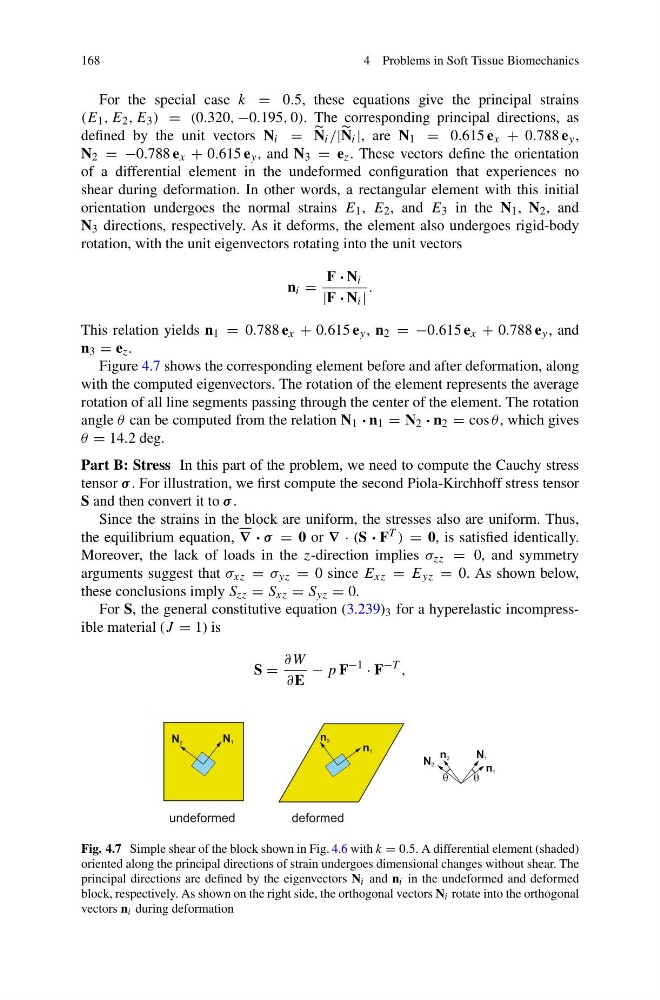
Figure 4.7 shows the corresponding element before and after deformation, along
with the computed eigenvectors. The rotation of the element represents the average
rotation of all line segments passing through the center of the element. The rotation
angle θ can be computed from the relation N 1 · n 1 = N 2 · n 2 = cos θ , which gives
θ = 14.2 deg.
Part B: Stress In this part of the problem, we need to compute the Cauchy stress
tensor σ . For illustration, we first compute the second Piola-Kirchhoff stress tensor
S and then convert it to σ .
Since the strains in the block are uniform, the stresses also are uniform. Thus,
the equilibrium equation, ∇ · σ = 0 or ∇ · (S · F T ) = 0, is satisfied identically.
Moreover, the lack of loads in the z-direction implies σ zz = 0, and symmetry
arguments suggest that σ xz = σ yz = 0 since E xz = E yz = 0. As shown below,
these conclusions imply S zz = S xz = S yz = 0.
For S, the general constitutive equation (3.239) 3 for a hyperelastic incompressible material (J = 1) is
S =
∂W
∂E
− p F
−1
· F
−T ,
N 1
N 2
n 1
n 2
undeformed
deformed
N 1
N 2
n 1
n 2
θ
θ
Fig. 4.7 Simple shear of the block shown in Fig. 4.6 with k = 0.5. A differential element (shaded)
oriented along the principal directions of strain undergoes dimensional changes without shear. The
principal directions are defined by the eigenvectors N i and n i in the undeformed and deformed
block, respectively. As shown on the right side, the orthogonal vectors N i rotate into the orthogonal
vectors n i during deformation
4 Problems in Soft Tissue Biomechanics
For the special case k = 0.5, these equations give the principal strains
(E 1 , E 2 , E 3 ) = (0.320, −0.195, 0). The corresponding principal directions, as
defined by the unit vectors N i = N i /| N i |, are N 1 = 0.615 e x + 0.788 e y ,
N 2 = −0.788 e x + 0.615 e y , and N 3 = e z . These vectors define the orientation
of a differential element in the undeformed configuration that experiences no
shear during deformation. In other words, a rectangular element with this initial
orientation undergoes the normal strains E 1 , E 2 , and E 3 in the N 1 , N 2 , and
N 3 directions, respectively. As it deforms, the element also undergoes rigid-body
rotation, with the unit eigenvectors rotating into the unit vectors
n i =
F · N i
|F · N i |
.
This relation yields n 1 = 0.788 e x + 0.615 e y , n 2 = −0.615 e x + 0.788 e y , and
n 3 = e z .
Figure 4.7 shows the corresponding element before and after deformation, along
with the computed eigenvectors. The rotation of the element represents the average
rotation of all line segments passing through the center of the element. The rotation
angle θ can be computed from the relation N 1 · n 1 = N 2 · n 2 = cos θ , which gives
θ = 14.2 deg.
Part B: Stress In this part of the problem, we need to compute the Cauchy stress
tensor σ . For illustration, we first compute the second Piola-Kirchhoff stress tensor
S and then convert it to σ .
Since the strains in the block are uniform, the stresses also are uniform. Thus,
the equilibrium equation, ∇ · σ = 0 or ∇ · (S · F T ) = 0, is satisfied identically.
Moreover, the lack of loads in the z-direction implies σ zz = 0, and symmetry
arguments suggest that σ xz = σ yz = 0 since E xz = E yz = 0. As shown below,
these conclusions imply S zz = S xz = S yz = 0.
For S, the general constitutive equation (3.239) 3 for a hyperelastic incompressible material (J = 1) is
S =
∂W
∂E
− p F
−1
· F
−T ,
N 1
N 2
n 1
n 2
undeformed
deformed
N 1
N 2
n 1
n 2
θ
θ
Fig. 4.7 Simple shear of the block shown in Fig. 4.6 with k = 0.5. A differential element (shaded)
oriented along the principal directions of strain undergoes dimensional changes without shear. The
principal directions are defined by the eigenvectors N i and n i in the undeformed and deformed
block, respectively. As shown on the right side, the orthogonal vectors N i rotate into the orthogonal
vectors n i during deformation