

3.6 Constitutive Relations
133
σ = J
−1 F ·
∂W
∂E
· F
T
P =
∂W
∂E
· F
T .
(3.209)
If P is used as the stress tensor of choice, an alternative form may be useful. With
W = W (F), Eqs. (3.189) and (3.207) give
P : ˙
F
T
= ˙
W (F),
(3.210)
and manipulations similar to those given above yield
P =
∂W
∂F T .
(3.211)
This form of the constitutive equation relates the tensors P and F, which are
generally not symmetric.
3.6.2 Incompressible Material
The constitutive equations must be modified if the material is incompressible. To
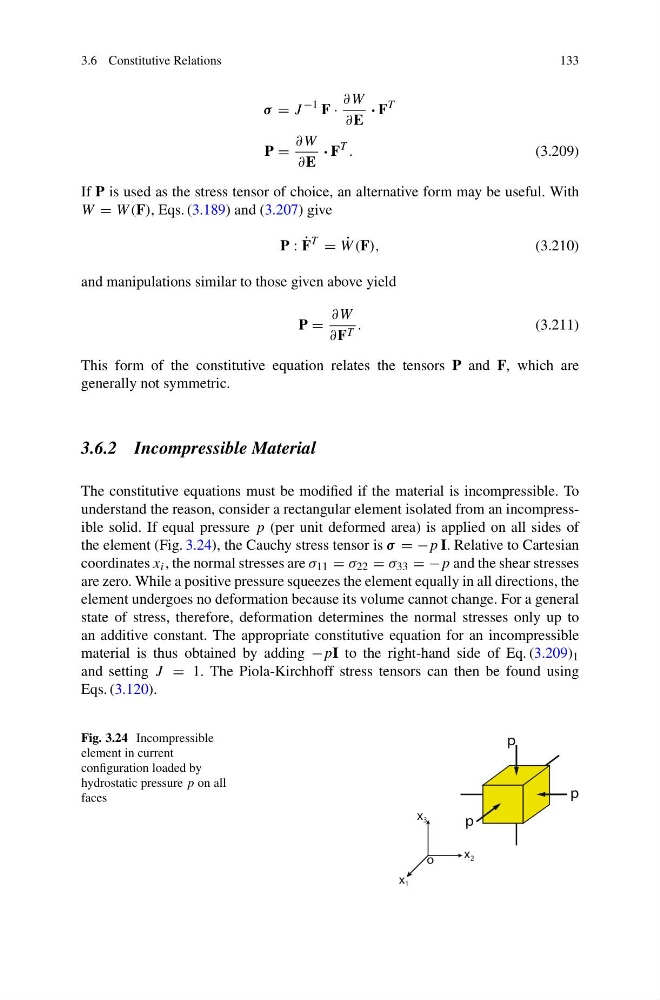
understand the reason, consider a rectangular element isolated from an incompressible solid. If equal pressure p (per unit deformed area) is applied on all sides of
the element (Fig. 3.24), the Cauchy stress tensor is σ = −p I. Relative to Cartesian
coordinates x i , the normal stresses are σ 11 = σ 22 = σ 33 = −p and the shear stresses
are zero. While a positive pressure squeezes the element equally in all directions, the
element undergoes no deformation because its volume cannot change. For a general
state of stress, therefore, deformation determines the normal stresses only up to
an additive constant. The appropriate constitutive equation for an incompressible
material is thus obtained by adding −pI to the right-hand side of Eq. (3.209) 1
and setting J = 1. The Piola-Kirchhoff stress tensors can then be found using
Eqs. (3.120).
Fig. 3.24 Incompressible
element in current
configuration loaded by
hydrostatic pressure p on all
faces
x 2
x 1
x 3
o
p
p
p
133
σ = J
−1 F ·
∂W
∂E
· F
T
P =
∂W
∂E
· F
T .
(3.209)
If P is used as the stress tensor of choice, an alternative form may be useful. With
W = W (F), Eqs. (3.189) and (3.207) give
P : ˙
F
T
= ˙
W (F),
(3.210)
and manipulations similar to those given above yield
P =
∂W
∂F T .
(3.211)
This form of the constitutive equation relates the tensors P and F, which are
generally not symmetric.
3.6.2 Incompressible Material
The constitutive equations must be modified if the material is incompressible. To
understand the reason, consider a rectangular element isolated from an incompressible solid. If equal pressure p (per unit deformed area) is applied on all sides of
the element (Fig. 3.24), the Cauchy stress tensor is σ = −p I. Relative to Cartesian
coordinates x i , the normal stresses are σ 11 = σ 22 = σ 33 = −p and the shear stresses
are zero. While a positive pressure squeezes the element equally in all directions, the
element undergoes no deformation because its volume cannot change. For a general
state of stress, therefore, deformation determines the normal stresses only up to
an additive constant. The appropriate constitutive equation for an incompressible
material is thus obtained by adding −pI to the right-hand side of Eq. (3.209) 1
and setting J = 1. The Piola-Kirchhoff stress tensors can then be found using
Eqs. (3.120).
Fig. 3.24 Incompressible
element in current
configuration loaded by
hydrostatic pressure p on all
faces
x 2
x 1
x 3
o
p
p
p