

110
3 Continuum Mechanics and Nonlinear Elasticity
where dA dx is the deformed volume of the element and a(x, t) is the acceleration
in the x-direction. Simplifying this relation gives the differential equation of motion
∂σ
∂x
+ b = ρa.
(3.139)
To write this equation in material form, we set dx = λ dX and σ = λP /J [see
Eq. (3.99)], where λ is the stretch ratio, J is the volume ratio, and P (X, t) is the first
Piola-Kirchhoff stress. Putting these relations into (3.139) and multiplying through
by J yield
∂P
∂X
+ J b = Jρa.
With ρ 0 = ρJ from (3.134) and b 0 = J b being the body force per unit undeformed
volume, this relation becomes
∂P
∂X
+ b 0 = ρ 0 a,
(3.140)
in which a = a(x(X, t), t) = a(X, t) is the material form of the acceleration field.
Equation of Motion in 2D
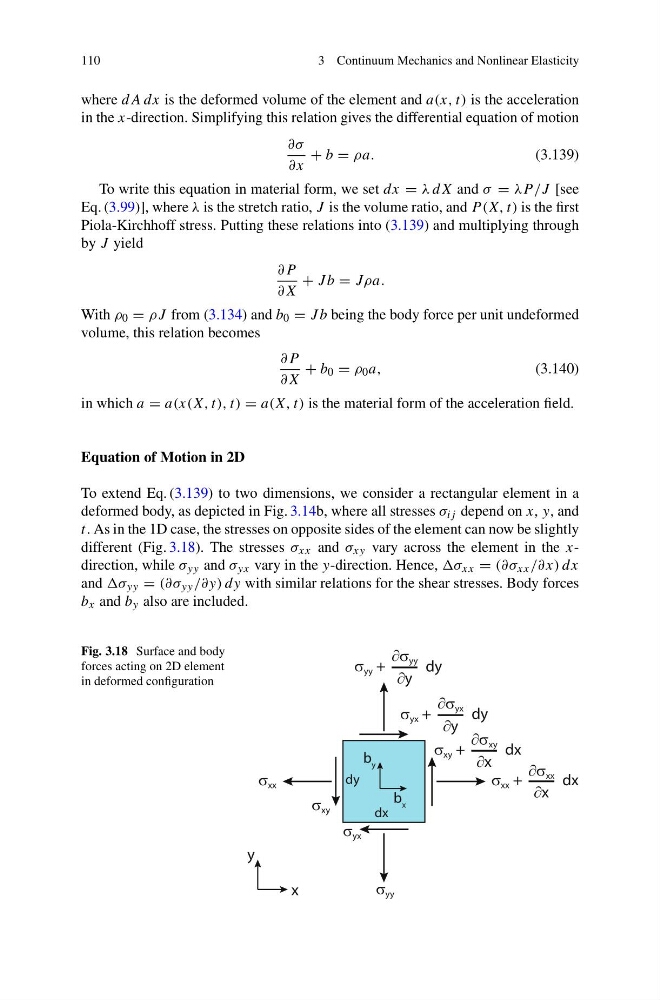
To extend Eq. (3.139) to two dimensions, we consider a rectangular element in a
deformed body, as depicted in Fig. 3.14b, where all stresses σ ij depend on x, y, and
t. As in the 1D case, the stresses on opposite sides of the element can now be slightly
different (Fig. 3.18). The stresses σ xx and σ xy vary across the element in the xdirection, while σ yy and σ yx vary in the y-direction. Hence, σ xx = (∂σ xx /∂x) dx
and σ yy = (∂σ yy /∂y) dy with similar relations for the shear stresses. Body forces
b x and b y also are included.
Fig. 3.18 Surface and body
forces acting on 2D element
in deformed configuration
dx
dy
V xx
V xy
V yx
V yy
y
x
V xx +
wV xx
wx
dx
V yx +
wV yx
wy
dy
V yy +
wV yy
wy
dy
V xy +
wV xy
wx
dx
b x
b y
3 Continuum Mechanics and Nonlinear Elasticity
where dA dx is the deformed volume of the element and a(x, t) is the acceleration
in the x-direction. Simplifying this relation gives the differential equation of motion
∂σ
∂x
+ b = ρa.
(3.139)
To write this equation in material form, we set dx = λ dX and σ = λP /J [see
Eq. (3.99)], where λ is the stretch ratio, J is the volume ratio, and P (X, t) is the first
Piola-Kirchhoff stress. Putting these relations into (3.139) and multiplying through
by J yield
∂P
∂X
+ J b = Jρa.
With ρ 0 = ρJ from (3.134) and b 0 = J b being the body force per unit undeformed
volume, this relation becomes
∂P
∂X
+ b 0 = ρ 0 a,
(3.140)
in which a = a(x(X, t), t) = a(X, t) is the material form of the acceleration field.
Equation of Motion in 2D
To extend Eq. (3.139) to two dimensions, we consider a rectangular element in a
deformed body, as depicted in Fig. 3.14b, where all stresses σ ij depend on x, y, and
t. As in the 1D case, the stresses on opposite sides of the element can now be slightly
different (Fig. 3.18). The stresses σ xx and σ xy vary across the element in the xdirection, while σ yy and σ yx vary in the y-direction. Hence, σ xx = (∂σ xx /∂x) dx
and σ yy = (∂σ yy /∂y) dy with similar relations for the shear stresses. Body forces
b x and b y also are included.
Fig. 3.18 Surface and body
forces acting on 2D element
in deformed configuration
dx
dy
V xx
V xy
V yx
V yy
y
x
V xx +
wV xx
wx
dx
V yx +
wV yx
wy
dy
V yy +
wV yy
wy
dy
V xy +
wV xy
wx
dx
b x
b y