

3.5 Balance Laws
109
is consistent with the above finding that the velocity field diverges, i.e., the body
spreads out, uniformly with time (∇ · v > 0).
3.5.2 Balance of Linear Momentum
Suppose a particle of mass m moves with velocity v relative to an inertial reference
frame, i.e., a frame that does not accelerate or rotate. The principle of linear
momentum for the particle can be written as
F =
d
dt
(mv),
(3.137)
where F is the resultant force acting on the particle and mv is the momentum.
Because m is constant, this relation is equivalent to Newton’s second law of motion,
F = ma.
Equation of Motion in 1D
Consider a differential element (or particle) with initial length dX, cross-sectional
area dA 0 , and mass density ρ 0 . For t > 0, these quantities become dx, dA, and
ρ, respectively, as the element is subjected to an axial Cauchy stress σ (x, t) and a
body force b per unit volume. In Sect. 3.4, we examined the case where the element
dimensions shrink to zero, giving the stress field at a point in a body. Here, the
dimensions are considered infinitesimal but not zero, i.e., the element represents a
particle rather than a point. Hence, the particle has mass, and the stress can vary
along its length.
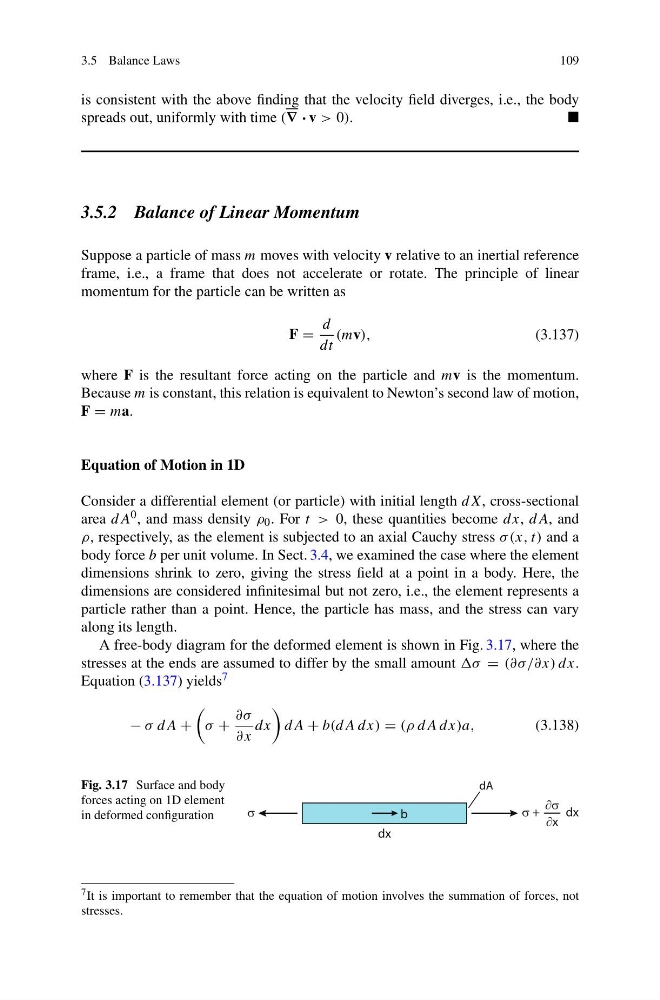
A free-body diagram for the deformed element is shown in Fig. 3.17, where the
stresses at the ends are assumed to differ by the small amount σ = (∂σ/∂x) dx.
Equation (3.137) yields 7
− σ dA +
σ +
∂σ
∂x
dx
dA + b(dA dx) = (ρ dA dx)a,
(3.138)
Fig. 3.17 Surface and body
forces acting on 1D element
in deformed configuration
V +
wV
wx
dx
b
dx
V
dA
7 It is important to remember that the equation of motion involves the summation of forces, not
stresses.
109
is consistent with the above finding that the velocity field diverges, i.e., the body
spreads out, uniformly with time (∇ · v > 0).
3.5.2 Balance of Linear Momentum
Suppose a particle of mass m moves with velocity v relative to an inertial reference
frame, i.e., a frame that does not accelerate or rotate. The principle of linear
momentum for the particle can be written as
F =
d
dt
(mv),
(3.137)
where F is the resultant force acting on the particle and mv is the momentum.
Because m is constant, this relation is equivalent to Newton’s second law of motion,
F = ma.
Equation of Motion in 1D
Consider a differential element (or particle) with initial length dX, cross-sectional
area dA 0 , and mass density ρ 0 . For t > 0, these quantities become dx, dA, and
ρ, respectively, as the element is subjected to an axial Cauchy stress σ (x, t) and a
body force b per unit volume. In Sect. 3.4, we examined the case where the element
dimensions shrink to zero, giving the stress field at a point in a body. Here, the
dimensions are considered infinitesimal but not zero, i.e., the element represents a
particle rather than a point. Hence, the particle has mass, and the stress can vary
along its length.
A free-body diagram for the deformed element is shown in Fig. 3.17, where the
stresses at the ends are assumed to differ by the small amount σ = (∂σ/∂x) dx.
Equation (3.137) yields 7
− σ dA +
σ +
∂σ
∂x
dx
dA + b(dA dx) = (ρ dA dx)a,
(3.138)
Fig. 3.17 Surface and body
forces acting on 1D element
in deformed configuration
V +
wV
wx
dx
b
dx
V
dA
7 It is important to remember that the equation of motion involves the summation of forces, not
stresses.