

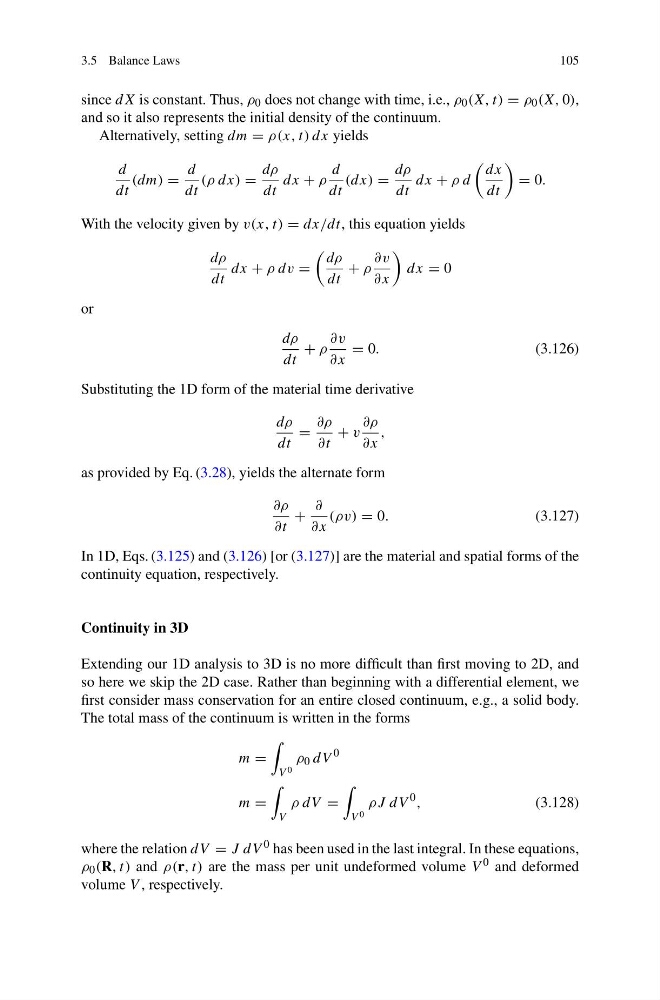
3.5 Balance Laws
105
since dX is constant. Thus, ρ 0 does not change with time, i.e., ρ 0 (X, t) = ρ 0 (X, 0),
and so it also represents the initial density of the continuum.
Alternatively, setting dm = ρ(x, t) dx yields
d
dt
(dm) =
d
dt
(ρ dx) =
dρ
dt
dx + ρ
d
dt
(dx) =
dρ
dt
dx + ρ d
dx
dt
= 0.
With the velocity given by v(x, t) = dx/dt, this equation yields
dρ
dt
dx + ρ dv =
dρ
dt
+ ρ
∂v
∂x
dx = 0
or
dρ
dt
+ ρ
∂v
∂x
= 0.
(3.126)
Substituting the 1D form of the material time derivative
dρ
dt
=
∂ρ
∂t
+ v
∂ρ
∂x
,
as provided by Eq. (3.28), yields the alternate form
∂ρ
∂t
+
∂
∂x
(ρv) = 0.
(3.127)
In 1D, Eqs. (3.125) and (3.126) [or (3.127)] are the material and spatial forms of the
continuity equation, respectively.
Continuity in 3D
Extending our 1D analysis to 3D is no more difficult than first moving to 2D, and
so here we skip the 2D case. Rather than beginning with a differential element, we
first consider mass conservation for an entire closed continuum, e.g., a solid body.
The total mass of the continuum is written in the forms
m =
V 0
ρ 0 dV
0
m =
V
ρ dV =
V 0
ρJ dV
0 ,
(3.128)
where the relation dV = J dV 0 has been used in the last integral. In these equations,
ρ 0 (R, t) and ρ(r, t) are the mass per unit undeformed volume V 0 and deformed
volume V , respectively.
105
since dX is constant. Thus, ρ 0 does not change with time, i.e., ρ 0 (X, t) = ρ 0 (X, 0),
and so it also represents the initial density of the continuum.
Alternatively, setting dm = ρ(x, t) dx yields
d
dt
(dm) =
d
dt
(ρ dx) =
dρ
dt
dx + ρ
d
dt
(dx) =
dρ
dt
dx + ρ d
dx
dt
= 0.
With the velocity given by v(x, t) = dx/dt, this equation yields
dρ
dt
dx + ρ dv =
dρ
dt
+ ρ
∂v
∂x
dx = 0
or
dρ
dt
+ ρ
∂v
∂x
= 0.
(3.126)
Substituting the 1D form of the material time derivative
dρ
dt
=
∂ρ
∂t
+ v
∂ρ
∂x
,
as provided by Eq. (3.28), yields the alternate form
∂ρ
∂t
+
∂
∂x
(ρv) = 0.
(3.127)
In 1D, Eqs. (3.125) and (3.126) [or (3.127)] are the material and spatial forms of the
continuity equation, respectively.
Continuity in 3D
Extending our 1D analysis to 3D is no more difficult than first moving to 2D, and
so here we skip the 2D case. Rather than beginning with a differential element, we
first consider mass conservation for an entire closed continuum, e.g., a solid body.
The total mass of the continuum is written in the forms
m =
V 0
ρ 0 dV
0
m =
V
ρ dV =
V 0
ρJ dV
0 ,
(3.128)
where the relation dV = J dV 0 has been used in the last integral. In these equations,
ρ 0 (R, t) and ρ(r, t) are the mass per unit undeformed volume V 0 and deformed
volume V , respectively.