

1 Foundation of Fluid Mechanics
75
namely
∂u i
∂ x j
≈
V t
l t
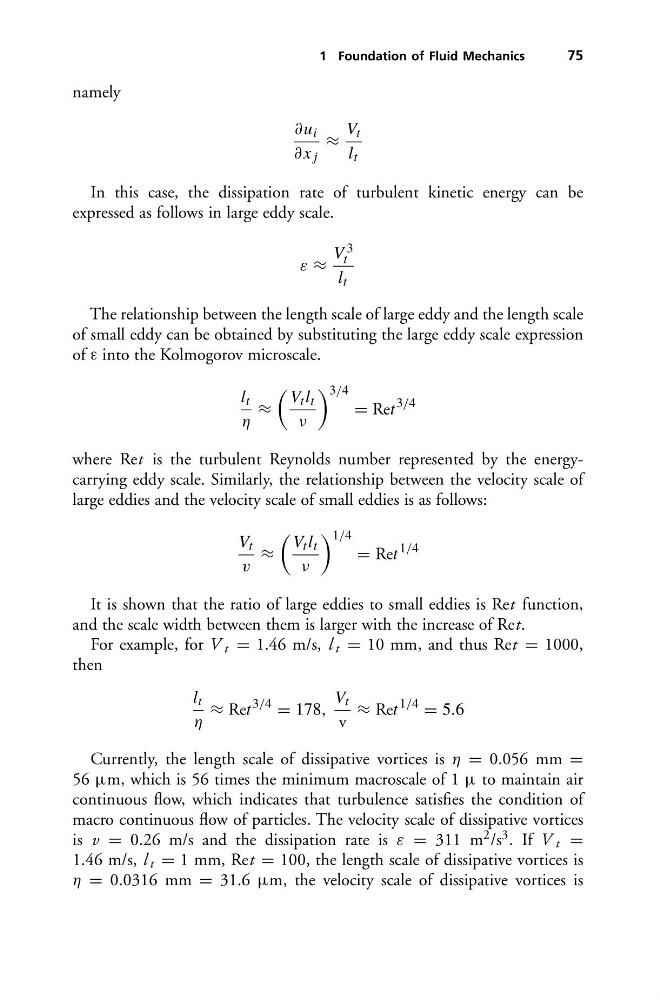
In this case, the dissipation rate of turbulent kinetic energy can be
expressed as follows in large eddy scale.
ε ≈
V 3
t
l t
The relationship between the length scale of large eddy and the length scale
of small eddy can be obtained by substituting the large eddy scale expression
of ε into the Kolmogorov microscale.
l t
η
≈
V t l t
ν
3/4
= Ret
3/4
where Ret is the turbulent Reynolds number represented by the energycarrying eddy scale. Similarly, the relationship between the velocity scale of
large eddies and the velocity scale of small eddies is as follows:
V t
v
≈
V t l t
ν
1/4
= Ret
1/4
It is shown that the ratio of large eddies to small eddies is Ret function,
and the scale width between them is larger with the increase of Ret.
For example, for V t = 1.46 m/s, l t = 10 mm, and thus Ret = 1000,
then
l t
η
≈ Ret
3/4
= 178,
V t
v
≈ Ret
1/4
= 5.6
Currently, the length scale of dissipative vortices is η = 0.056 mm =
56 μm, which is 56 times the minimum macroscale of 1 μ to maintain air
continuous flow, which indicates that turbulence satisfies the condition of
macro continuous flow of particles. The velocity scale of dissipative vortices
is v = 0.26 m/s and the dissipation rate is ε = 311 m 2 /s 3 . If V t =
1.46 m/s, l t = 1 mm, Ret = 100, the length scale of dissipative vortices is
η = 0.0316 mm = 31.6 μm, the velocity scale of dissipative vortices is
75
namely
∂u i
∂ x j
≈
V t
l t
In this case, the dissipation rate of turbulent kinetic energy can be
expressed as follows in large eddy scale.
ε ≈
V 3
t
l t
The relationship between the length scale of large eddy and the length scale
of small eddy can be obtained by substituting the large eddy scale expression
of ε into the Kolmogorov microscale.
l t
η
≈
V t l t
ν
3/4
= Ret
3/4
where Ret is the turbulent Reynolds number represented by the energycarrying eddy scale. Similarly, the relationship between the velocity scale of
large eddies and the velocity scale of small eddies is as follows:
V t
v
≈
V t l t
ν
1/4
= Ret
1/4
It is shown that the ratio of large eddies to small eddies is Ret function,
and the scale width between them is larger with the increase of Ret.
For example, for V t = 1.46 m/s, l t = 10 mm, and thus Ret = 1000,
then
l t
η
≈ Ret
3/4
= 178,
V t
v
≈ Ret
1/4
= 5.6
Currently, the length scale of dissipative vortices is η = 0.056 mm =
56 μm, which is 56 times the minimum macroscale of 1 μ to maintain air
continuous flow, which indicates that turbulence satisfies the condition of
macro continuous flow of particles. The velocity scale of dissipative vortices
is v = 0.26 m/s and the dissipation rate is ε = 311 m 2 /s 3 . If V t =
1.46 m/s, l t = 1 mm, Ret = 100, the length scale of dissipative vortices is
η = 0.0316 mm = 31.6 μm, the velocity scale of dissipative vortices is