

74
P. Liu
called energy-containing eddies. For dissipative scale vortices, Kolmogorov
considers that their length and velocity scales are determined by the viscous
coefficient of fluid motion ν and the dissipation rate of turbulent energy ε.
In the dissipative vorticity scale, assuming that the length scale is η and the
velocity scale is v, the particle fluctuation inertia force is considered to be the
same order of magnitude as the viscous force due to the viscous restriction,
that is, the particle fluctuation inertia force is equal to the viscous force.
Reη =
vη
υ
≈ 1.0
Through dimensional analysis, we can get the result.
η =
ν 3
ε
1/4
v = (νε)
1/4
τ =
ν
ε
1/2
Among them, τ is the time scale of dissipative eddies. These scales are also
called the Kolmogorov microscales. The dissipation rate of turbulent energy
dissipation ε is expressed in microscale terms.
ε ≈
v 3
η
Now we look at the relationship between large scale and microscale.
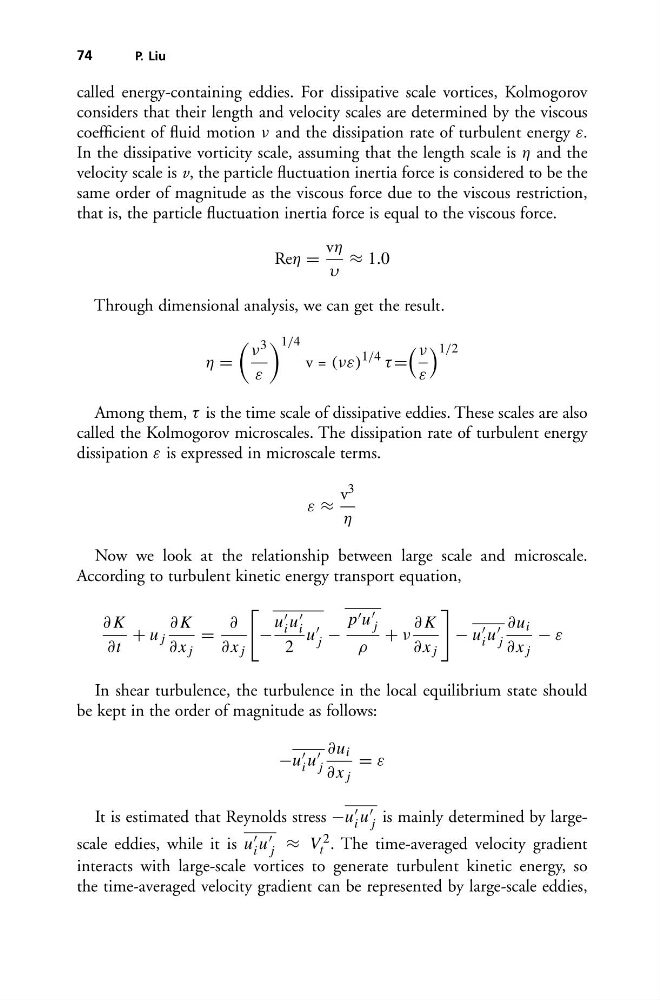
According to turbulent kinetic energy transport equation,
∂ K
∂t
+ u j
∂ K
∂ x j
=
∂
∂ x j
−
u
i u
i
2
u
j −
p u
j
ρ
+ ν
∂ K
∂ x j
− u
i u
j
∂u i
∂ x j
− ε
In shear turbulence, the turbulence in the local equilibrium state should
be kept in the order of magnitude as follows:
−u
i u
j
∂u i
∂ x j
= ε
It is estimated that Reynolds stress −u
i u
j is mainly determined by largescale eddies, while it is u
i u
j ≈ V 2
t . The time-averaged velocity gradient
interacts with large-scale vortices to generate turbulent kinetic energy, so
the time-averaged velocity gradient can be represented by large-scale eddies,
P. Liu
called energy-containing eddies. For dissipative scale vortices, Kolmogorov
considers that their length and velocity scales are determined by the viscous
coefficient of fluid motion ν and the dissipation rate of turbulent energy ε.
In the dissipative vorticity scale, assuming that the length scale is η and the
velocity scale is v, the particle fluctuation inertia force is considered to be the
same order of magnitude as the viscous force due to the viscous restriction,
that is, the particle fluctuation inertia force is equal to the viscous force.
Reη =
vη
υ
≈ 1.0
Through dimensional analysis, we can get the result.
η =
ν 3
ε
1/4
v = (νε)
1/4
τ =
ν
ε
1/2
Among them, τ is the time scale of dissipative eddies. These scales are also
called the Kolmogorov microscales. The dissipation rate of turbulent energy
dissipation ε is expressed in microscale terms.
ε ≈
v 3
η
Now we look at the relationship between large scale and microscale.
According to turbulent kinetic energy transport equation,
∂ K
∂t
+ u j
∂ K
∂ x j
=
∂
∂ x j
−
u
i u
i
2
u
j −
p u
j
ρ
+ ν
∂ K
∂ x j
− u
i u
j
∂u i
∂ x j
− ε
In shear turbulence, the turbulence in the local equilibrium state should
be kept in the order of magnitude as follows:
−u
i u
j
∂u i
∂ x j
= ε
It is estimated that Reynolds stress −u
i u
j is mainly determined by largescale eddies, while it is u
i u
j ≈ V 2
t . The time-averaged velocity gradient
interacts with large-scale vortices to generate turbulent kinetic energy, so
the time-averaged velocity gradient can be represented by large-scale eddies,