

8 Introduction to Celebrities in Fluid Mechanics
639
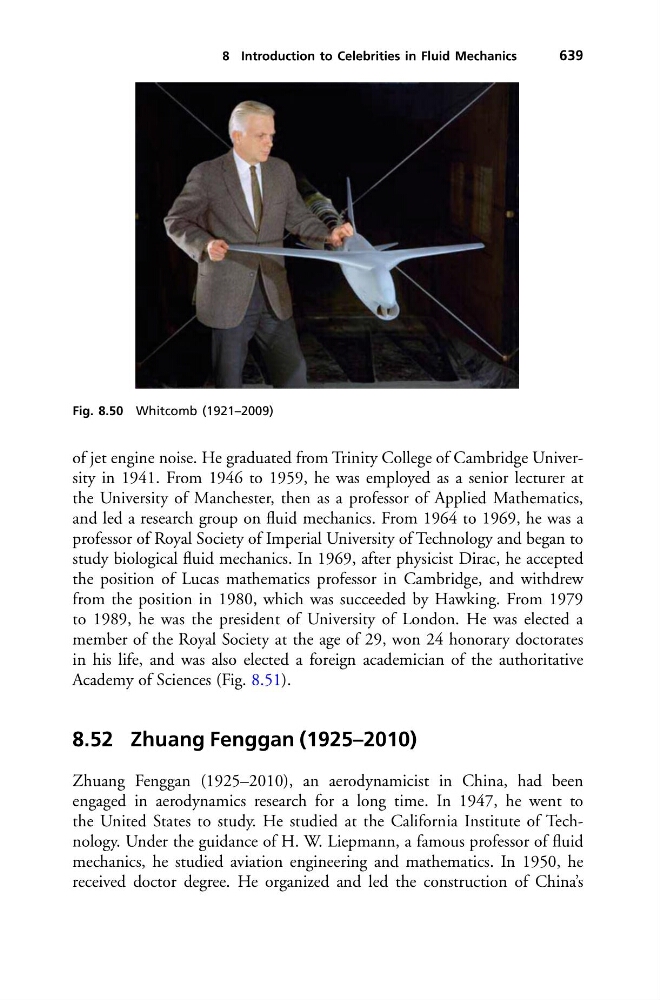
Fig. 8.50 Whitcomb (1921–2009)
of jet engine noise. He graduated from Trinity College of Cambridge University in 1941. From 1946 to 1959, he was employed as a senior lecturer at
the University of Manchester, then as a professor of Applied Mathematics,
and led a research group on fluid mechanics. From 1964 to 1969, he was a
professor of Royal Society of Imperial University of Technology and began to
study biological fluid mechanics. In 1969, after physicist Dirac, he accepted
the position of Lucas mathematics professor in Cambridge, and withdrew
from the position in 1980, which was succeeded by Hawking. From 1979
to 1989, he was the president of University of London. He was elected a
member of the Royal Society at the age of 29, won 24 honorary doctorates
in his life, and was also elected a foreign academician of the authoritative
Academy of Sciences (Fig. 8.51).
8.52 Zhuang Fenggan (1925–2010)
Zhuang Fenggan (1925–2010), an aerodynamicist in China, had been
engaged in aerodynamics research for a long time. In 1947, he went to
the United States to study. He studied at the California Institute of Technology. Under the guidance of H. W. Liepmann, a famous professor of fluid
mechanics, he studied aviation engineering and mathematics. In 1950, he
received doctor degree. He organized and led the construction of China’s
639
Fig. 8.50 Whitcomb (1921–2009)
of jet engine noise. He graduated from Trinity College of Cambridge University in 1941. From 1946 to 1959, he was employed as a senior lecturer at
the University of Manchester, then as a professor of Applied Mathematics,
and led a research group on fluid mechanics. From 1964 to 1969, he was a
professor of Royal Society of Imperial University of Technology and began to
study biological fluid mechanics. In 1969, after physicist Dirac, he accepted
the position of Lucas mathematics professor in Cambridge, and withdrew
from the position in 1980, which was succeeded by Hawking. From 1979
to 1989, he was the president of University of London. He was elected a
member of the Royal Society at the age of 29, won 24 honorary doctorates
in his life, and was also elected a foreign academician of the authoritative
Academy of Sciences (Fig. 8.51).
8.52 Zhuang Fenggan (1925–2010)
Zhuang Fenggan (1925–2010), an aerodynamicist in China, had been
engaged in aerodynamics research for a long time. In 1947, he went to
the United States to study. He studied at the California Institute of Technology. Under the guidance of H. W. Liepmann, a famous professor of fluid
mechanics, he studied aviation engineering and mathematics. In 1950, he
received doctor degree. He organized and led the construction of China’s