

8 Introduction to Celebrities in Fluid Mechanics
633
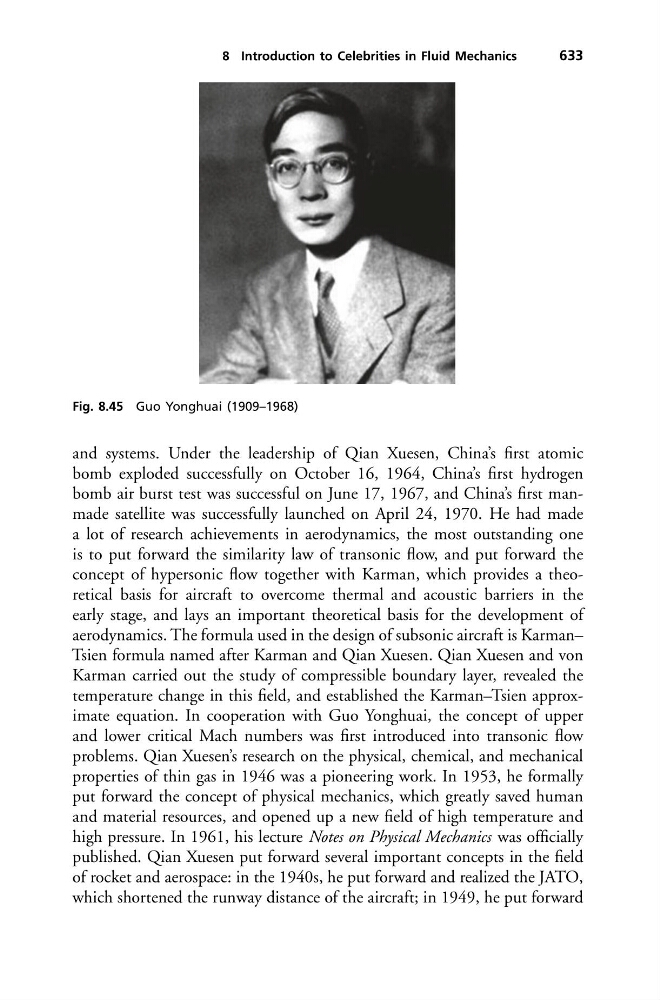
Fig. 8.45 Guo Yonghuai (1909–1968)
and systems. Under the leadership of Qian Xuesen, China’s first atomic
bomb exploded successfully on October 16, 1964, China’s first hydrogen
bomb air burst test was successful on June 17, 1967, and China’s first manmade satellite was successfully launched on April 24, 1970. He had made
a lot of research achievements in aerodynamics, the most outstanding one
is to put forward the similarity law of transonic flow, and put forward the
concept of hypersonic flow together with Karman, which provides a theoretical basis for aircraft to overcome thermal and acoustic barriers in the
early stage, and lays an important theoretical basis for the development of
aerodynamics. The formula used in the design of subsonic aircraft is Karman–
Tsien formula named after Karman and Qian Xuesen. Qian Xuesen and von
Karman carried out the study of compressible boundary layer, revealed the
temperature change in this field, and established the Karman–Tsien approximate equation. In cooperation with Guo Yonghuai, the concept of upper
and lower critical Mach numbers was first introduced into transonic flow
problems. Qian Xuesen’s research on the physical, chemical, and mechanical
properties of thin gas in 1946 was a pioneering work. In 1953, he formally
put forward the concept of physical mechanics, which greatly saved human
and material resources, and opened up a new field of high temperature and
high pressure. In 1961, his lecture Notes on Physical Mechanics was officially
published. Qian Xuesen put forward several important concepts in the field
of rocket and aerospace: in the 1940s, he put forward and realized the JATO,
which shortened the runway distance of the aircraft; in 1949, he put forward
633
Fig. 8.45 Guo Yonghuai (1909–1968)
and systems. Under the leadership of Qian Xuesen, China’s first atomic
bomb exploded successfully on October 16, 1964, China’s first hydrogen
bomb air burst test was successful on June 17, 1967, and China’s first manmade satellite was successfully launched on April 24, 1970. He had made
a lot of research achievements in aerodynamics, the most outstanding one
is to put forward the similarity law of transonic flow, and put forward the
concept of hypersonic flow together with Karman, which provides a theoretical basis for aircraft to overcome thermal and acoustic barriers in the
early stage, and lays an important theoretical basis for the development of
aerodynamics. The formula used in the design of subsonic aircraft is Karman–
Tsien formula named after Karman and Qian Xuesen. Qian Xuesen and von
Karman carried out the study of compressible boundary layer, revealed the
temperature change in this field, and established the Karman–Tsien approximate equation. In cooperation with Guo Yonghuai, the concept of upper
and lower critical Mach numbers was first introduced into transonic flow
problems. Qian Xuesen’s research on the physical, chemical, and mechanical
properties of thin gas in 1946 was a pioneering work. In 1953, he formally
put forward the concept of physical mechanics, which greatly saved human
and material resources, and opened up a new field of high temperature and
high pressure. In 1961, his lecture Notes on Physical Mechanics was officially
published. Qian Xuesen put forward several important concepts in the field
of rocket and aerospace: in the 1940s, he put forward and realized the JATO,
which shortened the runway distance of the aircraft; in 1949, he put forward