

1 Foundation of Fluid Mechanics
51
If the turbulent motion is neither stationary in time nor uniform in space,
we can decompose the instantaneous motion of turbulence into statistical
mean motion and pulsating motion in probability sense.
Although the above three decomposition methods are proposed for
different turbulent flow fields, they are statistically equivalent under certain
conditions. According to the Ergodic Theorem of probability theory, all
possible values of a random variable appearing in repeated experiments will
occur many times in a long time (or in a considerable space), and the probability of appearing is the same. Therefore, for a time-stable and space-uniform
turbulent flow field, the average values of each physical quantity obtained by
the above three decomposition methods are equal.
1.8 Statistical Theory of Turbulence
In the statistical theory of turbulence, the British meteorologist Richardson
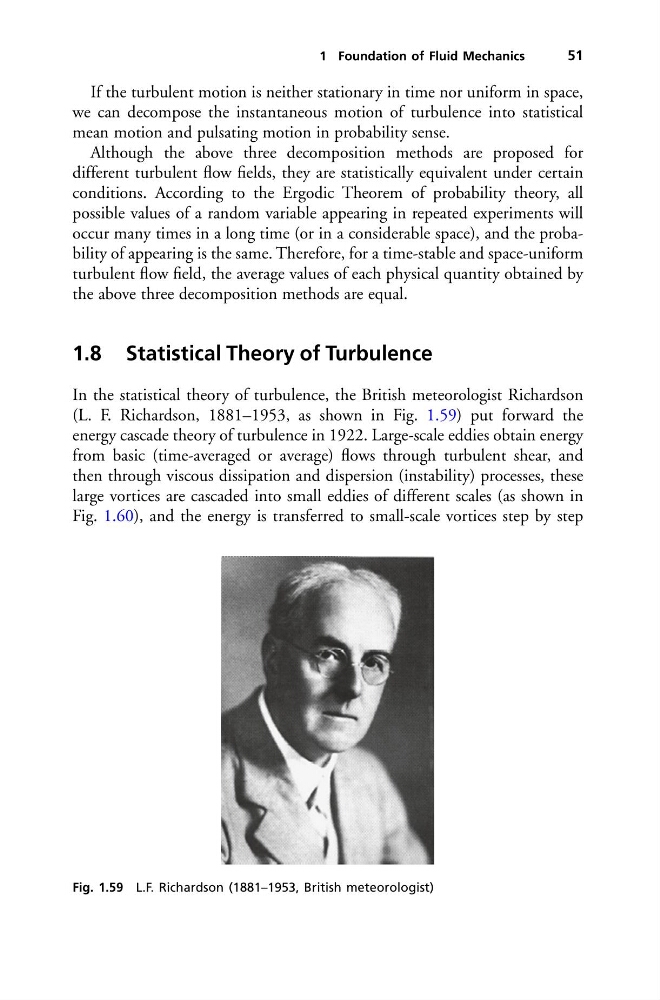
(L. F. Richardson, 1881–1953, as shown in Fig. 1.59) put forward the
energy cascade theory of turbulence in 1922. Large-scale eddies obtain energy
from basic (time-averaged or average) flows through turbulent shear, and
then through viscous dissipation and dispersion (instability) processes, these
large vortices are cascaded into small eddies of different scales (as shown in
Fig. 1.60), and the energy is transferred to small-scale vortices step by step
Fig. 1.59 L.F. Richardson (1881–1953, British meteorologist)
51
If the turbulent motion is neither stationary in time nor uniform in space,
we can decompose the instantaneous motion of turbulence into statistical
mean motion and pulsating motion in probability sense.
Although the above three decomposition methods are proposed for
different turbulent flow fields, they are statistically equivalent under certain
conditions. According to the Ergodic Theorem of probability theory, all
possible values of a random variable appearing in repeated experiments will
occur many times in a long time (or in a considerable space), and the probability of appearing is the same. Therefore, for a time-stable and space-uniform
turbulent flow field, the average values of each physical quantity obtained by
the above three decomposition methods are equal.
1.8 Statistical Theory of Turbulence
In the statistical theory of turbulence, the British meteorologist Richardson
(L. F. Richardson, 1881–1953, as shown in Fig. 1.59) put forward the
energy cascade theory of turbulence in 1922. Large-scale eddies obtain energy
from basic (time-averaged or average) flows through turbulent shear, and
then through viscous dissipation and dispersion (instability) processes, these
large vortices are cascaded into small eddies of different scales (as shown in
Fig. 1.60), and the energy is transferred to small-scale vortices step by step
Fig. 1.59 L.F. Richardson (1881–1953, British meteorologist)