

8 Introduction to Celebrities in Fluid Mechanics
623
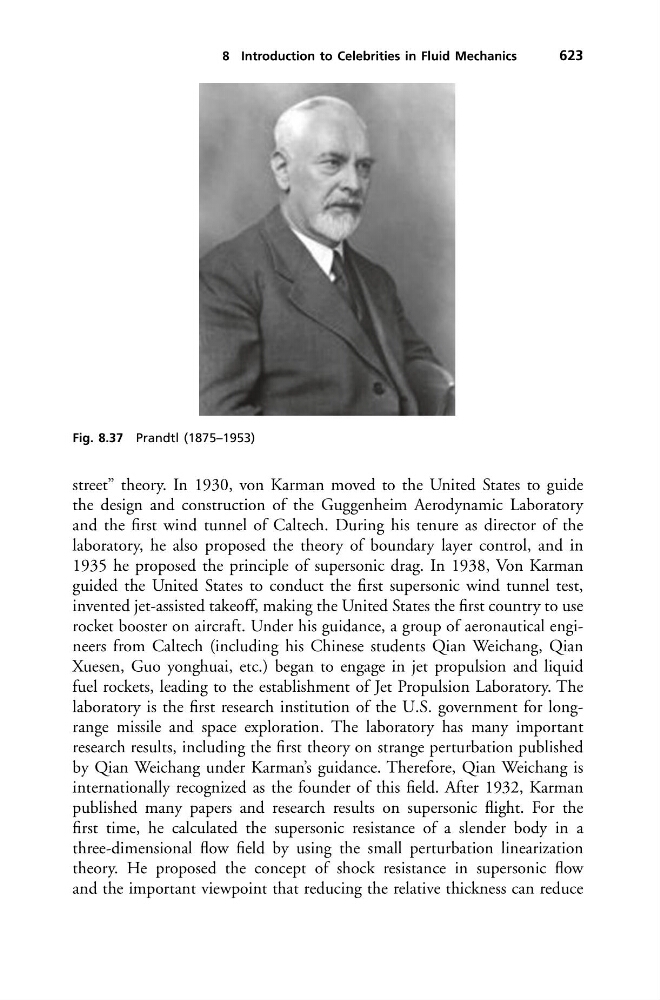
Fig. 8.37 Prandtl (1875–1953)
street” theory. In 1930, von Karman moved to the United States to guide
the design and construction of the Guggenheim Aerodynamic Laboratory
and the first wind tunnel of Caltech. During his tenure as director of the
laboratory, he also proposed the theory of boundary layer control, and in
1935 he proposed the principle of supersonic drag. In 1938, Von Karman
guided the United States to conduct the first supersonic wind tunnel test,
invented jet-assisted takeoff, making the United States the first country to use
rocket booster on aircraft. Under his guidance, a group of aeronautical engineers from Caltech (including his Chinese students Qian Weichang, Qian
Xuesen, Guo yonghuai, etc.) began to engage in jet propulsion and liquid
fuel rockets, leading to the establishment of Jet Propulsion Laboratory. The
laboratory is the first research institution of the U.S. government for longrange missile and space exploration. The laboratory has many important
research results, including the first theory on strange perturbation published
by Qian Weichang under Karman’s guidance. Therefore, Qian Weichang is
internationally recognized as the founder of this field. After 1932, Karman
published many papers and research results on supersonic flight. For the
first time, he calculated the supersonic resistance of a slender body in a
three-dimensional flow field by using the small perturbation linearization
theory. He proposed the concept of shock resistance in supersonic flow
and the important viewpoint that reducing the relative thickness can reduce
623
Fig. 8.37 Prandtl (1875–1953)
street” theory. In 1930, von Karman moved to the United States to guide
the design and construction of the Guggenheim Aerodynamic Laboratory
and the first wind tunnel of Caltech. During his tenure as director of the
laboratory, he also proposed the theory of boundary layer control, and in
1935 he proposed the principle of supersonic drag. In 1938, Von Karman
guided the United States to conduct the first supersonic wind tunnel test,
invented jet-assisted takeoff, making the United States the first country to use
rocket booster on aircraft. Under his guidance, a group of aeronautical engineers from Caltech (including his Chinese students Qian Weichang, Qian
Xuesen, Guo yonghuai, etc.) began to engage in jet propulsion and liquid
fuel rockets, leading to the establishment of Jet Propulsion Laboratory. The
laboratory is the first research institution of the U.S. government for longrange missile and space exploration. The laboratory has many important
research results, including the first theory on strange perturbation published
by Qian Weichang under Karman’s guidance. Therefore, Qian Weichang is
internationally recognized as the founder of this field. After 1932, Karman
published many papers and research results on supersonic flight. For the
first time, he calculated the supersonic resistance of a slender body in a
three-dimensional flow field by using the small perturbation linearization
theory. He proposed the concept of shock resistance in supersonic flow
and the important viewpoint that reducing the relative thickness can reduce