

616
P. Liu
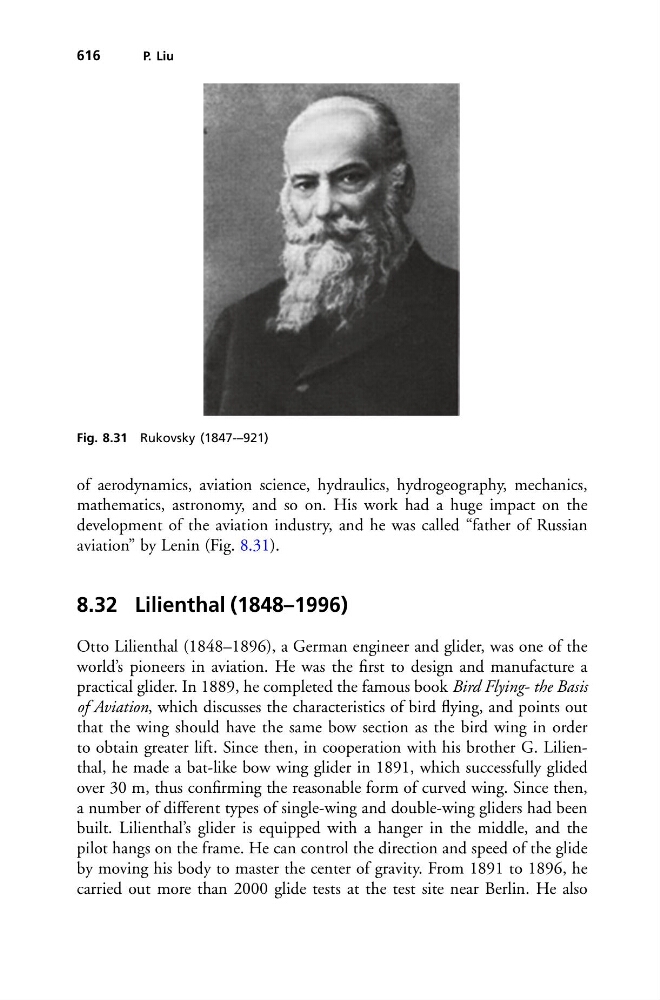
Fig. 8.31 Rukovsky (1847-–921)
of aerodynamics, aviation science, hydraulics, hydrogeography, mechanics,
mathematics, astronomy, and so on. His work had a huge impact on the
development of the aviation industry, and he was called “father of Russian
aviation” by Lenin (Fig. 8.31).
8.32 Lilienthal (1848–1996)
Otto Lilienthal (1848–1896), a German engineer and glider, was one of the
world’s pioneers in aviation. He was the first to design and manufacture a
practical glider. In 1889, he completed the famous book Bird Flying- the Basis
of Aviation, which discusses the characteristics of bird flying, and points out
that the wing should have the same bow section as the bird wing in order
to obtain greater lift. Since then, in cooperation with his brother G. Lilienthal, he made a bat-like bow wing glider in 1891, which successfully glided
over 30 m, thus confirming the reasonable form of curved wing. Since then,
a number of different types of single-wing and double-wing gliders had been
built. Lilienthal’s glider is equipped with a hanger in the middle, and the
pilot hangs on the frame. He can control the direction and speed of the glide
by moving his body to master the center of gravity. From 1891 to 1896, he
carried out more than 2000 glide tests at the test site near Berlin. He also
P. Liu
Fig. 8.31 Rukovsky (1847-–921)
of aerodynamics, aviation science, hydraulics, hydrogeography, mechanics,
mathematics, astronomy, and so on. His work had a huge impact on the
development of the aviation industry, and he was called “father of Russian
aviation” by Lenin (Fig. 8.31).
8.32 Lilienthal (1848–1996)
Otto Lilienthal (1848–1896), a German engineer and glider, was one of the
world’s pioneers in aviation. He was the first to design and manufacture a
practical glider. In 1889, he completed the famous book Bird Flying- the Basis
of Aviation, which discusses the characteristics of bird flying, and points out
that the wing should have the same bow section as the bird wing in order
to obtain greater lift. Since then, in cooperation with his brother G. Lilienthal, he made a bat-like bow wing glider in 1891, which successfully glided
over 30 m, thus confirming the reasonable form of curved wing. Since then,
a number of different types of single-wing and double-wing gliders had been
built. Lilienthal’s glider is equipped with a hanger in the middle, and the
pilot hangs on the frame. He can control the direction and speed of the glide
by moving his body to master the center of gravity. From 1891 to 1896, he
carried out more than 2000 glide tests at the test site near Berlin. He also