

8 Introduction to Celebrities in Fluid Mechanics
613
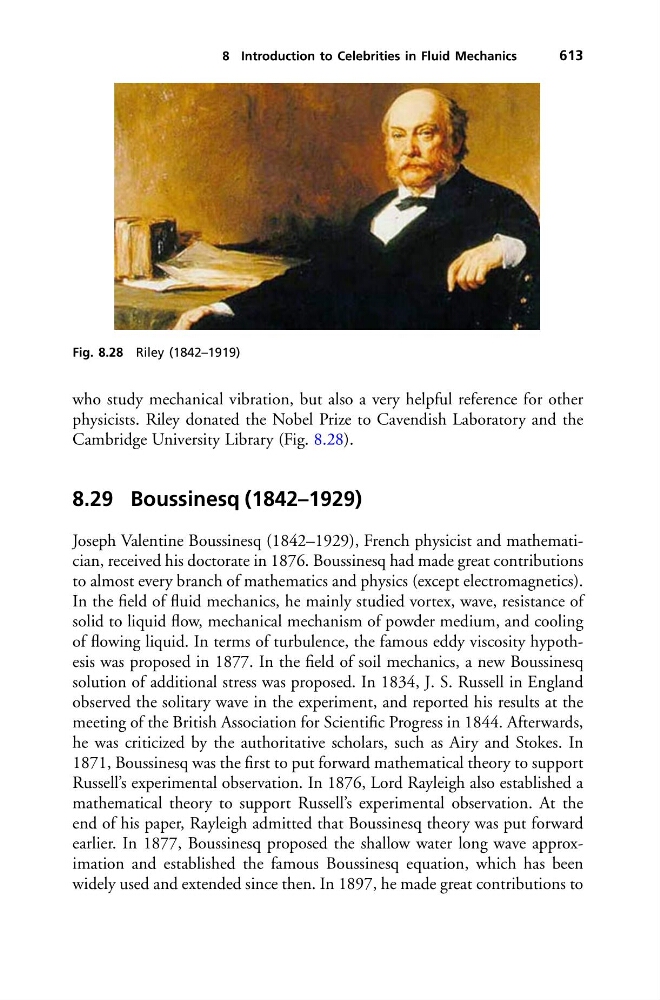
Fig. 8.28 Riley (1842–1919)
who study mechanical vibration, but also a very helpful reference for other
physicists. Riley donated the Nobel Prize to Cavendish Laboratory and the
Cambridge University Library (Fig. 8.28).
8.29 Boussinesq (1842–1929)
Joseph Valentine Boussinesq (1842–1929), French physicist and mathematician, received his doctorate in 1876. Boussinesq had made great contributions
to almost every branch of mathematics and physics (except electromagnetics).
In the field of fluid mechanics, he mainly studied vortex, wave, resistance of
solid to liquid flow, mechanical mechanism of powder medium, and cooling
of flowing liquid. In terms of turbulence, the famous eddy viscosity hypothesis was proposed in 1877. In the field of soil mechanics, a new Boussinesq
solution of additional stress was proposed. In 1834, J. S. Russell in England
observed the solitary wave in the experiment, and reported his results at the
meeting of the British Association for Scientific Progress in 1844. Afterwards,
he was criticized by the authoritative scholars, such as Airy and Stokes. In
1871, Boussinesq was the first to put forward mathematical theory to support
Russell’s experimental observation. In 1876, Lord Rayleigh also established a
mathematical theory to support Russell’s experimental observation. At the
end of his paper, Rayleigh admitted that Boussinesq theory was put forward
earlier. In 1877, Boussinesq proposed the shallow water long wave approximation and established the famous Boussinesq equation, which has been
widely used and extended since then. In 1897, he made great contributions to
613
Fig. 8.28 Riley (1842–1919)
who study mechanical vibration, but also a very helpful reference for other
physicists. Riley donated the Nobel Prize to Cavendish Laboratory and the
Cambridge University Library (Fig. 8.28).
8.29 Boussinesq (1842–1929)
Joseph Valentine Boussinesq (1842–1929), French physicist and mathematician, received his doctorate in 1876. Boussinesq had made great contributions
to almost every branch of mathematics and physics (except electromagnetics).
In the field of fluid mechanics, he mainly studied vortex, wave, resistance of
solid to liquid flow, mechanical mechanism of powder medium, and cooling
of flowing liquid. In terms of turbulence, the famous eddy viscosity hypothesis was proposed in 1877. In the field of soil mechanics, a new Boussinesq
solution of additional stress was proposed. In 1834, J. S. Russell in England
observed the solitary wave in the experiment, and reported his results at the
meeting of the British Association for Scientific Progress in 1844. Afterwards,
he was criticized by the authoritative scholars, such as Airy and Stokes. In
1871, Boussinesq was the first to put forward mathematical theory to support
Russell’s experimental observation. In 1876, Lord Rayleigh also established a
mathematical theory to support Russell’s experimental observation. At the
end of his paper, Rayleigh admitted that Boussinesq theory was put forward
earlier. In 1877, Boussinesq proposed the shallow water long wave approximation and established the famous Boussinesq equation, which has been
widely used and extended since then. In 1897, he made great contributions to