

8 Introduction to Celebrities in Fluid Mechanics
605
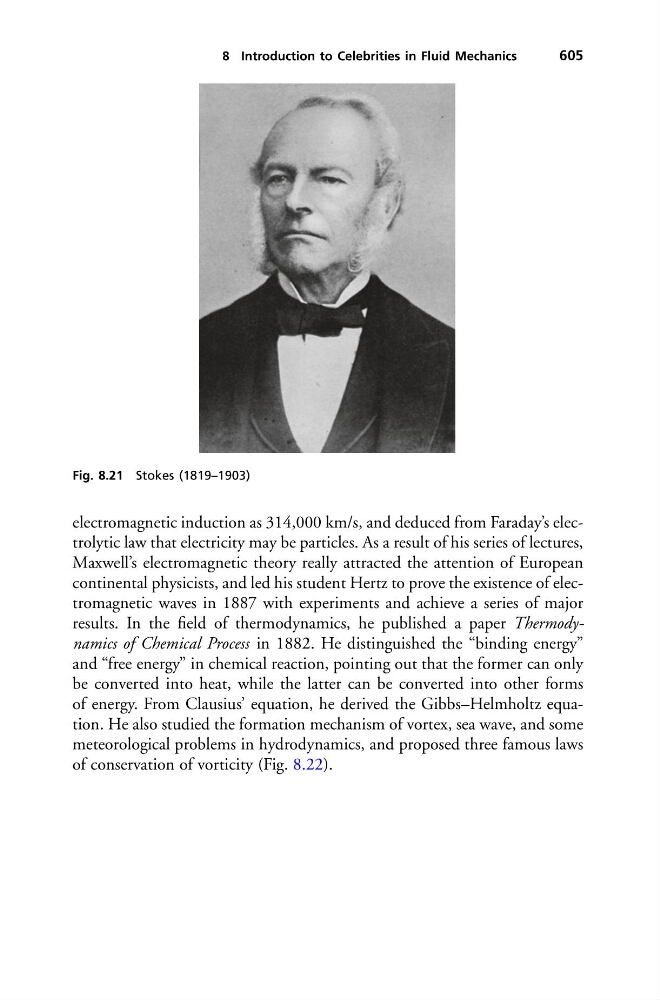
Fig. 8.21 Stokes (1819–1903)
electromagnetic induction as 314,000 km/s, and deduced from Faraday’s electrolytic law that electricity may be particles. As a result of his series of lectures,
Maxwell’s electromagnetic theory really attracted the attention of European
continental physicists, and led his student Hertz to prove the existence of electromagnetic waves in 1887 with experiments and achieve a series of major
results. In the field of thermodynamics, he published a paper Thermodynamics of Chemical Process in 1882. He distinguished the “binding energy”
and “free energy” in chemical reaction, pointing out that the former can only
be converted into heat, while the latter can be converted into other forms
of energy. From Clausius’ equation, he derived the Gibbs–Helmholtz equation. He also studied the formation mechanism of vortex, sea wave, and some
meteorological problems in hydrodynamics, and proposed three famous laws
of conservation of vorticity (Fig. 8.22).
605
Fig. 8.21 Stokes (1819–1903)
electromagnetic induction as 314,000 km/s, and deduced from Faraday’s electrolytic law that electricity may be particles. As a result of his series of lectures,
Maxwell’s electromagnetic theory really attracted the attention of European
continental physicists, and led his student Hertz to prove the existence of electromagnetic waves in 1887 with experiments and achieve a series of major
results. In the field of thermodynamics, he published a paper Thermodynamics of Chemical Process in 1882. He distinguished the “binding energy”
and “free energy” in chemical reaction, pointing out that the former can only
be converted into heat, while the latter can be converted into other forms
of energy. From Clausius’ equation, he derived the Gibbs–Helmholtz equation. He also studied the formation mechanism of vortex, sea wave, and some
meteorological problems in hydrodynamics, and proposed three famous laws
of conservation of vorticity (Fig. 8.22).