

8 Introduction to Celebrities in Fluid Mechanics
591
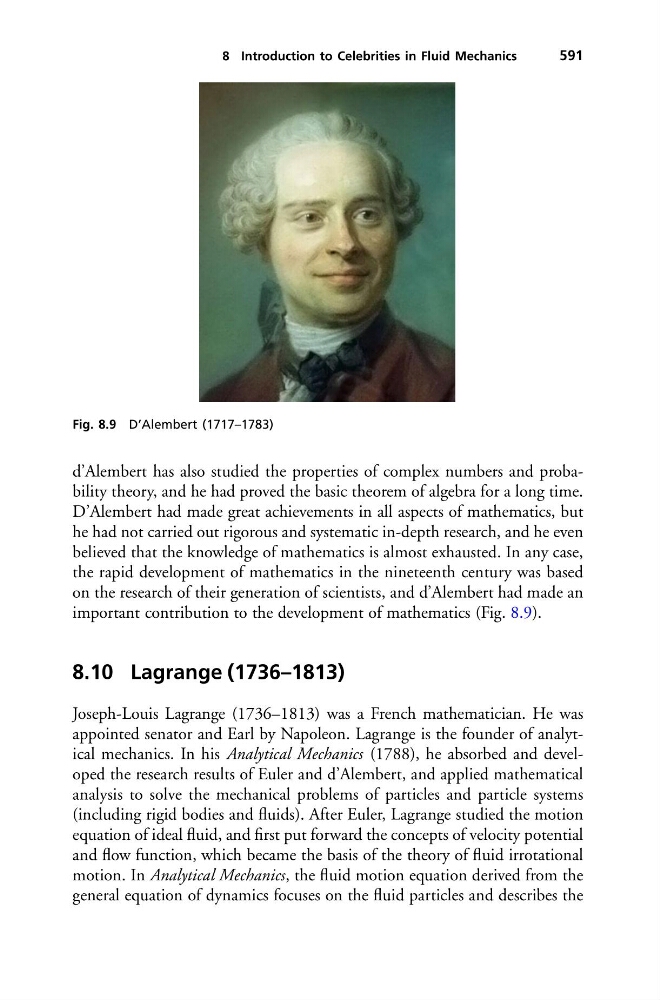
Fig. 8.9 D’Alembert (1717–1783)
d’Alembert has also studied the properties of complex numbers and probability theory, and he had proved the basic theorem of algebra for a long time.
D’Alembert had made great achievements in all aspects of mathematics, but
he had not carried out rigorous and systematic in-depth research, and he even
believed that the knowledge of mathematics is almost exhausted. In any case,
the rapid development of mathematics in the nineteenth century was based
on the research of their generation of scientists, and d’Alembert had made an
important contribution to the development of mathematics (Fig. 8.9).
8.10 Lagrange (1736–1813)
Joseph-Louis Lagrange (1736–1813) was a French mathematician. He was
appointed senator and Earl by Napoleon. Lagrange is the founder of analytical mechanics. In his Analytical Mechanics (1788), he absorbed and developed the research results of Euler and d’Alembert, and applied mathematical
analysis to solve the mechanical problems of particles and particle systems
(including rigid bodies and fluids). After Euler, Lagrange studied the motion
equation of ideal fluid, and first put forward the concepts of velocity potential
and flow function, which became the basis of the theory of fluid irrotational
motion. In Analytical Mechanics, the fluid motion equation derived from the
general equation of dynamics focuses on the fluid particles and describes the
591
Fig. 8.9 D’Alembert (1717–1783)
d’Alembert has also studied the properties of complex numbers and probability theory, and he had proved the basic theorem of algebra for a long time.
D’Alembert had made great achievements in all aspects of mathematics, but
he had not carried out rigorous and systematic in-depth research, and he even
believed that the knowledge of mathematics is almost exhausted. In any case,
the rapid development of mathematics in the nineteenth century was based
on the research of their generation of scientists, and d’Alembert had made an
important contribution to the development of mathematics (Fig. 8.9).
8.10 Lagrange (1736–1813)
Joseph-Louis Lagrange (1736–1813) was a French mathematician. He was
appointed senator and Earl by Napoleon. Lagrange is the founder of analytical mechanics. In his Analytical Mechanics (1788), he absorbed and developed the research results of Euler and d’Alembert, and applied mathematical
analysis to solve the mechanical problems of particles and particle systems
(including rigid bodies and fluids). After Euler, Lagrange studied the motion
equation of ideal fluid, and first put forward the concepts of velocity potential
and flow function, which became the basis of the theory of fluid irrotational
motion. In Analytical Mechanics, the fluid motion equation derived from the
general equation of dynamics focuses on the fluid particles and describes the