

7 Flight Mystery and Aerodynamic Principles
569
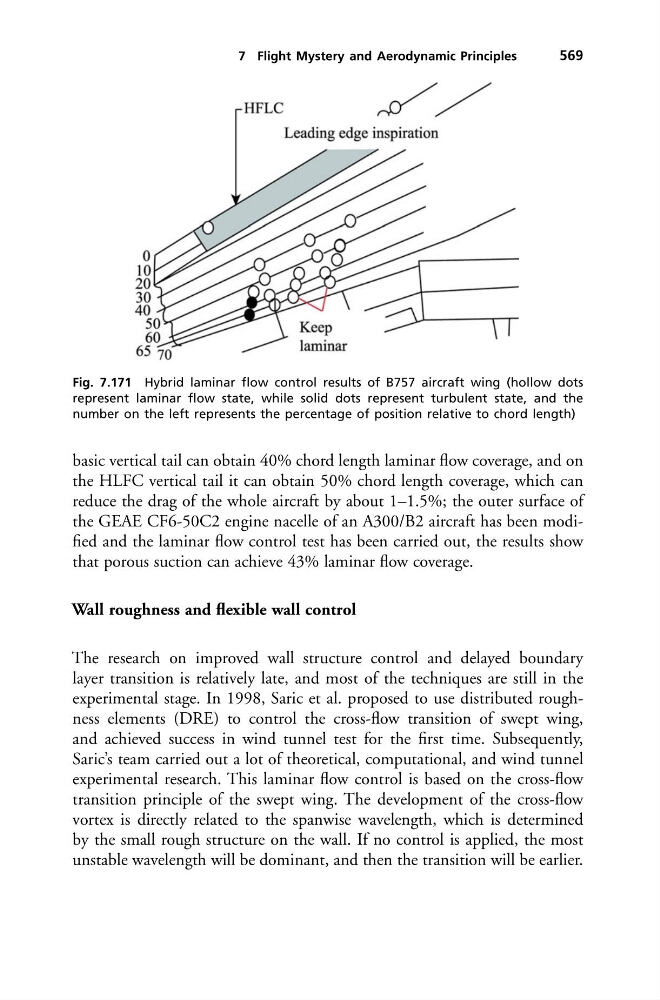
Fig. 7.171 Hybrid laminar flow control results of B757 aircraft wing (hollow dots
represent laminar flow state, while solid dots represent turbulent state, and the
number on the left represents the percentage of position relative to chord length)
basic vertical tail can obtain 40% chord length laminar flow coverage, and on
the HLFC vertical tail it can obtain 50% chord length coverage, which can
reduce the drag of the whole aircraft by about 1–1.5%; the outer surface of
the GEAE CF6-50C2 engine nacelle of an A300/B2 aircraft has been modified and the laminar flow control test has been carried out, the results show
that porous suction can achieve 43% laminar flow coverage.
Wall roughness and flexible wall control
The research on improved wall structure control and delayed boundary
layer transition is relatively late, and most of the techniques are still in the
experimental stage. In 1998, Saric et al. proposed to use distributed roughness elements (DRE) to control the cross-flow transition of swept wing,
and achieved success in wind tunnel test for the first time. Subsequently,
Saric’s team carried out a lot of theoretical, computational, and wind tunnel
experimental research. This laminar flow control is based on the cross-flow
transition principle of the swept wing. The development of the cross-flow
vortex is directly related to the spanwise wavelength, which is determined
by the small rough structure on the wall. If no control is applied, the most
unstable wavelength will be dominant, and then the transition will be earlier.
569
Fig. 7.171 Hybrid laminar flow control results of B757 aircraft wing (hollow dots
represent laminar flow state, while solid dots represent turbulent state, and the
number on the left represents the percentage of position relative to chord length)
basic vertical tail can obtain 40% chord length laminar flow coverage, and on
the HLFC vertical tail it can obtain 50% chord length coverage, which can
reduce the drag of the whole aircraft by about 1–1.5%; the outer surface of
the GEAE CF6-50C2 engine nacelle of an A300/B2 aircraft has been modified and the laminar flow control test has been carried out, the results show
that porous suction can achieve 43% laminar flow coverage.
Wall roughness and flexible wall control
The research on improved wall structure control and delayed boundary
layer transition is relatively late, and most of the techniques are still in the
experimental stage. In 1998, Saric et al. proposed to use distributed roughness elements (DRE) to control the cross-flow transition of swept wing,
and achieved success in wind tunnel test for the first time. Subsequently,
Saric’s team carried out a lot of theoretical, computational, and wind tunnel
experimental research. This laminar flow control is based on the cross-flow
transition principle of the swept wing. The development of the cross-flow
vortex is directly related to the spanwise wavelength, which is determined
by the small rough structure on the wall. If no control is applied, the most
unstable wavelength will be dominant, and then the transition will be earlier.