

562
P. Liu
reducing the frictional drag includes two aspects: one is to delay the occurrence of transitions as much as possible and expand the laminar flow area on
the surface; the second is to reduce the frictional drag in the flow region of
the turbulent boundary layer. In the past few decades, domestic and foreign
scholars have proposed many control technologies to reduce frictional drag,
and have done a lot of research on it. However, these technologies are still
in the research stage, and almost no control technology is used in actual
aircraft. Among the many control technologies, the laminar flow control is
one of the effective methods to reduce frictional drag. This technology adopts
control measures to delay the transition of the boundary layer and enlarge the
laminar flow area on the object surface, thereby achieving the purpose of drag
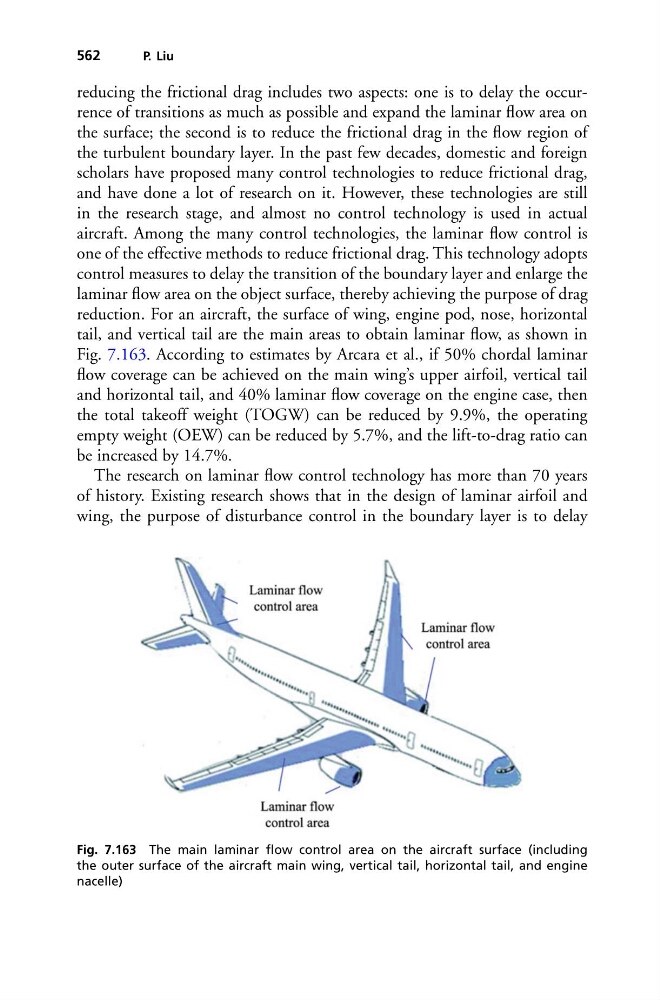
reduction. For an aircraft, the surface of wing, engine pod, nose, horizontal
tail, and vertical tail are the main areas to obtain laminar flow, as shown in
Fig. 7.163. According to estimates by Arcara et al., if 50% chordal laminar
flow coverage can be achieved on the main wing’s upper airfoil, vertical tail
and horizontal tail, and 40% laminar flow coverage on the engine case, then
the total takeoff weight (TOGW) can be reduced by 9.9%, the operating
empty weight (OEW) can be reduced by 5.7%, and the lift-to-drag ratio can
be increased by 14.7%.
The research on laminar flow control technology has more than 70 years
of history. Existing research shows that in the design of laminar airfoil and
wing, the purpose of disturbance control in the boundary layer is to delay
Fig. 7.163 The main laminar flow control area on the aircraft surface (including
the outer surface of the aircraft main wing, vertical tail, horizontal tail, and engine
nacelle)
P. Liu
reducing the frictional drag includes two aspects: one is to delay the occurrence of transitions as much as possible and expand the laminar flow area on
the surface; the second is to reduce the frictional drag in the flow region of
the turbulent boundary layer. In the past few decades, domestic and foreign
scholars have proposed many control technologies to reduce frictional drag,
and have done a lot of research on it. However, these technologies are still
in the research stage, and almost no control technology is used in actual
aircraft. Among the many control technologies, the laminar flow control is
one of the effective methods to reduce frictional drag. This technology adopts
control measures to delay the transition of the boundary layer and enlarge the
laminar flow area on the object surface, thereby achieving the purpose of drag
reduction. For an aircraft, the surface of wing, engine pod, nose, horizontal
tail, and vertical tail are the main areas to obtain laminar flow, as shown in
Fig. 7.163. According to estimates by Arcara et al., if 50% chordal laminar
flow coverage can be achieved on the main wing’s upper airfoil, vertical tail
and horizontal tail, and 40% laminar flow coverage on the engine case, then
the total takeoff weight (TOGW) can be reduced by 9.9%, the operating
empty weight (OEW) can be reduced by 5.7%, and the lift-to-drag ratio can
be increased by 14.7%.
The research on laminar flow control technology has more than 70 years
of history. Existing research shows that in the design of laminar airfoil and
wing, the purpose of disturbance control in the boundary layer is to delay
Fig. 7.163 The main laminar flow control area on the aircraft surface (including
the outer surface of the aircraft main wing, vertical tail, horizontal tail, and engine
nacelle)