

554
P. Liu
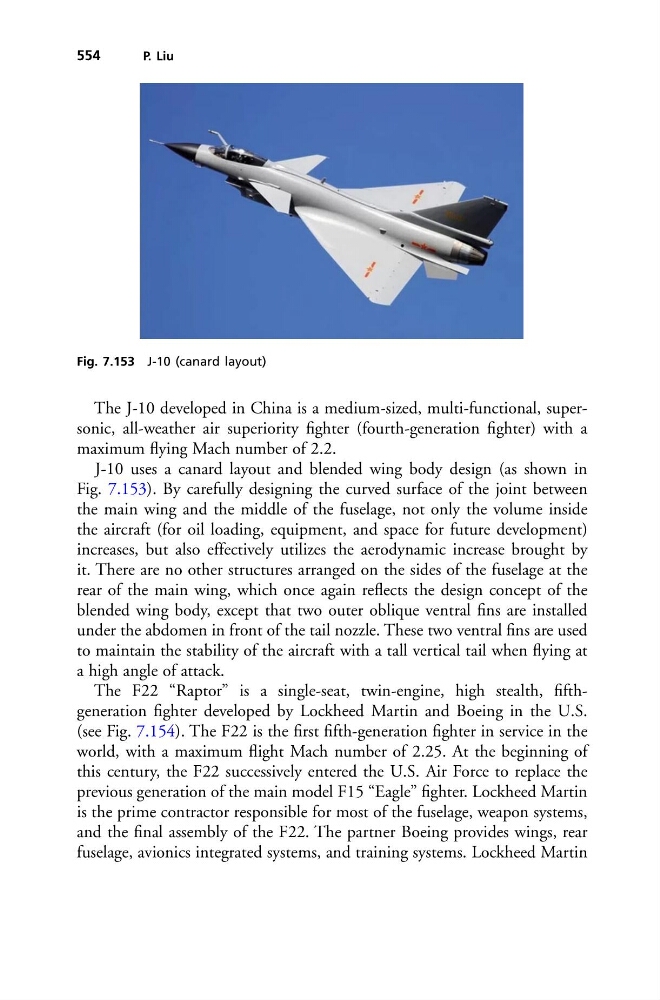
Fig. 7.153 J-10 (canard layout)
The J-10 developed in China is a medium-sized, multi-functional, supersonic, all-weather air superiority fighter (fourth-generation fighter) with a
maximum flying Mach number of 2.2.
J-10 uses a canard layout and blended wing body design (as shown in
Fig. 7.153). By carefully designing the curved surface of the joint between
the main wing and the middle of the fuselage, not only the volume inside
the aircraft (for oil loading, equipment, and space for future development)
increases, but also effectively utilizes the aerodynamic increase brought by
it. There are no other structures arranged on the sides of the fuselage at the
rear of the main wing, which once again reflects the design concept of the
blended wing body, except that two outer oblique ventral fins are installed
under the abdomen in front of the tail nozzle. These two ventral fins are used
to maintain the stability of the aircraft with a tall vertical tail when flying at
a high angle of attack.
The F22 “Raptor” is a single-seat, twin-engine, high stealth, fifthgeneration fighter developed by Lockheed Martin and Boeing in the U.S.
(see Fig. 7.154). The F22 is the first fifth-generation fighter in service in the
world, with a maximum flight Mach number of 2.25. At the beginning of
this century, the F22 successively entered the U.S. Air Force to replace the
previous generation of the main model F15 “Eagle” fighter. Lockheed Martin
is the prime contractor responsible for most of the fuselage, weapon systems,
and the final assembly of the F22. The partner Boeing provides wings, rear
fuselage, avionics integrated systems, and training systems. Lockheed Martin
P. Liu
Fig. 7.153 J-10 (canard layout)
The J-10 developed in China is a medium-sized, multi-functional, supersonic, all-weather air superiority fighter (fourth-generation fighter) with a
maximum flying Mach number of 2.2.
J-10 uses a canard layout and blended wing body design (as shown in
Fig. 7.153). By carefully designing the curved surface of the joint between
the main wing and the middle of the fuselage, not only the volume inside
the aircraft (for oil loading, equipment, and space for future development)
increases, but also effectively utilizes the aerodynamic increase brought by
it. There are no other structures arranged on the sides of the fuselage at the
rear of the main wing, which once again reflects the design concept of the
blended wing body, except that two outer oblique ventral fins are installed
under the abdomen in front of the tail nozzle. These two ventral fins are used
to maintain the stability of the aircraft with a tall vertical tail when flying at
a high angle of attack.
The F22 “Raptor” is a single-seat, twin-engine, high stealth, fifthgeneration fighter developed by Lockheed Martin and Boeing in the U.S.
(see Fig. 7.154). The F22 is the first fifth-generation fighter in service in the
world, with a maximum flight Mach number of 2.25. At the beginning of
this century, the F22 successively entered the U.S. Air Force to replace the
previous generation of the main model F15 “Eagle” fighter. Lockheed Martin
is the prime contractor responsible for most of the fuselage, weapon systems,
and the final assembly of the F22. The partner Boeing provides wings, rear
fuselage, avionics integrated systems, and training systems. Lockheed Martin